

How Molecular Modelling Tools Can Help …
201
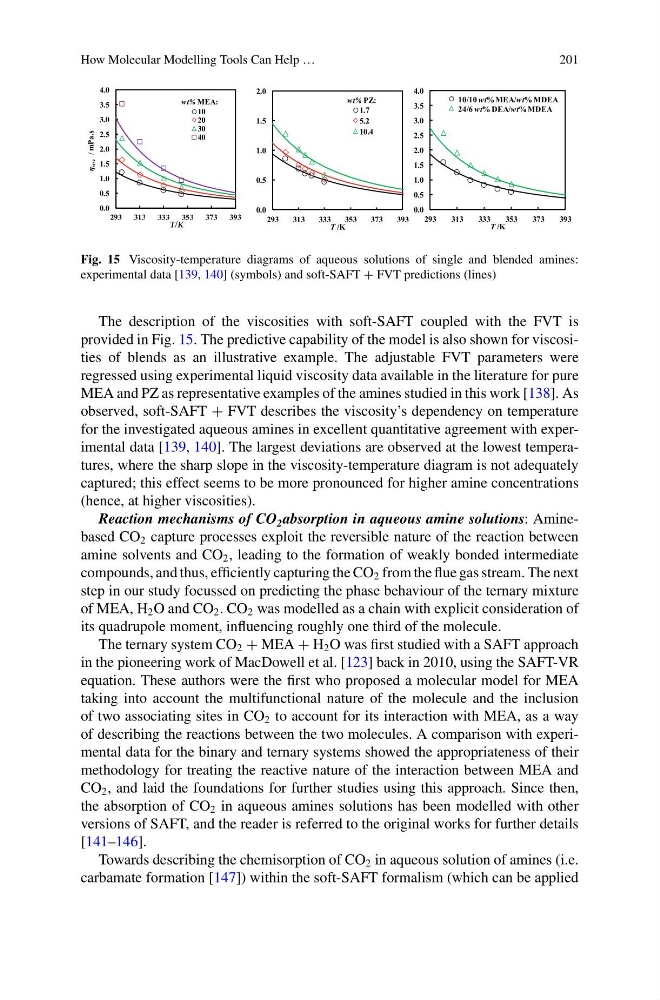
Fig. 15 Viscosity-temperature diagrams of aqueous solutions of single and blended amines:
experimental data [139, 140] (symbols) and soft-SAFT + FVT predictions (lines)
The description of the viscosities with soft-SAFT coupled with the FVT is
provided in Fig. 15. The predictive capability of the model is also shown for viscosities of blends as an illustrative example. The adjustable FVT parameters were
regressed using experimental liquid viscosity data available in the literature for pure
MEA and PZ as representative examples of the amines studied in this work [138]. As
observed, soft-SAFT + FVT describes the viscosity’s dependency on temperature
for the investigated aqueous amines in excellent quantitative agreement with experimental data [139, 140]. The largest deviations are observed at the lowest temperatures, where the sharp slope in the viscosity-temperature diagram is not adequately
captured; this effect seems to be more pronounced for higher amine concentrations
(hence, at higher viscosities).
Reaction mechanisms of CO 2 absorption in aqueous amine solutions: Aminebased CO 2 capture processes exploit the reversible nature of the reaction between
amine solvents and CO 2 , leading to the formation of weakly bonded intermediate
compounds, and thus, efficiently capturing the CO 2 from the flue gas stream. The next
step in our study focussed on predicting the phase behaviour of the ternary mixture
of MEA, H 2 O and CO 2 . CO 2 was modelled as a chain with explicit consideration of
its quadrupole moment, influencing roughly one third of the molecule.
The ternary system CO 2 + MEA + H 2 O was first studied with a SAFT approach
in the pioneering work of MacDowell et al. [123] back in 2010, using the SAFT-VR
equation. These authors were the first who proposed a molecular model for MEA
taking into account the multifunctional nature of the molecule and the inclusion
of two associating sites in CO 2 to account for its interaction with MEA, as a way
of describing the reactions between the two molecules. A comparison with experimental data for the binary and ternary systems showed the appropriateness of their
methodology for treating the reactive nature of the interaction between MEA and
CO 2 , and laid the foundations for further studies using this approach. Since then,
the absorption of CO 2 in aqueous amines solutions has been modelled with other
versions of SAFT, and the reader is referred to the original works for further details
[141–146].
Towards describing the chemisorption of CO 2 in aqueous solution of amines (i.e.
carbamate formation [147]) within the soft-SAFT formalism (which can be applied
201
Fig. 15 Viscosity-temperature diagrams of aqueous solutions of single and blended amines:
experimental data [139, 140] (symbols) and soft-SAFT + FVT predictions (lines)
The description of the viscosities with soft-SAFT coupled with the FVT is
provided in Fig. 15. The predictive capability of the model is also shown for viscosities of blends as an illustrative example. The adjustable FVT parameters were
regressed using experimental liquid viscosity data available in the literature for pure
MEA and PZ as representative examples of the amines studied in this work [138]. As
observed, soft-SAFT + FVT describes the viscosity’s dependency on temperature
for the investigated aqueous amines in excellent quantitative agreement with experimental data [139, 140]. The largest deviations are observed at the lowest temperatures, where the sharp slope in the viscosity-temperature diagram is not adequately
captured; this effect seems to be more pronounced for higher amine concentrations
(hence, at higher viscosities).
Reaction mechanisms of CO 2 absorption in aqueous amine solutions: Aminebased CO 2 capture processes exploit the reversible nature of the reaction between
amine solvents and CO 2 , leading to the formation of weakly bonded intermediate
compounds, and thus, efficiently capturing the CO 2 from the flue gas stream. The next
step in our study focussed on predicting the phase behaviour of the ternary mixture
of MEA, H 2 O and CO 2 . CO 2 was modelled as a chain with explicit consideration of
its quadrupole moment, influencing roughly one third of the molecule.
The ternary system CO 2 + MEA + H 2 O was first studied with a SAFT approach
in the pioneering work of MacDowell et al. [123] back in 2010, using the SAFT-VR
equation. These authors were the first who proposed a molecular model for MEA
taking into account the multifunctional nature of the molecule and the inclusion
of two associating sites in CO 2 to account for its interaction with MEA, as a way
of describing the reactions between the two molecules. A comparison with experimental data for the binary and ternary systems showed the appropriateness of their
methodology for treating the reactive nature of the interaction between MEA and
CO 2 , and laid the foundations for further studies using this approach. Since then,
the absorption of CO 2 in aqueous amines solutions has been modelled with other
versions of SAFT, and the reader is referred to the original works for further details
[141–146].
Towards describing the chemisorption of CO 2 in aqueous solution of amines (i.e.
carbamate formation [147]) within the soft-SAFT formalism (which can be applied