

200
L. F. Vega et al.
The selected amines, MEA, DEA, MDEA, AMP and PZ, were then modelled
within the soft-SAFT approach as LJ chains with association sites accounting for
the multifunctional characteristics of these fluids [123, 124]. The hydroxyl group
(–OH) was modelled in a manner similar to that previously adopted for 1-alkanols
[125], with two associating sites (one for O and the second one for H), while the
primary (–NH 2 ), secondary (–NH) and tertiary (N) amines groups were represented
using either three, two or one association site, respectively, in each of the amine
molecules: one site H for each hydrogen atom, and one site N representing the lone
pair of electrons in the nitrogen atom.
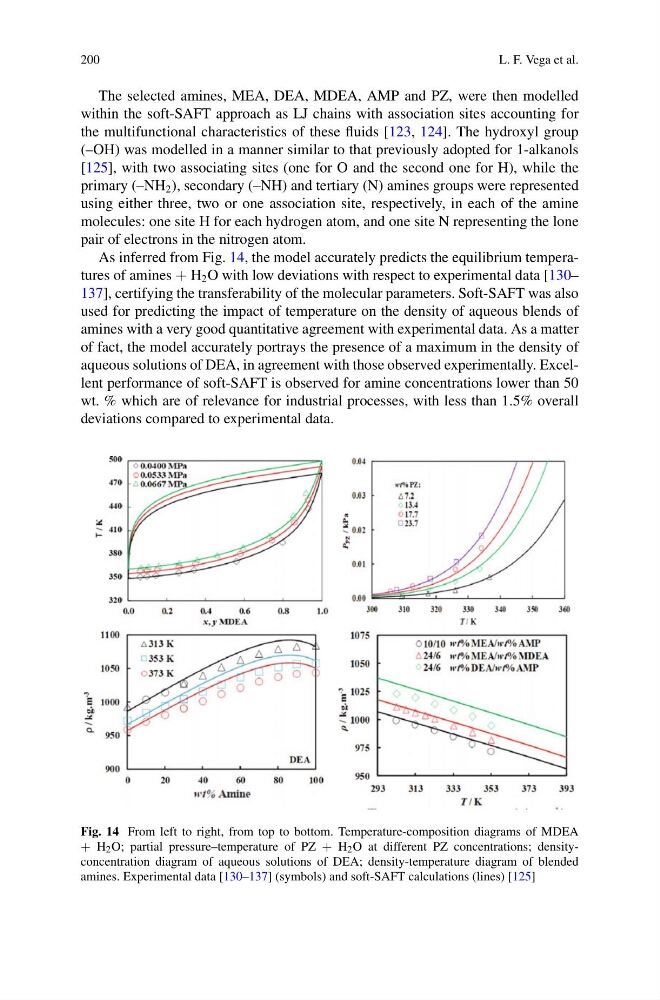
As inferred from Fig. 14, the model accurately predicts the equilibrium temperatures of amines + H 2 O with low deviations with respect to experimental data [130–
137], certifying the transferability of the molecular parameters. Soft-SAFT was also
used for predicting the impact of temperature on the density of aqueous blends of
amines with a very good quantitative agreement with experimental data. As a matter
of fact, the model accurately portrays the presence of a maximum in the density of
aqueous solutions of DEA, in agreement with those observed experimentally. Excellent performance of soft-SAFT is observed for amine concentrations lower than 50
wt. % which are of relevance for industrial processes, with less than 1.5% overall
deviations compared to experimental data.
Fig. 14 From left to right, from top to bottom. Temperature-composition diagrams of MDEA
+ H 2 O; partial pressure–temperature of PZ + H 2 O at different PZ concentrations; densityconcentration diagram of aqueous solutions of DEA; density-temperature diagram of blended
amines. Experimental data [130–137] (symbols) and soft-SAFT calculations (lines) [125]
L. F. Vega et al.
The selected amines, MEA, DEA, MDEA, AMP and PZ, were then modelled
within the soft-SAFT approach as LJ chains with association sites accounting for
the multifunctional characteristics of these fluids [123, 124]. The hydroxyl group
(–OH) was modelled in a manner similar to that previously adopted for 1-alkanols
[125], with two associating sites (one for O and the second one for H), while the
primary (–NH 2 ), secondary (–NH) and tertiary (N) amines groups were represented
using either three, two or one association site, respectively, in each of the amine
molecules: one site H for each hydrogen atom, and one site N representing the lone
pair of electrons in the nitrogen atom.
As inferred from Fig. 14, the model accurately predicts the equilibrium temperatures of amines + H 2 O with low deviations with respect to experimental data [130–
137], certifying the transferability of the molecular parameters. Soft-SAFT was also
used for predicting the impact of temperature on the density of aqueous blends of
amines with a very good quantitative agreement with experimental data. As a matter
of fact, the model accurately portrays the presence of a maximum in the density of
aqueous solutions of DEA, in agreement with those observed experimentally. Excellent performance of soft-SAFT is observed for amine concentrations lower than 50
wt. % which are of relevance for industrial processes, with less than 1.5% overall
deviations compared to experimental data.
Fig. 14 From left to right, from top to bottom. Temperature-composition diagrams of MDEA
+ H 2 O; partial pressure–temperature of PZ + H 2 O at different PZ concentrations; densityconcentration diagram of aqueous solutions of DEA; density-temperature diagram of blended
amines. Experimental data [130–137] (symbols) and soft-SAFT calculations (lines) [125]