

How Molecular Modelling Tools Can Help …
199
Consequently, screening results may be affected by the inaccuracies associated with
such type of experiments as well as by the combination of data from multiple sources.
Based on this screening, and according to the defined KPIs, four amines were
selected in order to be compared to the primary amine MEA as the benchmark:
DEA (secondary amine), MDEA (tertiary alkanolamine), AMP (sterically hindered
amine) and PZ (cyclic amine) [115, 118]. They are marked in Fig. 12 with stars. As
mentioned, the selection was based on their performance with respect to MEA in
terms of CO 2 loading, absorption rate and heat of absorption.
The molecular modelling study for selected aqueous amines presented next
proceeded in a systematic manner, first developing a soft-SAFT model for MEA from
the alkylamines family, from methylamine up to pentylamine, for which abundant
experimental data are available [119–122]. Reliable soft-SAFT molecular models
taking into account the functional groups were developed and validated using phase
equilibrium data for pure fluids and their binary mixtures, with associating parameters transferred from other chemical families. These models were inspired by the
work of MacDowell et al. [123], adapted to soft-SAFT [124]. In specific, a model with
3 association sites was used for the NH 2 group, with two positive association sites
corresponding to the two hydrogen atoms and one negative site corresponding to the
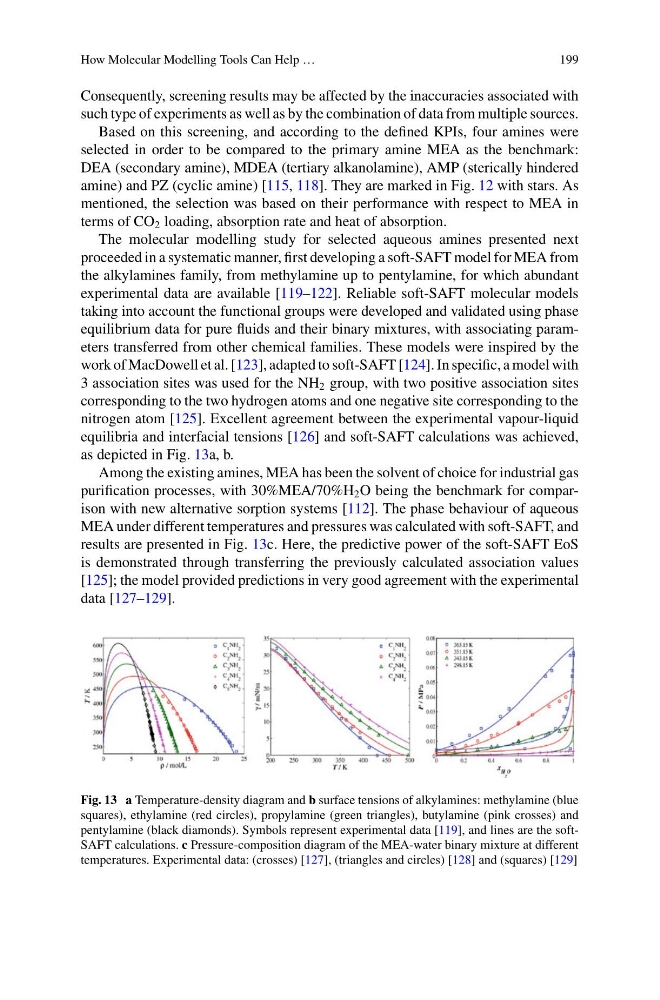
nitrogen atom [125]. Excellent agreement between the experimental vapour-liquid
equilibria and interfacial tensions [126] and soft-SAFT calculations was achieved,
as depicted in Fig. 13a, b.
Among the existing amines, MEA has been the solvent of choice for industrial gas
purification processes, with 30%MEA/70%H 2 O being the benchmark for comparison with new alternative sorption systems [112]. The phase behaviour of aqueous
MEA under different temperatures and pressures was calculated with soft-SAFT, and
results are presented in Fig. 13c. Here, the predictive power of the soft-SAFT EoS
is demonstrated through transferring the previously calculated association values
[125]; the model provided predictions in very good agreement with the experimental
data [127–129].
Fig. 13 a Temperature-density diagram and b surface tensions of alkylamines: methylamine (blue
squares), ethylamine (red circles), propylamine (green triangles), butylamine (pink crosses) and
pentylamine (black diamonds). Symbols represent experimental data [119], and lines are the softSAFT calculations. c Pressure-composition diagram of the MEA-water binary mixture at different
temperatures. Experimental data: (crosses) [127], (triangles and circles) [128] and (squares) [129]
199
Consequently, screening results may be affected by the inaccuracies associated with
such type of experiments as well as by the combination of data from multiple sources.
Based on this screening, and according to the defined KPIs, four amines were
selected in order to be compared to the primary amine MEA as the benchmark:
DEA (secondary amine), MDEA (tertiary alkanolamine), AMP (sterically hindered
amine) and PZ (cyclic amine) [115, 118]. They are marked in Fig. 12 with stars. As
mentioned, the selection was based on their performance with respect to MEA in
terms of CO 2 loading, absorption rate and heat of absorption.
The molecular modelling study for selected aqueous amines presented next
proceeded in a systematic manner, first developing a soft-SAFT model for MEA from
the alkylamines family, from methylamine up to pentylamine, for which abundant
experimental data are available [119–122]. Reliable soft-SAFT molecular models
taking into account the functional groups were developed and validated using phase
equilibrium data for pure fluids and their binary mixtures, with associating parameters transferred from other chemical families. These models were inspired by the
work of MacDowell et al. [123], adapted to soft-SAFT [124]. In specific, a model with
3 association sites was used for the NH 2 group, with two positive association sites
corresponding to the two hydrogen atoms and one negative site corresponding to the
nitrogen atom [125]. Excellent agreement between the experimental vapour-liquid
equilibria and interfacial tensions [126] and soft-SAFT calculations was achieved,
as depicted in Fig. 13a, b.
Among the existing amines, MEA has been the solvent of choice for industrial gas
purification processes, with 30%MEA/70%H 2 O being the benchmark for comparison with new alternative sorption systems [112]. The phase behaviour of aqueous
MEA under different temperatures and pressures was calculated with soft-SAFT, and
results are presented in Fig. 13c. Here, the predictive power of the soft-SAFT EoS
is demonstrated through transferring the previously calculated association values
[125]; the model provided predictions in very good agreement with the experimental
data [127–129].
Fig. 13 a Temperature-density diagram and b surface tensions of alkylamines: methylamine (blue
squares), ethylamine (red circles), propylamine (green triangles), butylamine (pink crosses) and
pentylamine (black diamonds). Symbols represent experimental data [119], and lines are the softSAFT calculations. c Pressure-composition diagram of the MEA-water binary mixture at different
temperatures. Experimental data: (crosses) [127], (triangles and circles) [128] and (squares) [129]