

198
L. F. Vega et al.
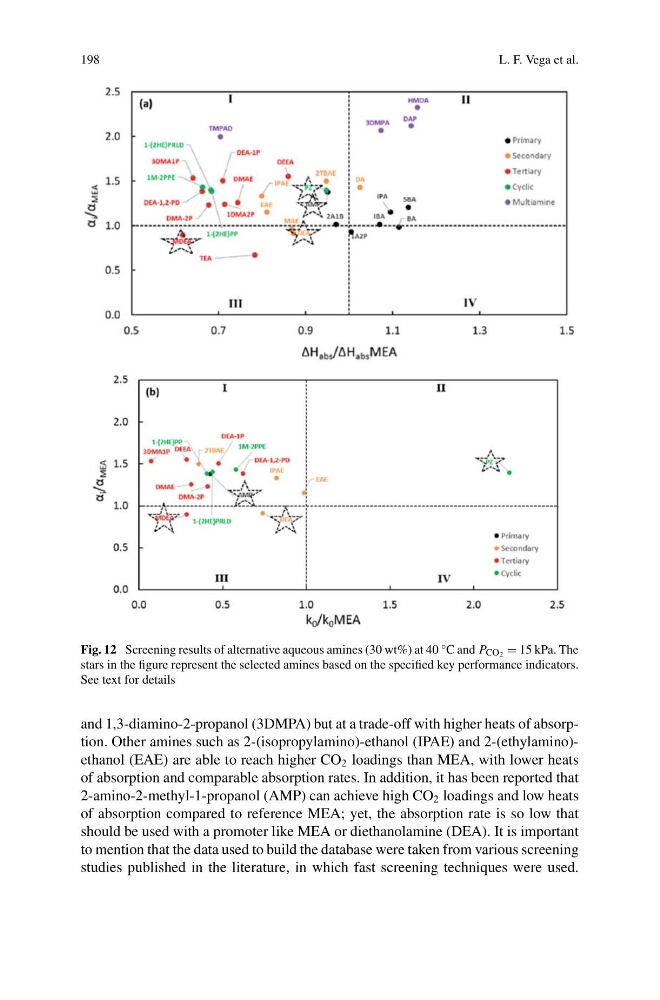
Fig. 12 Screening results of alternative aqueous amines (30 wt%) at 40 °C and P CO2 = 15 kPa. The
stars in the figure represent the selected amines based on the specified key performance indicators.
See text for details
and 1,3-diamino-2-propanol (3DMPA) but at a trade-off with higher heats of absorption. Other amines such as 2-(isopropylamino)-ethanol (IPAE) and 2-(ethylamino)ethanol (EAE) are able to reach higher CO 2 loadings than MEA, with lower heats
of absorption and comparable absorption rates. In addition, it has been reported that
2-amino-2-methyl-1-propanol (AMP) can achieve high CO 2 loadings and low heats
of absorption compared to reference MEA; yet, the absorption rate is so low that
should be used with a promoter like MEA or diethanolamine (DEA). It is important
to mention that the data used to build the database were taken from various screening
studies published in the literature, in which fast screening techniques were used.
L. F. Vega et al.
Fig. 12 Screening results of alternative aqueous amines (30 wt%) at 40 °C and P CO2 = 15 kPa. The
stars in the figure represent the selected amines based on the specified key performance indicators.
See text for details
and 1,3-diamino-2-propanol (3DMPA) but at a trade-off with higher heats of absorption. Other amines such as 2-(isopropylamino)-ethanol (IPAE) and 2-(ethylamino)ethanol (EAE) are able to reach higher CO 2 loadings than MEA, with lower heats
of absorption and comparable absorption rates. In addition, it has been reported that
2-amino-2-methyl-1-propanol (AMP) can achieve high CO 2 loadings and low heats
of absorption compared to reference MEA; yet, the absorption rate is so low that
should be used with a promoter like MEA or diethanolamine (DEA). It is important
to mention that the data used to build the database were taken from various screening
studies published in the literature, in which fast screening techniques were used.