

204
L. F. Vega et al.
Taking into account that no parameters were regressed to experimental solubility
data for the quaternary mixtures, this approach stands as an attractive and useful
method for the rapid screening of blends when experimental data are unavailable.
Furthermore, the potential of this modelling approach for assessing novel solvents
is highlighted by computing the cyclic capacity and the required solvent regeneration energy for both single amine solutions and blends [151]. The solvent cyclic
capacity, that can be determined from VLE data, is connected to the effective CO 2
quantity captured from the feed gas, expressed as the difference between the amount
of CO 2 absorbed at the absorption operating conditions (rich) and the amount of
CO 2 remaining in the solvent at the stripper column operating conditions (lean).
Conversely, the total regeneration energy of the solvent is obtained from the combination of three energy terms [166]: the heat of the solvent (sensible heat), the energy
required for the solvent evaporation (latent heat) and the energy needed to reverse
the absorption between CO 2 and amine (heat of absorption).
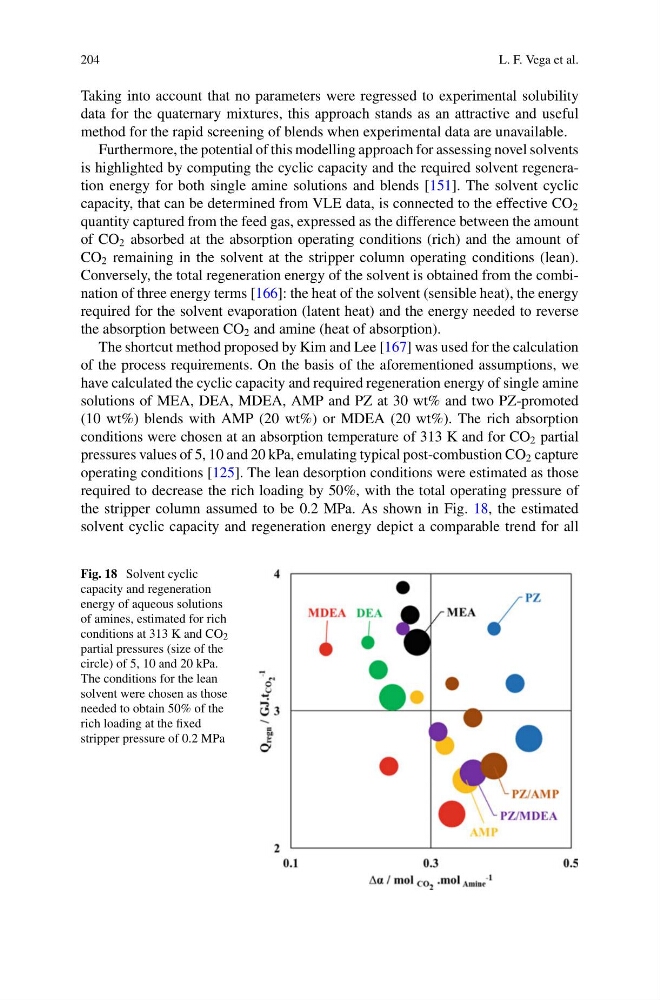
The shortcut method proposed by Kim and Lee [167] was used for the calculation
of the process requirements. On the basis of the aforementioned assumptions, we
have calculated the cyclic capacity and required regeneration energy of single amine
solutions of MEA, DEA, MDEA, AMP and PZ at 30 wt% and two PZ-promoted
(10 wt%) blends with AMP (20 wt%) or MDEA (20 wt%). The rich absorption
conditions were chosen at an absorption temperature of 313 K and for CO 2 partial
pressures values of 5, 10 and 20 kPa, emulating typical post-combustion CO 2 capture
operating conditions [125]. The lean desorption conditions were estimated as those
required to decrease the rich loading by 50%, with the total operating pressure of
the stripper column assumed to be 0.2 MPa. As shown in Fig. 18, the estimated
solvent cyclic capacity and regeneration energy depict a comparable trend for all
Fig. 18 Solvent cyclic
capacity and regeneration
energy of aqueous solutions
of amines, estimated for rich
conditions at 313 K and CO 2
partial pressures (size of the
circle) of 5, 10 and 20 kPa.
The conditions for the lean
solvent were chosen as those
needed to obtain 50% of the
rich loading at the fixed
stripper pressure of 0.2 MPa
L. F. Vega et al.
Taking into account that no parameters were regressed to experimental solubility
data for the quaternary mixtures, this approach stands as an attractive and useful
method for the rapid screening of blends when experimental data are unavailable.
Furthermore, the potential of this modelling approach for assessing novel solvents
is highlighted by computing the cyclic capacity and the required solvent regeneration energy for both single amine solutions and blends [151]. The solvent cyclic
capacity, that can be determined from VLE data, is connected to the effective CO 2
quantity captured from the feed gas, expressed as the difference between the amount
of CO 2 absorbed at the absorption operating conditions (rich) and the amount of
CO 2 remaining in the solvent at the stripper column operating conditions (lean).
Conversely, the total regeneration energy of the solvent is obtained from the combination of three energy terms [166]: the heat of the solvent (sensible heat), the energy
required for the solvent evaporation (latent heat) and the energy needed to reverse
the absorption between CO 2 and amine (heat of absorption).
The shortcut method proposed by Kim and Lee [167] was used for the calculation
of the process requirements. On the basis of the aforementioned assumptions, we
have calculated the cyclic capacity and required regeneration energy of single amine
solutions of MEA, DEA, MDEA, AMP and PZ at 30 wt% and two PZ-promoted
(10 wt%) blends with AMP (20 wt%) or MDEA (20 wt%). The rich absorption
conditions were chosen at an absorption temperature of 313 K and for CO 2 partial
pressures values of 5, 10 and 20 kPa, emulating typical post-combustion CO 2 capture
operating conditions [125]. The lean desorption conditions were estimated as those
required to decrease the rich loading by 50%, with the total operating pressure of
the stripper column assumed to be 0.2 MPa. As shown in Fig. 18, the estimated
solvent cyclic capacity and regeneration energy depict a comparable trend for all
Fig. 18 Solvent cyclic
capacity and regeneration
energy of aqueous solutions
of amines, estimated for rich
conditions at 313 K and CO 2
partial pressures (size of the
circle) of 5, 10 and 20 kPa.
The conditions for the lean
solvent were chosen as those
needed to obtain 50% of the
rich loading at the fixed
stripper pressure of 0.2 MPa