

194
L. F. Vega et al.
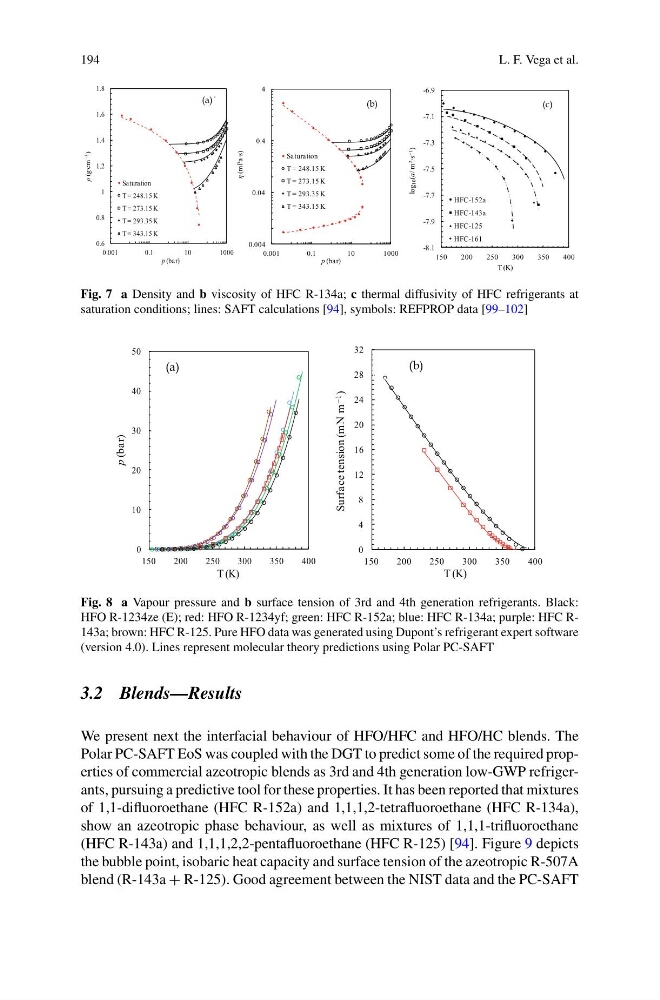
Fig. 7 a Density and b viscosity of HFC R-134a; c thermal diffusivity of HFC refrigerants at
saturation conditions; lines: SAFT calculations [94], symbols: REFPROP data [99–102]
Fig. 8 a Vapour pressure and b surface tension of 3rd and 4th generation refrigerants. Black:
HFO R-1234ze (E); red: HFO R-1234yf; green: HFC R-152a; blue: HFC R-134a; purple: HFC R143a; brown: HFC R-125. Pure HFO data was generated using Dupont’s refrigerant expert software
(version 4.0). Lines represent molecular theory predictions using Polar PC-SAFT
3.2 Blends—Results
We present next the interfacial behaviour of HFO/HFC and HFO/HC blends. The
Polar PC-SAFT EoS was coupled with the DGT to predict some of the required properties of commercial azeotropic blends as 3rd and 4th generation low-GWP refrigerants, pursuing a predictive tool for these properties. It has been reported that mixtures
of 1,1-difluoroethane (HFC R-152a) and 1,1,1,2-tetrafluoroethane (HFC R-134a),
show an azeotropic phase behaviour, as well as mixtures of 1,1,1-trifluoroethane
(HFC R-143a) and 1,1,1,2,2-pentafluoroethane (HFC R-125) [94]. Figure 9 depicts
the bubble point, isobaric heat capacity and surface tension of the azeotropic R-507A
blend (R-143a + R-125). Good agreement between the NIST data and the PC-SAFT
L. F. Vega et al.
Fig. 7 a Density and b viscosity of HFC R-134a; c thermal diffusivity of HFC refrigerants at
saturation conditions; lines: SAFT calculations [94], symbols: REFPROP data [99–102]
Fig. 8 a Vapour pressure and b surface tension of 3rd and 4th generation refrigerants. Black:
HFO R-1234ze (E); red: HFO R-1234yf; green: HFC R-152a; blue: HFC R-134a; purple: HFC R143a; brown: HFC R-125. Pure HFO data was generated using Dupont’s refrigerant expert software
(version 4.0). Lines represent molecular theory predictions using Polar PC-SAFT
3.2 Blends—Results
We present next the interfacial behaviour of HFO/HFC and HFO/HC blends. The
Polar PC-SAFT EoS was coupled with the DGT to predict some of the required properties of commercial azeotropic blends as 3rd and 4th generation low-GWP refrigerants, pursuing a predictive tool for these properties. It has been reported that mixtures
of 1,1-difluoroethane (HFC R-152a) and 1,1,1,2-tetrafluoroethane (HFC R-134a),
show an azeotropic phase behaviour, as well as mixtures of 1,1,1-trifluoroethane
(HFC R-143a) and 1,1,1,2,2-pentafluoroethane (HFC R-125) [94]. Figure 9 depicts
the bubble point, isobaric heat capacity and surface tension of the azeotropic R-507A
blend (R-143a + R-125). Good agreement between the NIST data and the PC-SAFT