

186
L. F. Vega et al.
Various types of SAFT equations have been proposed over the decades, with their
primary difference being in the reference term. The most widely used include the
original SAFT and simplified SAFT [29, 30, 37], with a hard-sphere fluid reference
term, the soft-SAFT equation [38, 39], using a Lennard–Jones fluid for the reference
term, the SAFT-VR equation [40], which considers a variable range square-well fluid
for its reference fluid, PC-SAFT [41], in which the reference fluid is a hard-chain
and, more recently, SAFT-γ-Mie, using a Mie potential as the reference fluid [42].
As mentioned, excellent reviews on the subject have been published and the reader
is referred to those works for additional details [31, 32].
Results obtained from two of the most popular SAFT variants, soft-SAFT and
PC-SAFT, will be presented and discussed in the next section. We briefly outline
here the main differences between them. In the soft-SAFT equation developed by
Blas and Vega [38, 43] fluids are represented as spherical Lennard–Jones (LJ) (12–6)
segments (monomers) connected to form a chain, characterised by a specific set of
molecular parameters, which account for the repulsive and attractive interactions of
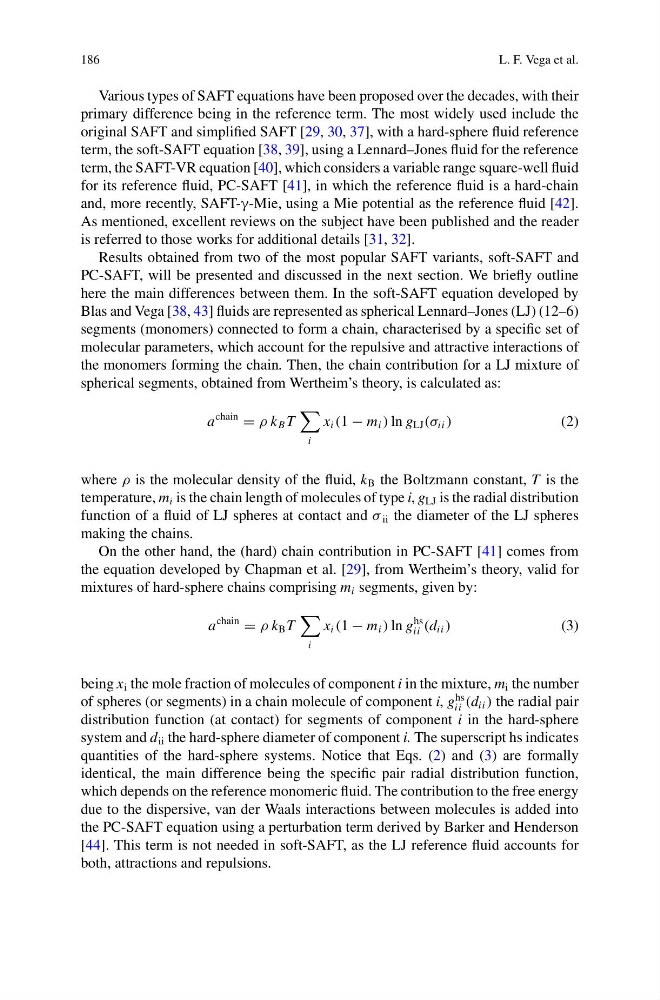
the monomers forming the chain. Then, the chain contribution for a LJ mixture of
spherical segments, obtained from Wertheim’s theory, is calculated as:
a
chain
= ρ k B T
i
x i (1 − m i ) ln g LJ (σ ii )
(2)
where ρ is the molecular density of the fluid, k B the Boltzmann constant, T is the
temperature, m i is the chain length of molecules of type i, g LJ is the radial distribution
function of a fluid of LJ spheres at contact and σ ii the diameter of the LJ spheres
making the chains.
On the other hand, the (hard) chain contribution in PC-SAFT [41] comes from
the equation developed by Chapman et al. [29], from Wertheim’s theory, valid for
mixtures of hard-sphere chains comprising m i segments, given by:
a
chain
= ρ k B T
i
x i (1 − m i ) ln g
hs
ii (d ii )
(3)
being x i the mole fraction of molecules of component i in the mixture, m i the number
of spheres (or segments) in a chain molecule of component i, g
hs
ii (d ii ) the radial pair
distribution function (at contact) for segments of component i in the hard-sphere
system and d ii the hard-sphere diameter of component i. The superscript hs indicates
quantities of the hard-sphere systems. Notice that Eqs. (2) and (3) are formally
identical, the main difference being the specific pair radial distribution function,
which depends on the reference monomeric fluid. The contribution to the free energy
due to the dispersive, van der Waals interactions between molecules is added into
the PC-SAFT equation using a perturbation term derived by Barker and Henderson
[44]. This term is not needed in soft-SAFT, as the LJ reference fluid accounts for
both, attractions and repulsions.
L. F. Vega et al.
Various types of SAFT equations have been proposed over the decades, with their
primary difference being in the reference term. The most widely used include the
original SAFT and simplified SAFT [29, 30, 37], with a hard-sphere fluid reference
term, the soft-SAFT equation [38, 39], using a Lennard–Jones fluid for the reference
term, the SAFT-VR equation [40], which considers a variable range square-well fluid
for its reference fluid, PC-SAFT [41], in which the reference fluid is a hard-chain
and, more recently, SAFT-γ-Mie, using a Mie potential as the reference fluid [42].
As mentioned, excellent reviews on the subject have been published and the reader
is referred to those works for additional details [31, 32].
Results obtained from two of the most popular SAFT variants, soft-SAFT and
PC-SAFT, will be presented and discussed in the next section. We briefly outline
here the main differences between them. In the soft-SAFT equation developed by
Blas and Vega [38, 43] fluids are represented as spherical Lennard–Jones (LJ) (12–6)
segments (monomers) connected to form a chain, characterised by a specific set of
molecular parameters, which account for the repulsive and attractive interactions of
the monomers forming the chain. Then, the chain contribution for a LJ mixture of
spherical segments, obtained from Wertheim’s theory, is calculated as:
a
chain
= ρ k B T
i
x i (1 − m i ) ln g LJ (σ ii )
(2)
where ρ is the molecular density of the fluid, k B the Boltzmann constant, T is the
temperature, m i is the chain length of molecules of type i, g LJ is the radial distribution
function of a fluid of LJ spheres at contact and σ ii the diameter of the LJ spheres
making the chains.
On the other hand, the (hard) chain contribution in PC-SAFT [41] comes from
the equation developed by Chapman et al. [29], from Wertheim’s theory, valid for
mixtures of hard-sphere chains comprising m i segments, given by:
a
chain
= ρ k B T
i
x i (1 − m i ) ln g
hs
ii (d ii )
(3)
being x i the mole fraction of molecules of component i in the mixture, m i the number
of spheres (or segments) in a chain molecule of component i, g
hs
ii (d ii ) the radial pair
distribution function (at contact) for segments of component i in the hard-sphere
system and d ii the hard-sphere diameter of component i. The superscript hs indicates
quantities of the hard-sphere systems. Notice that Eqs. (2) and (3) are formally
identical, the main difference being the specific pair radial distribution function,
which depends on the reference monomeric fluid. The contribution to the free energy
due to the dispersive, van der Waals interactions between molecules is added into
the PC-SAFT equation using a perturbation term derived by Barker and Henderson
[44]. This term is not needed in soft-SAFT, as the LJ reference fluid accounts for
both, attractions and repulsions.