

How Molecular Modelling Tools Can Help …
187
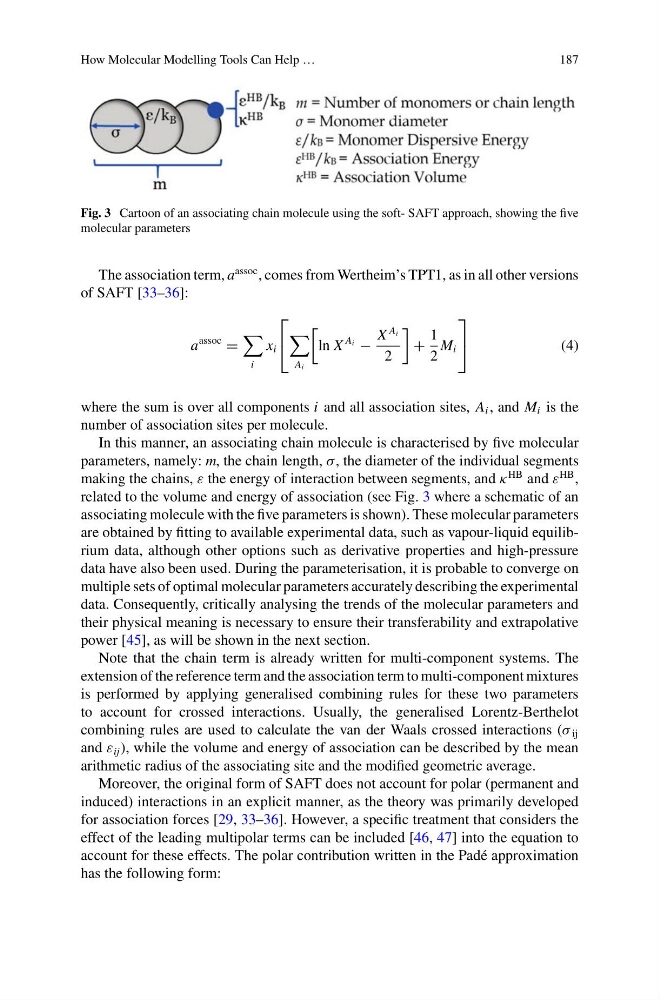
Fig. 3 Cartoon of an associating chain molecule using the soft- SAFT approach, showing the five
molecular parameters
The association term, a
assoc , comes from Wertheim’s TPT1, as in all other versions
of SAFT [33–36]:
a
assoc
=
i
x i
⎡
⎣
A i
ln X
A i −
X
A i
2
+
1
2
M i
⎤
⎦
(4)
where the sum is over all components i and all association sites, A i , and M i is the
number of association sites per molecule.
In this manner, an associating chain molecule is characterised by five molecular
parameters, namely: m, the chain length, σ, the diameter of the individual segments
making the chains, ε the energy of interaction between segments, and κ
HB and ε
HB ,
related to the volume and energy of association (see Fig. 3 where a schematic of an
associating molecule with the five parameters is shown). These molecular parameters
are obtained by fitting to available experimental data, such as vapour-liquid equilibrium data, although other options such as derivative properties and high-pressure
data have also been used. During the parameterisation, it is probable to converge on
multiple sets of optimal molecular parameters accurately describing the experimental
data. Consequently, critically analysing the trends of the molecular parameters and
their physical meaning is necessary to ensure their transferability and extrapolative
power [45], as will be shown in the next section.
Note that the chain term is already written for multi-component systems. The
extension of the reference term and the association term to multi-component mixtures
is performed by applying generalised combining rules for these two parameters
to account for crossed interactions. Usually, the generalised Lorentz-Berthelot
combining rules are used to calculate the van der Waals crossed interactions (σ ij
and ε ij ), while the volume and energy of association can be described by the mean
arithmetic radius of the associating site and the modified geometric average.
Moreover, the original form of SAFT does not account for polar (permanent and
induced) interactions in an explicit manner, as the theory was primarily developed
for association forces [29, 33–36]. However, a specific treatment that considers the
effect of the leading multipolar terms can be included [46, 47] into the equation to
account for these effects. The polar contribution written in the Padé approximation
has the following form:
187
Fig. 3 Cartoon of an associating chain molecule using the soft- SAFT approach, showing the five
molecular parameters
The association term, a
assoc , comes from Wertheim’s TPT1, as in all other versions
of SAFT [33–36]:
a
assoc
=
i
x i
⎡
⎣
A i
ln X
A i −
X
A i
2
+
1
2
M i
⎤
⎦
(4)
where the sum is over all components i and all association sites, A i , and M i is the
number of association sites per molecule.
In this manner, an associating chain molecule is characterised by five molecular
parameters, namely: m, the chain length, σ, the diameter of the individual segments
making the chains, ε the energy of interaction between segments, and κ
HB and ε
HB ,
related to the volume and energy of association (see Fig. 3 where a schematic of an
associating molecule with the five parameters is shown). These molecular parameters
are obtained by fitting to available experimental data, such as vapour-liquid equilibrium data, although other options such as derivative properties and high-pressure
data have also been used. During the parameterisation, it is probable to converge on
multiple sets of optimal molecular parameters accurately describing the experimental
data. Consequently, critically analysing the trends of the molecular parameters and
their physical meaning is necessary to ensure their transferability and extrapolative
power [45], as will be shown in the next section.
Note that the chain term is already written for multi-component systems. The
extension of the reference term and the association term to multi-component mixtures
is performed by applying generalised combining rules for these two parameters
to account for crossed interactions. Usually, the generalised Lorentz-Berthelot
combining rules are used to calculate the van der Waals crossed interactions (σ ij
and ε ij ), while the volume and energy of association can be described by the mean
arithmetic radius of the associating site and the modified geometric average.
Moreover, the original form of SAFT does not account for polar (permanent and
induced) interactions in an explicit manner, as the theory was primarily developed
for association forces [29, 33–36]. However, a specific treatment that considers the
effect of the leading multipolar terms can be included [46, 47] into the equation to
account for these effects. The polar contribution written in the Padé approximation
has the following form: