

How Molecular Modelling Tools Can Help …
185
solutions and solid adsorbents for CO 2 capture and separation. This work is part of a
long-term project focussed on developing general and reliable molecular models for
the thermodynamic characterisation of environmentally friendly systems, from their
fundamental understanding to the design and optimization of the processes in which
they will be applied, bridging the fundamental knowledge of the substances/materials
performance to their industrial applications.
2 Physicochemical Properties Calculations
from Molecular-Based Theories and Molecular
Simulations
2.1 The Statistical Associating Fluid Theory (SAFT)
Equation of State
The statistical associating fluid theory (SAFT) developed by Chapman et al. [29, 30] is
perchance the most recognized equation of state (EoS) routed on statistical mechanics
used for chain and associating fluids. The equation encompasses essential physical
features of the molecules integrating the fluid. Additionally, SAFT molecular parameters are limited in number, with inherent physical meaning and ability to transfer
to other systems and conditions, effectively positioning SAFT as a powerful tool for
engineering applications, particularly those for which other classical EoSs fail. The
successful adoption and application of the equation (with its different versions) are
well established by the large amount of published works since its development [31,
32]. SAFT models are expressed based on the residual Helmholtz energy, wherein
each term in the equation corresponds to distinct microscopic contributions to the
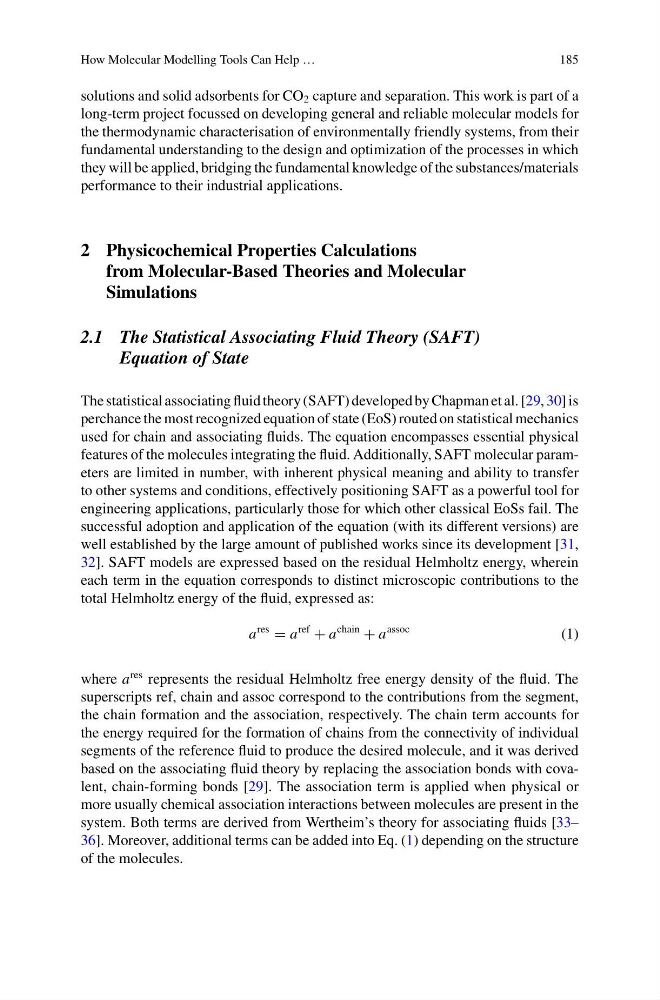
total Helmholtz energy of the fluid, expressed as:
a
res
= a
ref
+ a
chain
+ a
assoc
(1)
where a
res represents the residual Helmholtz free energy density of the fluid. The
superscripts ref, chain and assoc correspond to the contributions from the segment,
the chain formation and the association, respectively. The chain term accounts for
the energy required for the formation of chains from the connectivity of individual
segments of the reference fluid to produce the desired molecule, and it was derived
based on the associating fluid theory by replacing the association bonds with covalent, chain-forming bonds [29]. The association term is applied when physical or
more usually chemical association interactions between molecules are present in the
system. Both terms are derived from Wertheim’s theory for associating fluids [33–
36]. Moreover, additional terms can be added into Eq. (1) depending on the structure
of the molecules.
185
solutions and solid adsorbents for CO 2 capture and separation. This work is part of a
long-term project focussed on developing general and reliable molecular models for
the thermodynamic characterisation of environmentally friendly systems, from their
fundamental understanding to the design and optimization of the processes in which
they will be applied, bridging the fundamental knowledge of the substances/materials
performance to their industrial applications.
2 Physicochemical Properties Calculations
from Molecular-Based Theories and Molecular
Simulations
2.1 The Statistical Associating Fluid Theory (SAFT)
Equation of State
The statistical associating fluid theory (SAFT) developed by Chapman et al. [29, 30] is
perchance the most recognized equation of state (EoS) routed on statistical mechanics
used for chain and associating fluids. The equation encompasses essential physical
features of the molecules integrating the fluid. Additionally, SAFT molecular parameters are limited in number, with inherent physical meaning and ability to transfer
to other systems and conditions, effectively positioning SAFT as a powerful tool for
engineering applications, particularly those for which other classical EoSs fail. The
successful adoption and application of the equation (with its different versions) are
well established by the large amount of published works since its development [31,
32]. SAFT models are expressed based on the residual Helmholtz energy, wherein
each term in the equation corresponds to distinct microscopic contributions to the
total Helmholtz energy of the fluid, expressed as:
a
res
= a
ref
+ a
chain
+ a
assoc
(1)
where a
res represents the residual Helmholtz free energy density of the fluid. The
superscripts ref, chain and assoc correspond to the contributions from the segment,
the chain formation and the association, respectively. The chain term accounts for
the energy required for the formation of chains from the connectivity of individual
segments of the reference fluid to produce the desired molecule, and it was derived
based on the associating fluid theory by replacing the association bonds with covalent, chain-forming bonds [29]. The association term is applied when physical or
more usually chemical association interactions between molecules are present in the
system. Both terms are derived from Wertheim’s theory for associating fluids [33–
36]. Moreover, additional terms can be added into Eq. (1) depending on the structure
of the molecules.