

184
L. F. Vega et al.
nations to gradually phase out the consumption and production of HFCs by the late
2040s. This Amendment has promoted an active area of research towards the development of low-GWP refrigerants and considerably supports the Paris Agreement to
avert an approximate increase in temperature of half a degree Celsius by the end of
this century [20].
Most of the currently in place and proposed regulations (for instance the F-Gas
in the European Union and the CARB and EC regulations in North America) [21],
target refrigerants to be used that do not exceed 750 GWP for air conditioning and
150 GWP for refrigeration applications, thus immediately producing a mandate for
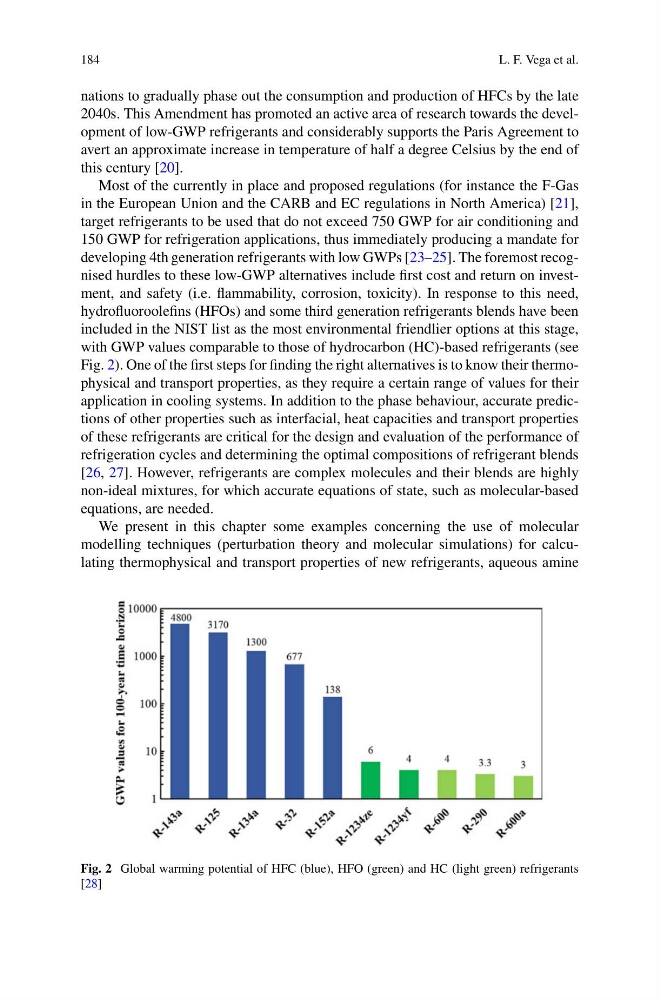
developing 4th generation refrigerants with low GWPs [23–25]. The foremost recognised hurdles to these low-GWP alternatives include first cost and return on investment, and safety (i.e. flammability, corrosion, toxicity). In response to this need,
hydrofluoroolefins (HFOs) and some third generation refrigerants blends have been
included in the NIST list as the most environmental friendlier options at this stage,
with GWP values comparable to those of hydrocarbon (HC)-based refrigerants (see
Fig. 2). One of the first steps for finding the right alternatives is to know their thermophysical and transport properties, as they require a certain range of values for their
application in cooling systems. In addition to the phase behaviour, accurate predictions of other properties such as interfacial, heat capacities and transport properties
of these refrigerants are critical for the design and evaluation of the performance of
refrigeration cycles and determining the optimal compositions of refrigerant blends
[26, 27]. However, refrigerants are complex molecules and their blends are highly
non-ideal mixtures, for which accurate equations of state, such as molecular-based
equations, are needed.
We present in this chapter some examples concerning the use of molecular
modelling techniques (perturbation theory and molecular simulations) for calculating thermophysical and transport properties of new refrigerants, aqueous amine
Fig. 2 Global warming potential of HFC (blue), HFO (green) and HC (light green) refrigerants
[28]
L. F. Vega et al.
nations to gradually phase out the consumption and production of HFCs by the late
2040s. This Amendment has promoted an active area of research towards the development of low-GWP refrigerants and considerably supports the Paris Agreement to
avert an approximate increase in temperature of half a degree Celsius by the end of
this century [20].
Most of the currently in place and proposed regulations (for instance the F-Gas
in the European Union and the CARB and EC regulations in North America) [21],
target refrigerants to be used that do not exceed 750 GWP for air conditioning and
150 GWP for refrigeration applications, thus immediately producing a mandate for
developing 4th generation refrigerants with low GWPs [23–25]. The foremost recognised hurdles to these low-GWP alternatives include first cost and return on investment, and safety (i.e. flammability, corrosion, toxicity). In response to this need,
hydrofluoroolefins (HFOs) and some third generation refrigerants blends have been
included in the NIST list as the most environmental friendlier options at this stage,
with GWP values comparable to those of hydrocarbon (HC)-based refrigerants (see
Fig. 2). One of the first steps for finding the right alternatives is to know their thermophysical and transport properties, as they require a certain range of values for their
application in cooling systems. In addition to the phase behaviour, accurate predictions of other properties such as interfacial, heat capacities and transport properties
of these refrigerants are critical for the design and evaluation of the performance of
refrigeration cycles and determining the optimal compositions of refrigerant blends
[26, 27]. However, refrigerants are complex molecules and their blends are highly
non-ideal mixtures, for which accurate equations of state, such as molecular-based
equations, are needed.
We present in this chapter some examples concerning the use of molecular
modelling techniques (perturbation theory and molecular simulations) for calculating thermophysical and transport properties of new refrigerants, aqueous amine
Fig. 2 Global warming potential of HFC (blue), HFO (green) and HC (light green) refrigerants
[28]