

170
H. Sun et al.
U
R
N
= U b
R
N
+ U nb
R
N
(20)
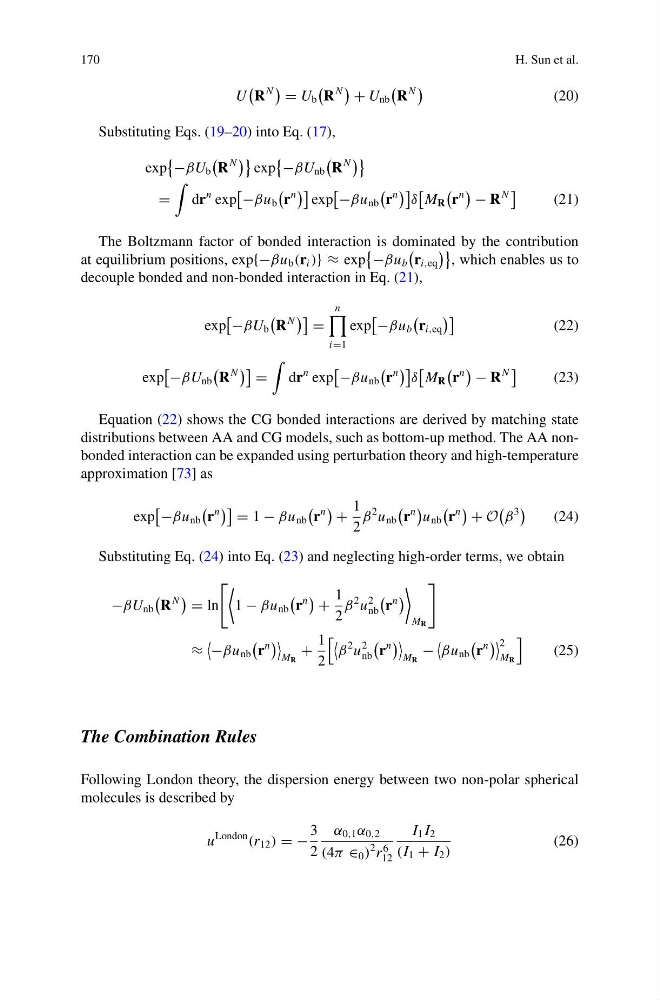
Substituting Eqs. (19–20) into Eq. (17),
exp
−βU b
R
N
exp
−βU nb
R
N
=
dr
n exp
−βu b
r
n
exp
−βu nb
r
n
δ
M R
r
n
− R
N
(21)
The Boltzmann factor of bonded interaction is dominated by the contribution
at equilibrium positions, exp{−βu b (r i )} ≈ exp
−βu b
r i,eq
, which enables us to
decouple bonded and non-bonded interaction in Eq. (21),
exp
−βU b
R
N
=
n
i=1
exp
−βu b
r i,eq
(22)
exp
−βU nb
R
N
=
dr
n exp
−βu nb
r
n
δ
M R
r
n
− R
N
(23)
Equation (22) shows the CG bonded interactions are derived by matching state
distributions between AA and CG models, such as bottom-up method. The AA nonbonded interaction can be expanded using perturbation theory and high-temperature
approximation [73] as
exp
−βu nb
r
n
= 1 − βu nb
r
n
+
1
2
β
2 u nb
r
n
u nb
r
n
+ O
β
3
(24)
Substituting Eq. (24) into Eq. (23) and neglecting high-order terms, we obtain
−βU nb
R
N
= ln
1 − βu nb
r
n
+
1
2
β
2 u
2
nb
r
n
M R
≈
−βu nb
r
n
M R
+
1
2
β
2 u
2
nb
r
n
M R
−
βu nb
r
n
2
M R
(25)
The Combination Rules
Following London theory, the dispersion energy between two non-polar spherical
molecules is described by
u
London
(r 12 ) = −
3
2
α 0,1 α 0,2
(4π ∈ 0 )
2 r
6
12
I 1 I 2
(I 1 + I 2 )
(26)
H. Sun et al.
U
R
N
= U b
R
N
+ U nb
R
N
(20)
Substituting Eqs. (19–20) into Eq. (17),
exp
−βU b
R
N
exp
−βU nb
R
N
=
dr
n exp
−βu b
r
n
exp
−βu nb
r
n
δ
M R
r
n
− R
N
(21)
The Boltzmann factor of bonded interaction is dominated by the contribution
at equilibrium positions, exp{−βu b (r i )} ≈ exp
−βu b
r i,eq
, which enables us to
decouple bonded and non-bonded interaction in Eq. (21),
exp
−βU b
R
N
=
n
i=1
exp
−βu b
r i,eq
(22)
exp
−βU nb
R
N
=
dr
n exp
−βu nb
r
n
δ
M R
r
n
− R
N
(23)
Equation (22) shows the CG bonded interactions are derived by matching state
distributions between AA and CG models, such as bottom-up method. The AA nonbonded interaction can be expanded using perturbation theory and high-temperature
approximation [73] as
exp
−βu nb
r
n
= 1 − βu nb
r
n
+
1
2
β
2 u nb
r
n
u nb
r
n
+ O
β
3
(24)
Substituting Eq. (24) into Eq. (23) and neglecting high-order terms, we obtain
−βU nb
R
N
= ln
1 − βu nb
r
n
+
1
2
β
2 u
2
nb
r
n
M R
≈
−βu nb
r
n
M R
+
1
2
β
2 u
2
nb
r
n
M R
−
βu nb
r
n
2
M R
(25)
The Combination Rules
Following London theory, the dispersion energy between two non-polar spherical
molecules is described by
u
London
(r 12 ) = −
3
2
α 0,1 α 0,2
(4π ∈ 0 )
2 r
6
12
I 1 I 2
(I 1 + I 2 )
(26)