

Coarse-Grained Force Fields Built on Atomistic …
171
where α 0,i is electronic polarizability, I i is ionization energy and ∈ 0 is vacuum
permittivity, i = 1, 2. The intermolecular attraction between two particles of an
identical type can be described by r
−6 term in LJ potential,
u(r ii ) = −4ε
LJ
ii
σ ii
r ii
6
(27)
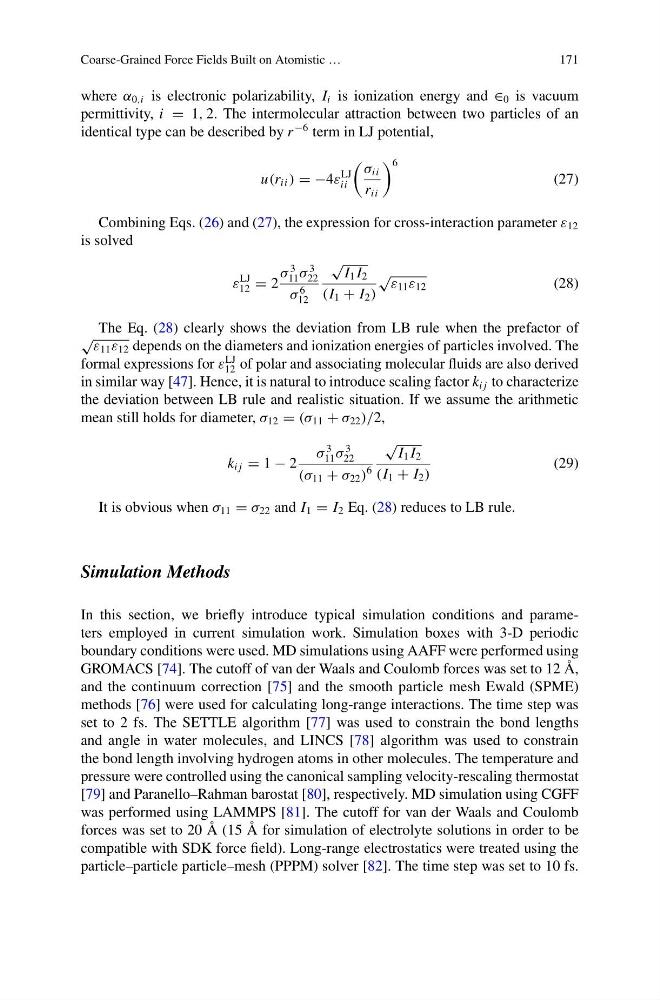
Combining Eqs. (26) and (27), the expression for cross-interaction parameter ε 12
is solved
ε
LJ
12 = 2
σ
3
11 σ
3
22
σ
6
12
√
I 1 I 2
(I 1 + I 2 )
√ ε 11 ε 12
(28)
The Eq. (28) clearly shows the deviation from LB rule when the prefactor of
√
ε 11 ε 12 depends on the diameters and ionization energies of particles involved. The
formal expressions for ε
LJ
12 of polar and associating molecular fluids are also derived
in similar way [47]. Hence, it is natural to introduce scaling factor k i j to characterize
the deviation between LB rule and realistic situation. If we assume the arithmetic
mean still holds for diameter, σ 12 = (σ 11 + σ 22 )/2,
k i j = 1 − 2
σ
3
11 σ
3
22
(σ 11 + σ 22 )
6
√
I 1 I 2
(I 1 + I 2 )
(29)
It is obvious when σ 11 = σ 22 and I 1 = I 2 Eq. (28) reduces to LB rule.
Simulation Methods
In this section, we briefly introduce typical simulation conditions and parameters employed in current simulation work. Simulation boxes with 3-D periodic
boundary conditions were used. MD simulations using AAFF were performed using
GROMACS [74]. The cutoff of van der Waals and Coulomb forces was set to 12 Å,
and the continuum correction [75] and the smooth particle mesh Ewald (SPME)
methods [76] were used for calculating long-range interactions. The time step was
set to 2 fs. The SETTLE algorithm [77] was used to constrain the bond lengths
and angle in water molecules, and LINCS [78] algorithm was used to constrain
the bond length involving hydrogen atoms in other molecules. The temperature and
pressure were controlled using the canonical sampling velocity-rescaling thermostat
[79] and Paranello–Rahman barostat [80], respectively. MD simulation using CGFF
was performed using LAMMPS [81]. The cutoff for van der Waals and Coulomb
forces was set to 20 Å (15 Å for simulation of electrolyte solutions in order to be
compatible with SDK force field). Long-range electrostatics were treated using the
particle–particle particle–mesh (PPPM) solver [82]. The time step was set to 10 fs.
171
where α 0,i is electronic polarizability, I i is ionization energy and ∈ 0 is vacuum
permittivity, i = 1, 2. The intermolecular attraction between two particles of an
identical type can be described by r
−6 term in LJ potential,
u(r ii ) = −4ε
LJ
ii
σ ii
r ii
6
(27)
Combining Eqs. (26) and (27), the expression for cross-interaction parameter ε 12
is solved
ε
LJ
12 = 2
σ
3
11 σ
3
22
σ
6
12
√
I 1 I 2
(I 1 + I 2 )
√ ε 11 ε 12
(28)
The Eq. (28) clearly shows the deviation from LB rule when the prefactor of
√
ε 11 ε 12 depends on the diameters and ionization energies of particles involved. The
formal expressions for ε
LJ
12 of polar and associating molecular fluids are also derived
in similar way [47]. Hence, it is natural to introduce scaling factor k i j to characterize
the deviation between LB rule and realistic situation. If we assume the arithmetic
mean still holds for diameter, σ 12 = (σ 11 + σ 22 )/2,
k i j = 1 − 2
σ
3
11 σ
3
22
(σ 11 + σ 22 )
6
√
I 1 I 2
(I 1 + I 2 )
(29)
It is obvious when σ 11 = σ 22 and I 1 = I 2 Eq. (28) reduces to LB rule.
Simulation Methods
In this section, we briefly introduce typical simulation conditions and parameters employed in current simulation work. Simulation boxes with 3-D periodic
boundary conditions were used. MD simulations using AAFF were performed using
GROMACS [74]. The cutoff of van der Waals and Coulomb forces was set to 12 Å,
and the continuum correction [75] and the smooth particle mesh Ewald (SPME)
methods [76] were used for calculating long-range interactions. The time step was
set to 2 fs. The SETTLE algorithm [77] was used to constrain the bond lengths
and angle in water molecules, and LINCS [78] algorithm was used to constrain
the bond length involving hydrogen atoms in other molecules. The temperature and
pressure were controlled using the canonical sampling velocity-rescaling thermostat
[79] and Paranello–Rahman barostat [80], respectively. MD simulation using CGFF
was performed using LAMMPS [81]. The cutoff for van der Waals and Coulomb
forces was set to 20 Å (15 Å for simulation of electrolyte solutions in order to be
compatible with SDK force field). Long-range electrostatics were treated using the
particle–particle particle–mesh (PPPM) solver [82]. The time step was set to 10 fs.