

Coarse-Grained Force Fields Built on Atomistic …
169
(p 1 , · · · p n ) and interatomic interaction u(r
n
), the Hamiltonian H
A A is
H
A A
r
n
, p
n
=
n
i=1
p
2
i
2m i
+ u
r
n
(14)
Accordingly, the CG model of N CG beads is specified by CG configuration R
N
=
(R 1 , · · · R N ), momenta P
N
= (P 1 , · · · P N ) and interatomic interaction U
R
N
, and
CG Hamiltonian H
CG is
H
CG
R
N
, P
N
=
N
I =1
P
2
i
2M I
+ U
R
N
(15)
The consistency condition is derived by linking canonical probability distributions
between AA and CG representations through CG mapping operator M R (r
n
) and
M P (p
n
) in phase space [43],
exp
−β H
CG
R
N
, P
N
=
dr
n dp
n exp
−β H
A A
r
n
, p
n
δ
M R
r
n
− R
N
δ
M P
p
n
− P
N
(16)
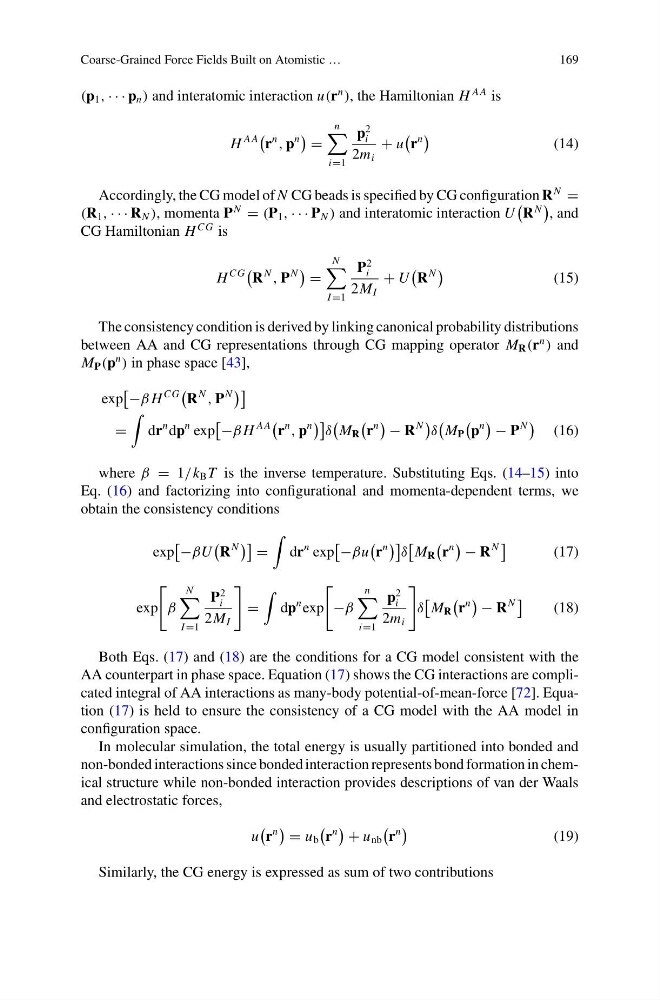
where β = 1/k B T is the inverse temperature. Substituting Eqs. (14–15) into
Eq. (16) and factorizing into configurational and momenta-dependent terms, we
obtain the consistency conditions
exp
−βU
R
N
=
dr
n exp
−βu
r
n
δ
M R
r
n
− R
N
(17)
exp
β
N
I =1
P
2
i
2M I
=
dp
n exp
−β
n
i=1
p
2
i
2m i
δ
M R
r
n
− R
N
(18)
Both Eqs. (17) and (18) are the conditions for a CG model consistent with the
AA counterpart in phase space. Equation (17) shows the CG interactions are complicated integral of AA interactions as many-body potential-of-mean-force [72]. Equation (17) is held to ensure the consistency of a CG model with the AA model in
configuration space.
In molecular simulation, the total energy is usually partitioned into bonded and
non-bonded interactions since bonded interaction represents bond formation in chemical structure while non-bonded interaction provides descriptions of van der Waals
and electrostatic forces,
u
r
n
= u b
r
n
+ u nb
r
n
(19)
Similarly, the CG energy is expressed as sum of two contributions
169
(p 1 , · · · p n ) and interatomic interaction u(r
n
), the Hamiltonian H
A A is
H
A A
r
n
, p
n
=
n
i=1
p
2
i
2m i
+ u
r
n
(14)
Accordingly, the CG model of N CG beads is specified by CG configuration R
N
=
(R 1 , · · · R N ), momenta P
N
= (P 1 , · · · P N ) and interatomic interaction U
R
N
, and
CG Hamiltonian H
CG is
H
CG
R
N
, P
N
=
N
I =1
P
2
i
2M I
+ U
R
N
(15)
The consistency condition is derived by linking canonical probability distributions
between AA and CG representations through CG mapping operator M R (r
n
) and
M P (p
n
) in phase space [43],
exp
−β H
CG
R
N
, P
N
=
dr
n dp
n exp
−β H
A A
r
n
, p
n
δ
M R
r
n
− R
N
δ
M P
p
n
− P
N
(16)
where β = 1/k B T is the inverse temperature. Substituting Eqs. (14–15) into
Eq. (16) and factorizing into configurational and momenta-dependent terms, we
obtain the consistency conditions
exp
−βU
R
N
=
dr
n exp
−βu
r
n
δ
M R
r
n
− R
N
(17)
exp
β
N
I =1
P
2
i
2M I
=
dp
n exp
−β
n
i=1
p
2
i
2m i
δ
M R
r
n
− R
N
(18)
Both Eqs. (17) and (18) are the conditions for a CG model consistent with the
AA counterpart in phase space. Equation (17) shows the CG interactions are complicated integral of AA interactions as many-body potential-of-mean-force [72]. Equation (17) is held to ensure the consistency of a CG model with the AA model in
configuration space.
In molecular simulation, the total energy is usually partitioned into bonded and
non-bonded interactions since bonded interaction represents bond formation in chemical structure while non-bonded interaction provides descriptions of van der Waals
and electrostatic forces,
u
r
n
= u b
r
n
+ u nb
r
n
(19)
Similarly, the CG energy is expressed as sum of two contributions