

152
H. Sun et al.
The scaling factor k i j can be deduced from London’s dispersion energy expression
with an assumption that the radius parameters obey the arithmetic combination rule
(see SI). According to our calculations on non-polar or weak-polar molecules so far,
it seems a generic scaling factor of k i j = 0.08 is appropriate [24–27].
Special functions may be needed for ionic species. Although charge-neutral beads
can be defined for polar functional groups, the ionic beads with net charge are required
for simulation of systems such as electrolyte solutions. In the aqueous solution, the
ionic beads represent hydrated ions. Depending on the size and the charge of ion, the
cation and anion may form so called contact-ion pair (CIP), in which the hydration
shells are penetrated by the ions, and solvent-separated-ion pair (SSIP), in which the
ions are surrounded and separated by the solvent molecules [26, 47–50]. A simple LJ
function as used in several CGFFs [51–53] cannot represent the different interactions.
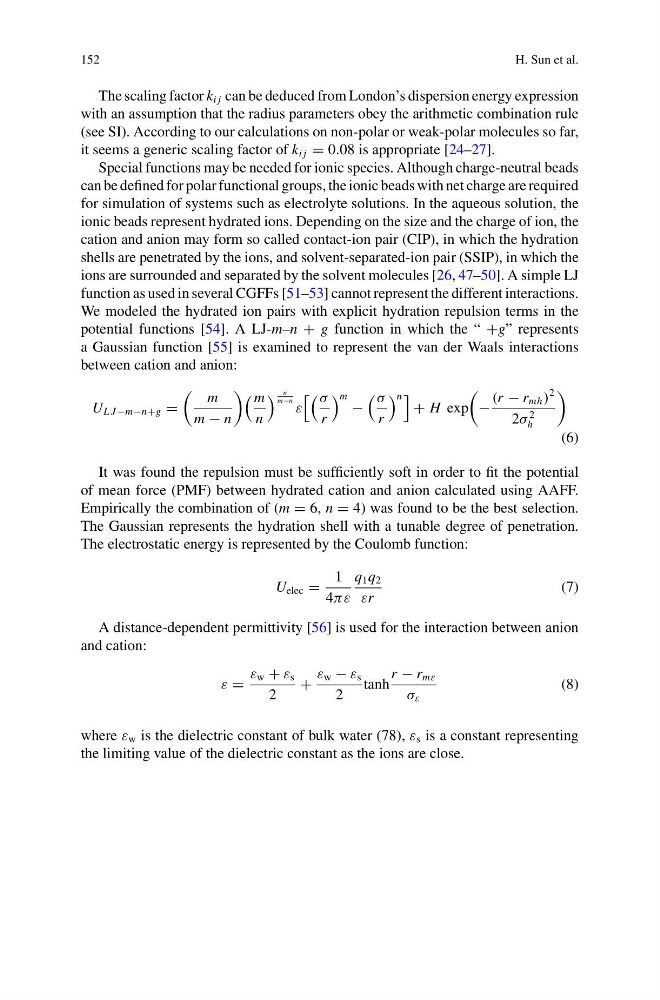
We modeled the hydrated ion pairs with explicit hydration repulsion terms in the
potential functions [54]. A LJ-m–n + g function in which the “ +g” represents
a Gaussian function [55] is examined to represent the van der Waals interactions
between cation and anion:
U L J−m−n+g =
m
m − n
m
n
n
m−n ε
σ
r
m −
σ
r
n
+ H exp
−
(r − r mh )
2
2σ
2
h
(6)
It was found the repulsion must be sufficiently soft in order to fit the potential
of mean force (PMF) between hydrated cation and anion calculated using AAFF.
Empirically the combination of (m = 6, n = 4) was found to be the best selection.
The Gaussian represents the hydration shell with a tunable degree of penetration.
The electrostatic energy is represented by the Coulomb function:
U elec =
1
4πε
q 1 q 2
εr
(7)
A distance-dependent permittivity [56] is used for the interaction between anion
and cation:
ε =
ε w + ε s
2
+
ε w − ε s
2
tanh
r − r mε
σ ε
(8)
where ε w is the dielectric constant of bulk water (78), ε s is a constant representing
the limiting value of the dielectric constant as the ions are close.
H. Sun et al.
The scaling factor k i j can be deduced from London’s dispersion energy expression
with an assumption that the radius parameters obey the arithmetic combination rule
(see SI). According to our calculations on non-polar or weak-polar molecules so far,
it seems a generic scaling factor of k i j = 0.08 is appropriate [24–27].
Special functions may be needed for ionic species. Although charge-neutral beads
can be defined for polar functional groups, the ionic beads with net charge are required
for simulation of systems such as electrolyte solutions. In the aqueous solution, the
ionic beads represent hydrated ions. Depending on the size and the charge of ion, the
cation and anion may form so called contact-ion pair (CIP), in which the hydration
shells are penetrated by the ions, and solvent-separated-ion pair (SSIP), in which the
ions are surrounded and separated by the solvent molecules [26, 47–50]. A simple LJ
function as used in several CGFFs [51–53] cannot represent the different interactions.
We modeled the hydrated ion pairs with explicit hydration repulsion terms in the
potential functions [54]. A LJ-m–n + g function in which the “ +g” represents
a Gaussian function [55] is examined to represent the van der Waals interactions
between cation and anion:
U L J−m−n+g =
m
m − n
m
n
n
m−n ε
σ
r
m −
σ
r
n
+ H exp
−
(r − r mh )
2
2σ
2
h
(6)
It was found the repulsion must be sufficiently soft in order to fit the potential
of mean force (PMF) between hydrated cation and anion calculated using AAFF.
Empirically the combination of (m = 6, n = 4) was found to be the best selection.
The Gaussian represents the hydration shell with a tunable degree of penetration.
The electrostatic energy is represented by the Coulomb function:
U elec =
1
4πε
q 1 q 2
εr
(7)
A distance-dependent permittivity [56] is used for the interaction between anion
and cation:
ε =
ε w + ε s
2
+
ε w − ε s
2
tanh
r − r mε
σ ε
(8)
where ε w is the dielectric constant of bulk water (78), ε s is a constant representing
the limiting value of the dielectric constant as the ions are close.