

Coarse-Grained Force Fields Built on Atomistic …
151
U
R
N
=
u
r
n
M R
−
k B T
2
β
2 u
2
r
n
M R
−
βu
r
n
2
M R
+ O
β
3
(2)
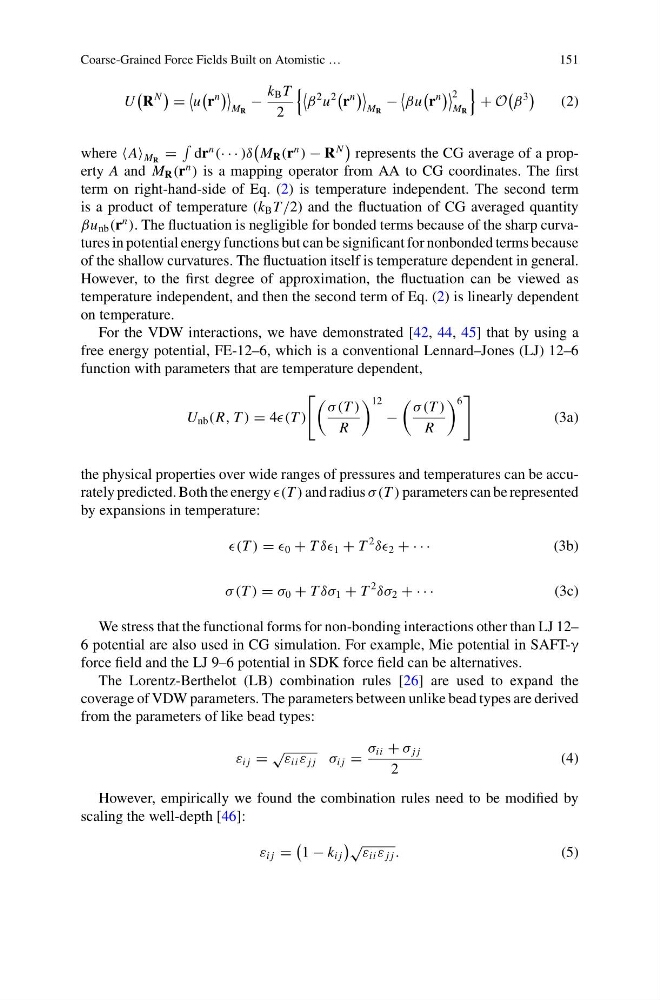
where A M R =
dr
n
(· · · )δ
M R (r
n
) − R
N
represents the CG average of a property A and M R (r
n
) is a mapping operator from AA to CG coordinates. The first
term on right-hand-side of Eq. (2) is temperature independent. The second term
is a product of temperature (k B T /2) and the fluctuation of CG averaged quantity
βu nb (r
n
). The fluctuation is negligible for bonded terms because of the sharp curvatures in potential energy functions but can be significant for nonbonded terms because
of the shallow curvatures. The fluctuation itself is temperature dependent in general.
However, to the first degree of approximation, the fluctuation can be viewed as
temperature independent, and then the second term of Eq. (2) is linearly dependent
on temperature.
For the VDW interactions, we have demonstrated [42, 44, 45] that by using a
free energy potential, FE-12–6, which is a conventional Lennard–Jones (LJ) 12–6
function with parameters that are temperature dependent,
U nb (R, T ) = 4(T )
σ (T )
R
12
−
σ (T )
R
6
(3a)
the physical properties over wide ranges of pressures and temperatures can be accurately predicted. Both the energy (T ) and radius σ (T ) parameters can be represented
by expansions in temperature:
(T ) = 0 + T δδ 1 + T
2
δδ 2 + · · ·
(3b)
σ (T ) = σ 0 + T δσ 1 + T
2
δσ 2 + · · ·
(3c)
We stress that the functional forms for non-bonding interactions other than LJ 12–
6 potential are also used in CG simulation. For example, Mie potential in SAFT-γ
force field and the LJ 9–6 potential in SDK force field can be alternatives.
The Lorentz-Berthelot (LB) combination rules [26] are used to expand the
coverage of VDW parameters. The parameters between unlike bead types are derived
from the parameters of like bead types:
ε i j =
√ ε ii ε j j σ i j =
σ ii + σ j j
2
(4)
However, empirically we found the combination rules need to be modified by
scaling the well-depth [46]:
ε i j =
1 − k i j
√ ε ii ε j j .
(5)
151
U
R
N
=
u
r
n
M R
−
k B T
2
β
2 u
2
r
n
M R
−
βu
r
n
2
M R
+ O
β
3
(2)
where A M R =
dr
n
(· · · )δ
M R (r
n
) − R
N
represents the CG average of a property A and M R (r
n
) is a mapping operator from AA to CG coordinates. The first
term on right-hand-side of Eq. (2) is temperature independent. The second term
is a product of temperature (k B T /2) and the fluctuation of CG averaged quantity
βu nb (r
n
). The fluctuation is negligible for bonded terms because of the sharp curvatures in potential energy functions but can be significant for nonbonded terms because
of the shallow curvatures. The fluctuation itself is temperature dependent in general.
However, to the first degree of approximation, the fluctuation can be viewed as
temperature independent, and then the second term of Eq. (2) is linearly dependent
on temperature.
For the VDW interactions, we have demonstrated [42, 44, 45] that by using a
free energy potential, FE-12–6, which is a conventional Lennard–Jones (LJ) 12–6
function with parameters that are temperature dependent,
U nb (R, T ) = 4(T )
σ (T )
R
12
−
σ (T )
R
6
(3a)
the physical properties over wide ranges of pressures and temperatures can be accurately predicted. Both the energy (T ) and radius σ (T ) parameters can be represented
by expansions in temperature:
(T ) = 0 + T δδ 1 + T
2
δδ 2 + · · ·
(3b)
σ (T ) = σ 0 + T δσ 1 + T
2
δσ 2 + · · ·
(3c)
We stress that the functional forms for non-bonding interactions other than LJ 12–
6 potential are also used in CG simulation. For example, Mie potential in SAFT-γ
force field and the LJ 9–6 potential in SDK force field can be alternatives.
The Lorentz-Berthelot (LB) combination rules [26] are used to expand the
coverage of VDW parameters. The parameters between unlike bead types are derived
from the parameters of like bead types:
ε i j =
√ ε ii ε j j σ i j =
σ ii + σ j j
2
(4)
However, empirically we found the combination rules need to be modified by
scaling the well-depth [46]:
ε i j =
1 − k i j
√ ε ii ε j j .
(5)