

150
H. Sun et al.
Coupled with the bead types, the total energy is expressed as the bonded (bond,
angle and dihedral angle) and nonbonded (VDW and columbic) terms using simplified functional forms of TEAM-AMBER [41] or TEAM-MS [15, 42]. For example,
the bonded term in TEAM-MS form is:
U b
R
N
=
bonds
k b 1 (b − b 0 )
2
+ k b 2 (b − b 0 )
3
+ k b 3 (b − b 0 )
4
+
angle
k a 1 (θ − θ 0 )
2
+ k a 2 (θ − θ 0 )
3
+ k a 3 (θ − θ 0 )
4
+
dihedral
k n [1 + cos(nϕ − ϕ 0 )]
(1)
where b 0 , θ 0 , ϕ 0 are the reference values of bond length, bond angle and dihedral
angle, respectively; and k as , k bs , k ns are corresponding force constants. The reference
value of the dihedral angle, ϕ 0 = 0 if n = 1, 3 or ϕ 0 = π if n = 2, 4. The
bond and angle functions include the high-order contributions which facilitate the
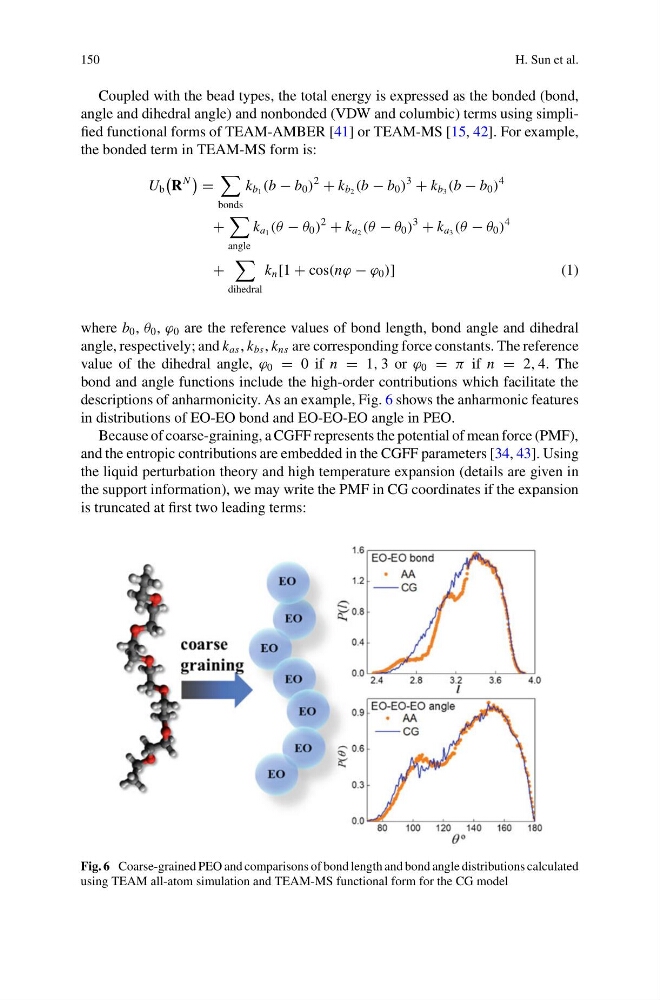
descriptions of anharmonicity. As an example, Fig. 6 shows the anharmonic features
in distributions of EO-EO bond and EO-EO-EO angle in PEO.
Because of coarse-graining, a CGFF represents the potential of mean force (PMF),
and the entropic contributions are embedded in the CGFF parameters [34, 43]. Using
the liquid perturbation theory and high temperature expansion (details are given in
the support information), we may write the PMF in CG coordinates if the expansion
is truncated at first two leading terms:
Fig. 6 Coarse-grained PEO and comparisons of bond length and bond angle distributions calculated
using TEAM all-atom simulation and TEAM-MS functional form for the CG model
H. Sun et al.
Coupled with the bead types, the total energy is expressed as the bonded (bond,
angle and dihedral angle) and nonbonded (VDW and columbic) terms using simplified functional forms of TEAM-AMBER [41] or TEAM-MS [15, 42]. For example,
the bonded term in TEAM-MS form is:
U b
R
N
=
bonds
k b 1 (b − b 0 )
2
+ k b 2 (b − b 0 )
3
+ k b 3 (b − b 0 )
4
+
angle
k a 1 (θ − θ 0 )
2
+ k a 2 (θ − θ 0 )
3
+ k a 3 (θ − θ 0 )
4
+
dihedral
k n [1 + cos(nϕ − ϕ 0 )]
(1)
where b 0 , θ 0 , ϕ 0 are the reference values of bond length, bond angle and dihedral
angle, respectively; and k as , k bs , k ns are corresponding force constants. The reference
value of the dihedral angle, ϕ 0 = 0 if n = 1, 3 or ϕ 0 = π if n = 2, 4. The
bond and angle functions include the high-order contributions which facilitate the
descriptions of anharmonicity. As an example, Fig. 6 shows the anharmonic features
in distributions of EO-EO bond and EO-EO-EO angle in PEO.
Because of coarse-graining, a CGFF represents the potential of mean force (PMF),
and the entropic contributions are embedded in the CGFF parameters [34, 43]. Using
the liquid perturbation theory and high temperature expansion (details are given in
the support information), we may write the PMF in CG coordinates if the expansion
is truncated at first two leading terms:
Fig. 6 Coarse-grained PEO and comparisons of bond length and bond angle distributions calculated
using TEAM all-atom simulation and TEAM-MS functional form for the CG model