

Coarse-Grained Force Fields Built on Atomistic …
149
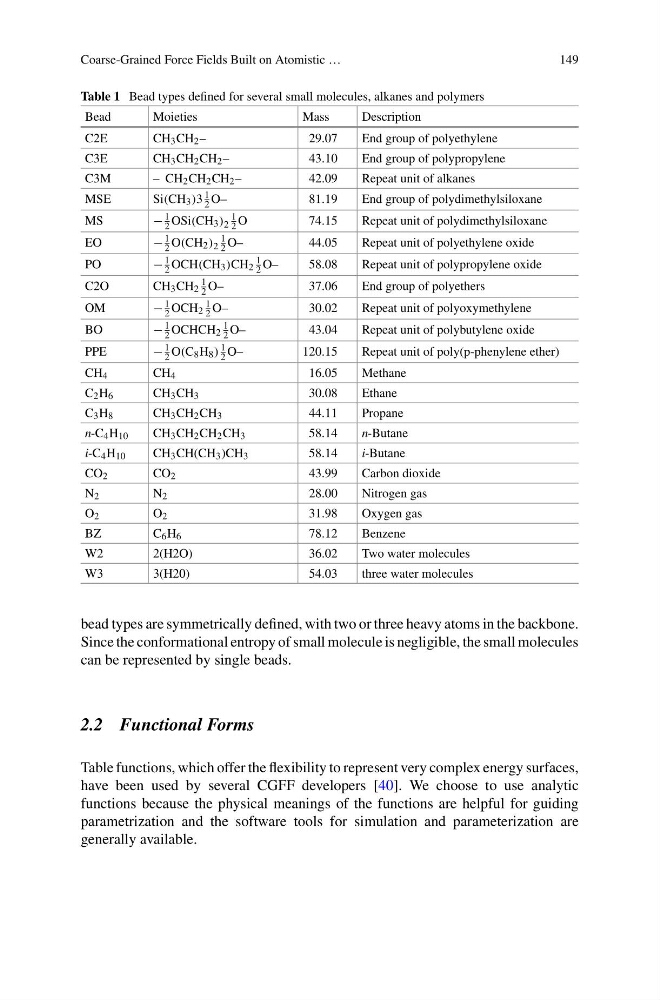
Table 1 Bead types defined for several small molecules, alkanes and polymers
Bead
Moieties
Mass
Description
C2E
CH 3 CH 2 –
29.07
End group of polyethylene
C3E
CH 3 CH 2 CH 2 –
43.10
End group of polypropylene
C3M
– CH 2 CH 2 CH 2 –
42.09
Repeat unit of alkanes
MSE
Si(CH 3 )3
1
2 O–
81.19
End group of polydimethylsiloxane
MS
−
1
2 OSi(CH 3 ) 2
1
2 O
74.15
Repeat unit of polydimethylsiloxane
EO
−
1
2 O(CH 2 ) 2
1
2 O–
44.05
Repeat unit of polyethylene oxide
PO
−
1
2 OCH(CH 3 )CH 2
1
2 O–
58.08
Repeat unit of polypropylene oxide
C2O
CH 3 CH 2
1
2 O–
37.06
End group of polyethers
OM
−
1
2 OCH 2
1
2 O–
30.02
Repeat unit of polyoxymethylene
BO
−
1
2 OCHCH 2
1
2 O–
43.04
Repeat unit of polybutylene oxide
PPE
−
1
2 O(C 8 H 8 )
1
2 O–
120.15
Repeat unit of poly(p-phenylene ether)
CH 4
CH 4
16.05
Methane
C 2 H 6
CH 3 CH 3
30.08
Ethane
C 3 H 8
CH 3 CH 2 CH 3
44.11
Propane
n-C 4 H 10
CH 3 CH 2 CH 2 CH 3
58.14
n-Butane
i-C 4 H 10
CH 3 CH(CH 3 )CH 3
58.14
i-Butane
CO 2
CO 2
43.99
Carbon dioxide
N 2
N 2
28.00
Nitrogen gas
O 2
O 2
31.98
Oxygen gas
BZ
C 6 H 6
78.12
Benzene
W2
2(H2O)
36.02
Two water molecules
W3
3(H20)
54.03
three water molecules
bead types are symmetrically defined, with two or three heavy atoms in the backbone.
Since the conformational entropy of small molecule is negligible, the small molecules
can be represented by single beads.
2.2 Functional Forms
Table functions, which offer the flexibility to represent very complex energy surfaces,
have been used by several CGFF developers [40]. We choose to use analytic
functions because the physical meanings of the functions are helpful for guiding
parametrization and the software tools for simulation and parameterization are
generally available.
149
Table 1 Bead types defined for several small molecules, alkanes and polymers
Bead
Moieties
Mass
Description
C2E
CH 3 CH 2 –
29.07
End group of polyethylene
C3E
CH 3 CH 2 CH 2 –
43.10
End group of polypropylene
C3M
– CH 2 CH 2 CH 2 –
42.09
Repeat unit of alkanes
MSE
Si(CH 3 )3
1
2 O–
81.19
End group of polydimethylsiloxane
MS
−
1
2 OSi(CH 3 ) 2
1
2 O
74.15
Repeat unit of polydimethylsiloxane
EO
−
1
2 O(CH 2 ) 2
1
2 O–
44.05
Repeat unit of polyethylene oxide
PO
−
1
2 OCH(CH 3 )CH 2
1
2 O–
58.08
Repeat unit of polypropylene oxide
C2O
CH 3 CH 2
1
2 O–
37.06
End group of polyethers
OM
−
1
2 OCH 2
1
2 O–
30.02
Repeat unit of polyoxymethylene
BO
−
1
2 OCHCH 2
1
2 O–
43.04
Repeat unit of polybutylene oxide
PPE
−
1
2 O(C 8 H 8 )
1
2 O–
120.15
Repeat unit of poly(p-phenylene ether)
CH 4
CH 4
16.05
Methane
C 2 H 6
CH 3 CH 3
30.08
Ethane
C 3 H 8
CH 3 CH 2 CH 3
44.11
Propane
n-C 4 H 10
CH 3 CH 2 CH 2 CH 3
58.14
n-Butane
i-C 4 H 10
CH 3 CH(CH 3 )CH 3
58.14
i-Butane
CO 2
CO 2
43.99
Carbon dioxide
N 2
N 2
28.00
Nitrogen gas
O 2
O 2
31.98
Oxygen gas
BZ
C 6 H 6
78.12
Benzene
W2
2(H2O)
36.02
Two water molecules
W3
3(H20)
54.03
three water molecules
bead types are symmetrically defined, with two or three heavy atoms in the backbone.
Since the conformational entropy of small molecule is negligible, the small molecules
can be represented by single beads.
2.2 Functional Forms
Table functions, which offer the flexibility to represent very complex energy surfaces,
have been used by several CGFF developers [40]. We choose to use analytic
functions because the physical meanings of the functions are helpful for guiding
parametrization and the software tools for simulation and parameterization are
generally available.