

148
H. Sun et al.
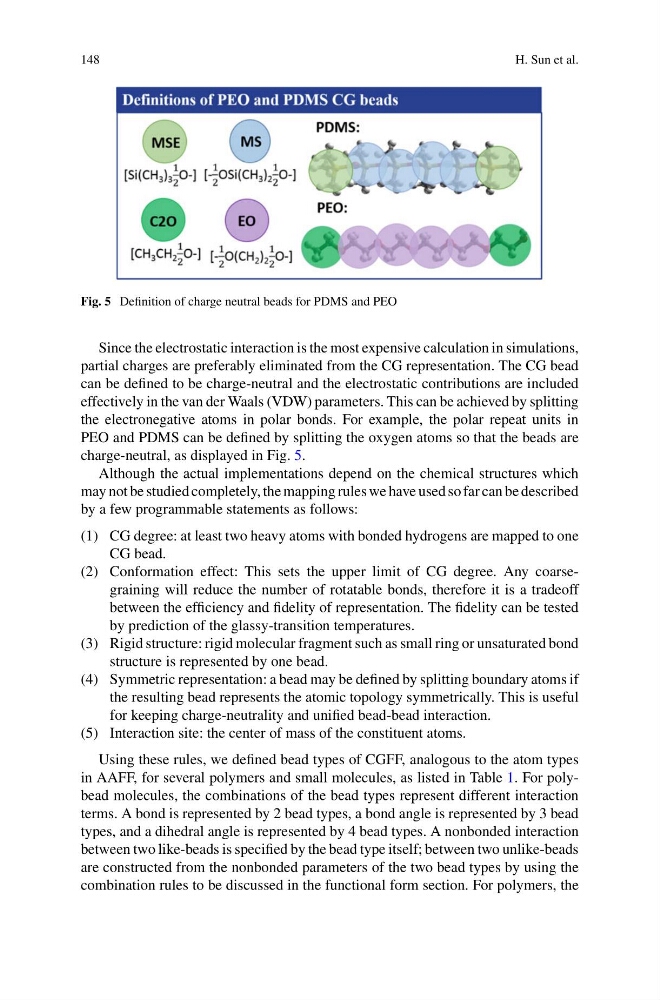
Fig. 5 Definition of charge neutral beads for PDMS and PEO
Since the electrostatic interaction is the most expensive calculation in simulations,
partial charges are preferably eliminated from the CG representation. The CG bead
can be defined to be charge-neutral and the electrostatic contributions are included
effectively in the van der Waals (VDW) parameters. This can be achieved by splitting
the electronegative atoms in polar bonds. For example, the polar repeat units in
PEO and PDMS can be defined by splitting the oxygen atoms so that the beads are
charge-neutral, as displayed in Fig. 5.
Although the actual implementations depend on the chemical structures which
may not be studied completely, the mapping rules we have used so far can be described
by a few programmable statements as follows:
(1) CG degree: at least two heavy atoms with bonded hydrogens are mapped to one
CG bead.
(2) Conformation effect: This sets the upper limit of CG degree. Any coarsegraining will reduce the number of rotatable bonds, therefore it is a tradeoff
between the efficiency and fidelity of representation. The fidelity can be tested
by prediction of the glassy-transition temperatures.
(3) Rigid structure: rigid molecular fragment such as small ring or unsaturated bond
structure is represented by one bead.
(4) Symmetric representation: a bead may be defined by splitting boundary atoms if
the resulting bead represents the atomic topology symmetrically. This is useful
for keeping charge-neutrality and unified bead-bead interaction.
(5) Interaction site: the center of mass of the constituent atoms.
Using these rules, we defined bead types of CGFF, analogous to the atom types
in AAFF, for several polymers and small molecules, as listed in Table 1. For polybead molecules, the combinations of the bead types represent different interaction
terms. A bond is represented by 2 bead types, a bond angle is represented by 3 bead
types, and a dihedral angle is represented by 4 bead types. A nonbonded interaction
between two like-beads is specified by the bead type itself; between two unlike-beads
are constructed from the nonbonded parameters of the two bead types by using the
combination rules to be discussed in the functional form section. For polymers, the
H. Sun et al.
Fig. 5 Definition of charge neutral beads for PDMS and PEO
Since the electrostatic interaction is the most expensive calculation in simulations,
partial charges are preferably eliminated from the CG representation. The CG bead
can be defined to be charge-neutral and the electrostatic contributions are included
effectively in the van der Waals (VDW) parameters. This can be achieved by splitting
the electronegative atoms in polar bonds. For example, the polar repeat units in
PEO and PDMS can be defined by splitting the oxygen atoms so that the beads are
charge-neutral, as displayed in Fig. 5.
Although the actual implementations depend on the chemical structures which
may not be studied completely, the mapping rules we have used so far can be described
by a few programmable statements as follows:
(1) CG degree: at least two heavy atoms with bonded hydrogens are mapped to one
CG bead.
(2) Conformation effect: This sets the upper limit of CG degree. Any coarsegraining will reduce the number of rotatable bonds, therefore it is a tradeoff
between the efficiency and fidelity of representation. The fidelity can be tested
by prediction of the glassy-transition temperatures.
(3) Rigid structure: rigid molecular fragment such as small ring or unsaturated bond
structure is represented by one bead.
(4) Symmetric representation: a bead may be defined by splitting boundary atoms if
the resulting bead represents the atomic topology symmetrically. This is useful
for keeping charge-neutrality and unified bead-bead interaction.
(5) Interaction site: the center of mass of the constituent atoms.
Using these rules, we defined bead types of CGFF, analogous to the atom types
in AAFF, for several polymers and small molecules, as listed in Table 1. For polybead molecules, the combinations of the bead types represent different interaction
terms. A bond is represented by 2 bead types, a bond angle is represented by 3 bead
types, and a dihedral angle is represented by 4 bead types. A nonbonded interaction
between two like-beads is specified by the bead type itself; between two unlike-beads
are constructed from the nonbonded parameters of the two bead types by using the
combination rules to be discussed in the functional form section. For polymers, the