

Coarse-Grained Force Fields Built on Atomistic …
147
For flexible moieties, the bead size may be reduced so that the structural features of
conformational isomers can be represented. One example to illustrate this is butane.
Because the trans and cis conformers exhibit different end-end distances, two beads
together with a double-well potential are required to describe the difference. For
propane it is not necessary to use two beads because there is no internal rotation of
the heavy atoms in the molecule. This can be summarized as a new bead is required
when a new dihedral angle is formed. For example, it may not be necessary to add a
new bead to a benzene bead to represent methylbenzene but it is necessary to add a
new bead to the benzene bead for ethylbenzene.
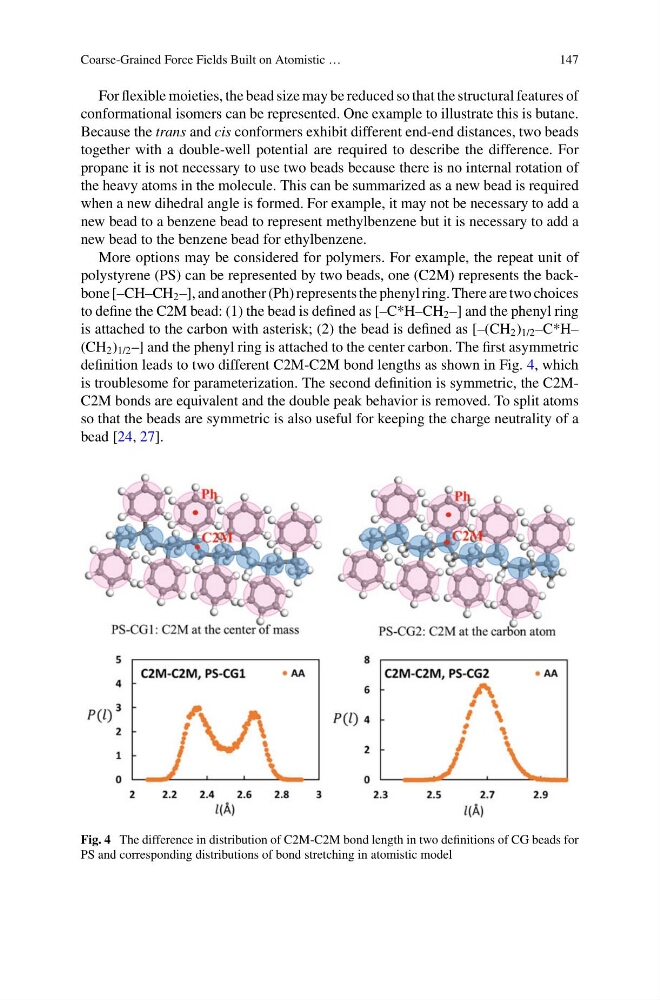
More options may be considered for polymers. For example, the repeat unit of
polystyrene (PS) can be represented by two beads, one (C2M) represents the backbone [–CH–CH 2 –], and another (Ph) represents the phenyl ring. There are two choices
to define the C2M bead: (1) the bead is defined as [–C*H–CH 2 –] and the phenyl ring
is attached to the carbon with asterisk; (2) the bead is defined as [–(CH 2 ) 1/2 –C*H–
(CH 2 ) 1/2 –] and the phenyl ring is attached to the center carbon. The first asymmetric
definition leads to two different C2M-C2M bond lengths as shown in Fig. 4, which
is troublesome for parameterization. The second definition is symmetric, the C2MC2M bonds are equivalent and the double peak behavior is removed. To split atoms
so that the beads are symmetric is also useful for keeping the charge neutrality of a
bead [24, 27].
Fig. 4 The difference in distribution of C2M-C2M bond length in two definitions of CG beads for
PS and corresponding distributions of bond stretching in atomistic model
147
For flexible moieties, the bead size may be reduced so that the structural features of
conformational isomers can be represented. One example to illustrate this is butane.
Because the trans and cis conformers exhibit different end-end distances, two beads
together with a double-well potential are required to describe the difference. For
propane it is not necessary to use two beads because there is no internal rotation of
the heavy atoms in the molecule. This can be summarized as a new bead is required
when a new dihedral angle is formed. For example, it may not be necessary to add a
new bead to a benzene bead to represent methylbenzene but it is necessary to add a
new bead to the benzene bead for ethylbenzene.
More options may be considered for polymers. For example, the repeat unit of
polystyrene (PS) can be represented by two beads, one (C2M) represents the backbone [–CH–CH 2 –], and another (Ph) represents the phenyl ring. There are two choices
to define the C2M bead: (1) the bead is defined as [–C*H–CH 2 –] and the phenyl ring
is attached to the carbon with asterisk; (2) the bead is defined as [–(CH 2 ) 1/2 –C*H–
(CH 2 ) 1/2 –] and the phenyl ring is attached to the center carbon. The first asymmetric
definition leads to two different C2M-C2M bond lengths as shown in Fig. 4, which
is troublesome for parameterization. The second definition is symmetric, the C2MC2M bonds are equivalent and the double peak behavior is removed. To split atoms
so that the beads are symmetric is also useful for keeping the charge neutrality of a
bead [24, 27].
Fig. 4 The difference in distribution of C2M-C2M bond length in two definitions of CG beads for
PS and corresponding distributions of bond stretching in atomistic model