

146
H. Sun et al.
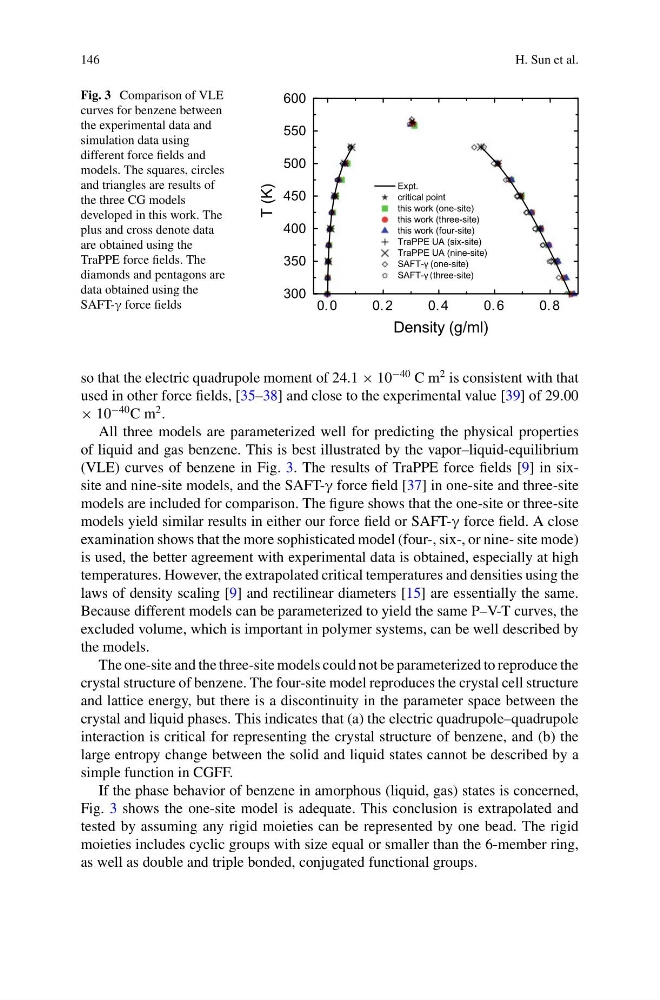
Fig. 3 Comparison of VLE
curves for benzene between
the experimental data and
simulation data using
different force fields and
models. The squares, circles
and triangles are results of
the three CG models
developed in this work. The
plus and cross denote data
are obtained using the
TraPPE force fields. The
diamonds and pentagons are
data obtained using the
SAFT-γ force fields
0. 0
0. 2
0. 4
0. 6
0. 8
300
350
400
450
500
550
600
Expt.
critical point
this work (one-site)
this work (three-site)
this work (four-site)
TraPPE UA (six-site)
TraPPE UA (nine-site)
SAFT-γ (one-site)
SAFT-γ (three-site)
T (K)
Density (g/ml)
so that the electric quadrupole moment of 24.1 × 10
−40 C m
2 is consistent with that
used in other force fields, [35–38] and close to the experimental value [39] of 29.00
× 10
−40 C m
2 .
All three models are parameterized well for predicting the physical properties
of liquid and gas benzene. This is best illustrated by the vapor–liquid-equilibrium
(VLE) curves of benzene in Fig. 3. The results of TraPPE force fields [9] in sixsite and nine-site models, and the SAFT-γ force field [37] in one-site and three-site
models are included for comparison. The figure shows that the one-site or three-site
models yield similar results in either our force field or SAFT-γ force field. A close
examination shows that the more sophisticated model (four-, six-, or nine- site mode)
is used, the better agreement with experimental data is obtained, especially at high
temperatures. However, the extrapolated critical temperatures and densities using the
laws of density scaling [9] and rectilinear diameters [15] are essentially the same.
Because different models can be parameterized to yield the same P–V-T curves, the
excluded volume, which is important in polymer systems, can be well described by
the models.
The one-site and the three-site models could not be parameterized to reproduce the
crystal structure of benzene. The four-site model reproduces the crystal cell structure
and lattice energy, but there is a discontinuity in the parameter space between the
crystal and liquid phases. This indicates that (a) the electric quadrupole–quadrupole
interaction is critical for representing the crystal structure of benzene, and (b) the
large entropy change between the solid and liquid states cannot be described by a
simple function in CGFF.
If the phase behavior of benzene in amorphous (liquid, gas) states is concerned,
Fig. 3 shows the one-site model is adequate. This conclusion is extrapolated and
tested by assuming any rigid moieties can be represented by one bead. The rigid
moieties includes cyclic groups with size equal or smaller than the 6-member ring,
as well as double and triple bonded, conjugated functional groups.
H. Sun et al.
Fig. 3 Comparison of VLE
curves for benzene between
the experimental data and
simulation data using
different force fields and
models. The squares, circles
and triangles are results of
the three CG models
developed in this work. The
plus and cross denote data
are obtained using the
TraPPE force fields. The
diamonds and pentagons are
data obtained using the
SAFT-γ force fields
0. 0
0. 2
0. 4
0. 6
0. 8
300
350
400
450
500
550
600
Expt.
critical point
this work (one-site)
this work (three-site)
this work (four-site)
TraPPE UA (six-site)
TraPPE UA (nine-site)
SAFT-γ (one-site)
SAFT-γ (three-site)
T (K)
Density (g/ml)
so that the electric quadrupole moment of 24.1 × 10
−40 C m
2 is consistent with that
used in other force fields, [35–38] and close to the experimental value [39] of 29.00
× 10
−40 C m
2 .
All three models are parameterized well for predicting the physical properties
of liquid and gas benzene. This is best illustrated by the vapor–liquid-equilibrium
(VLE) curves of benzene in Fig. 3. The results of TraPPE force fields [9] in sixsite and nine-site models, and the SAFT-γ force field [37] in one-site and three-site
models are included for comparison. The figure shows that the one-site or three-site
models yield similar results in either our force field or SAFT-γ force field. A close
examination shows that the more sophisticated model (four-, six-, or nine- site mode)
is used, the better agreement with experimental data is obtained, especially at high
temperatures. However, the extrapolated critical temperatures and densities using the
laws of density scaling [9] and rectilinear diameters [15] are essentially the same.
Because different models can be parameterized to yield the same P–V-T curves, the
excluded volume, which is important in polymer systems, can be well described by
the models.
The one-site and the three-site models could not be parameterized to reproduce the
crystal structure of benzene. The four-site model reproduces the crystal cell structure
and lattice energy, but there is a discontinuity in the parameter space between the
crystal and liquid phases. This indicates that (a) the electric quadrupole–quadrupole
interaction is critical for representing the crystal structure of benzene, and (b) the
large entropy change between the solid and liquid states cannot be described by a
simple function in CGFF.
If the phase behavior of benzene in amorphous (liquid, gas) states is concerned,
Fig. 3 shows the one-site model is adequate. This conclusion is extrapolated and
tested by assuming any rigid moieties can be represented by one bead. The rigid
moieties includes cyclic groups with size equal or smaller than the 6-member ring,
as well as double and triple bonded, conjugated functional groups.