

Coarse-Grained Force Fields Built on Atomistic …
145
2 Methodologies
2.1 The Mapping Rules
The design of CG mapping is a balance between the gain of computational efficiency
and the fidelity of representation. Because the mapping alters the molecular shapes
and volumes, it has a strong impact on the ability to predict thermodynamic and
transport properties [33]. Above UAFF, the low-end of CG mapping is to have one
bead representing two heavy atoms. Using larger beads increases the computational
efficiency as well as the uncertainty in representation. Therefore, it is necessary to
find out where is the optimal boundary.
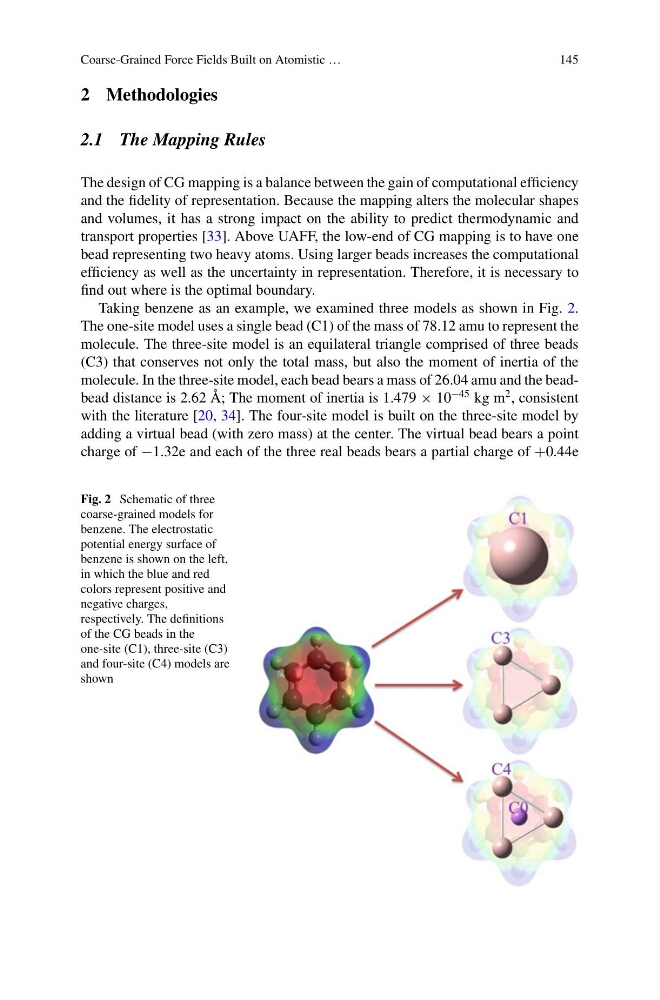
Taking benzene as an example, we examined three models as shown in Fig. 2.
The one-site model uses a single bead (C1) of the mass of 78.12 amu to represent the
molecule. The three-site model is an equilateral triangle comprised of three beads
(C3) that conserves not only the total mass, but also the moment of inertia of the
molecule. In the three-site model, each bead bears a mass of 26.04 amu and the beadbead distance is 2.62 Å; The moment of inertia is 1.479 × 10
−45 kg m
2 , consistent
with the literature [20, 34]. The four-site model is built on the three-site model by
adding a virtual bead (with zero mass) at the center. The virtual bead bears a point
charge of −1.32e and each of the three real beads bears a partial charge of +0.44e
Fig. 2 Schematic of three
coarse-grained models for
benzene. The electrostatic
potential energy surface of
benzene is shown on the left,
in which the blue and red
colors represent positive and
negative charges,
respectively. The definitions
of the CG beads in the
one-site (C1), three-site (C3)
and four-site (C4) models are
shown
145
2 Methodologies
2.1 The Mapping Rules
The design of CG mapping is a balance between the gain of computational efficiency
and the fidelity of representation. Because the mapping alters the molecular shapes
and volumes, it has a strong impact on the ability to predict thermodynamic and
transport properties [33]. Above UAFF, the low-end of CG mapping is to have one
bead representing two heavy atoms. Using larger beads increases the computational
efficiency as well as the uncertainty in representation. Therefore, it is necessary to
find out where is the optimal boundary.
Taking benzene as an example, we examined three models as shown in Fig. 2.
The one-site model uses a single bead (C1) of the mass of 78.12 amu to represent the
molecule. The three-site model is an equilateral triangle comprised of three beads
(C3) that conserves not only the total mass, but also the moment of inertia of the
molecule. In the three-site model, each bead bears a mass of 26.04 amu and the beadbead distance is 2.62 Å; The moment of inertia is 1.479 × 10
−45 kg m
2 , consistent
with the literature [20, 34]. The four-site model is built on the three-site model by
adding a virtual bead (with zero mass) at the center. The virtual bead bears a point
charge of −1.32e and each of the three real beads bears a partial charge of +0.44e
Fig. 2 Schematic of three
coarse-grained models for
benzene. The electrostatic
potential energy surface of
benzene is shown on the left,
in which the blue and red
colors represent positive and
negative charges,
respectively. The definitions
of the CG beads in the
one-site (C1), three-site (C3)
and four-site (C4) models are
shown