

144
H. Sun et al.
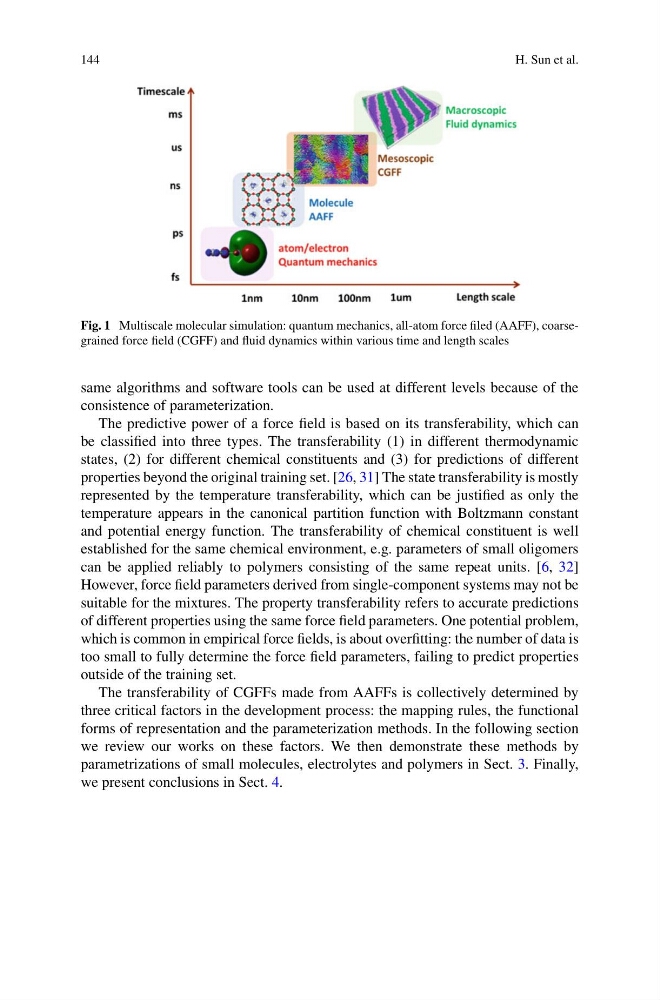
Fig. 1 Multiscale molecular simulation: quantum mechanics, all-atom force filed (AAFF), coarsegrained force field (CGFF) and fluid dynamics within various time and length scales
same algorithms and software tools can be used at different levels because of the
consistence of parameterization.
The predictive power of a force field is based on its transferability, which can
be classified into three types. The transferability (1) in different thermodynamic
states, (2) for different chemical constituents and (3) for predictions of different
properties beyond the original training set. [26, 31] The state transferability is mostly
represented by the temperature transferability, which can be justified as only the
temperature appears in the canonical partition function with Boltzmann constant
and potential energy function. The transferability of chemical constituent is well
established for the same chemical environment, e.g. parameters of small oligomers
can be applied reliably to polymers consisting of the same repeat units. [6, 32]
However, force field parameters derived from single-component systems may not be
suitable for the mixtures. The property transferability refers to accurate predictions
of different properties using the same force field parameters. One potential problem,
which is common in empirical force fields, is about overfitting: the number of data is
too small to fully determine the force field parameters, failing to predict properties
outside of the training set.
The transferability of CGFFs made from AAFFs is collectively determined by
three critical factors in the development process: the mapping rules, the functional
forms of representation and the parameterization methods. In the following section
we review our works on these factors. We then demonstrate these methods by
parametrizations of small molecules, electrolytes and polymers in Sect. 3. Finally,
we present conclusions in Sect. 4.
H. Sun et al.
Fig. 1 Multiscale molecular simulation: quantum mechanics, all-atom force filed (AAFF), coarsegrained force field (CGFF) and fluid dynamics within various time and length scales
same algorithms and software tools can be used at different levels because of the
consistence of parameterization.
The predictive power of a force field is based on its transferability, which can
be classified into three types. The transferability (1) in different thermodynamic
states, (2) for different chemical constituents and (3) for predictions of different
properties beyond the original training set. [26, 31] The state transferability is mostly
represented by the temperature transferability, which can be justified as only the
temperature appears in the canonical partition function with Boltzmann constant
and potential energy function. The transferability of chemical constituent is well
established for the same chemical environment, e.g. parameters of small oligomers
can be applied reliably to polymers consisting of the same repeat units. [6, 32]
However, force field parameters derived from single-component systems may not be
suitable for the mixtures. The property transferability refers to accurate predictions
of different properties using the same force field parameters. One potential problem,
which is common in empirical force fields, is about overfitting: the number of data is
too small to fully determine the force field parameters, failing to predict properties
outside of the training set.
The transferability of CGFFs made from AAFFs is collectively determined by
three critical factors in the development process: the mapping rules, the functional
forms of representation and the parameterization methods. In the following section
we review our works on these factors. We then demonstrate these methods by
parametrizations of small molecules, electrolytes and polymers in Sect. 3. Finally,
we present conclusions in Sect. 4.