

Efficient Sampling of High-Dimensional …
129
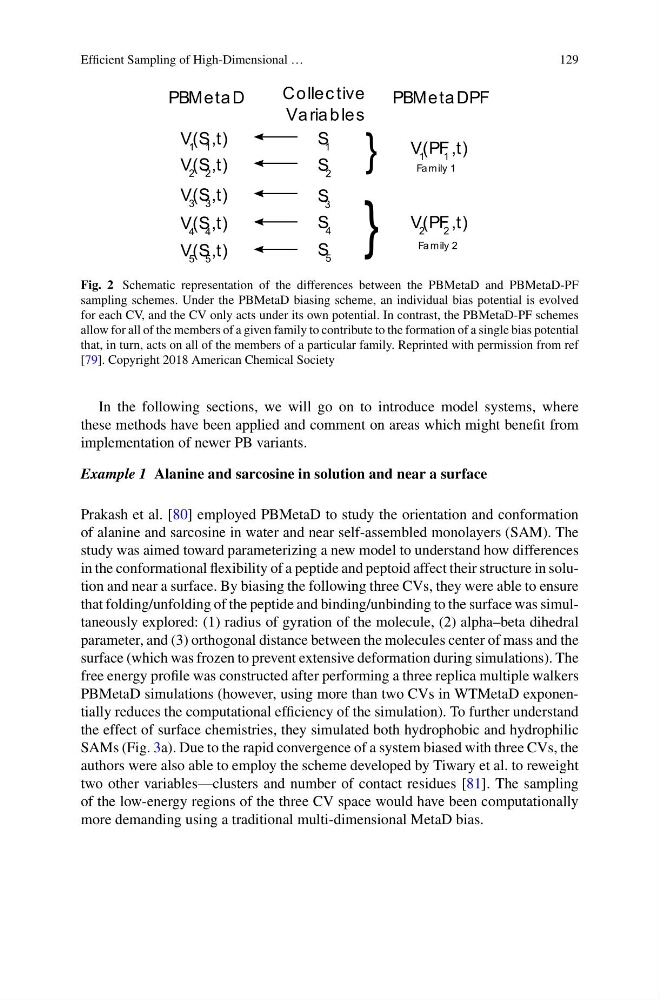
Fig. 2 Schematic representation of the differences between the PBMetaD and PBMetaD-PF
sampling schemes. Under the PBMetaD biasing scheme, an individual bias potential is evolved
for each CV, and the CV only acts under its own potential. In contrast, the PBMetaD-PF schemes
allow for all of the members of a given family to contribute to the formation of a single bias potential
that, in turn, acts on all of the members of a particular family. Reprinted with permission from ref
[79]. Copyright 2018 American Chemical Society
In the following sections, we will go on to introduce model systems, where
these methods have been applied and comment on areas which might benefit from
implementation of newer PB variants.
Example 1 Alanine and sarcosine in solution and near a surface
Prakash et al. [80] employed PBMetaD to study the orientation and conformation
of alanine and sarcosine in water and near self-assembled monolayers (SAM). The
study was aimed toward parameterizing a new model to understand how differences
in the conformational flexibility of a peptide and peptoid affect their structure in solution and near a surface. By biasing the following three CVs, they were able to ensure
that folding/unfolding of the peptide and binding/unbinding to the surface was simultaneously explored: (1) radius of gyration of the molecule, (2) alpha–beta dihedral
parameter, and (3) orthogonal distance between the molecules center of mass and the
surface (which was frozen to prevent extensive deformation during simulations). The
free energy profile was constructed after performing a three replica multiple walkers
PBMetaD simulations (however, using more than two CVs in WTMetaD exponentially reduces the computational efficiency of the simulation). To further understand
the effect of surface chemistries, they simulated both hydrophobic and hydrophilic
SAMs (Fig. 3a). Due to the rapid convergence of a system biased with three CVs, the
authors were also able to employ the scheme developed by Tiwary et al. to reweight
two other variables—clusters and number of contact residues [81]. The sampling
of the low-energy regions of the three CV space would have been computationally
more demanding using a traditional multi-dimensional MetaD bias.
129
Fig. 2 Schematic representation of the differences between the PBMetaD and PBMetaD-PF
sampling schemes. Under the PBMetaD biasing scheme, an individual bias potential is evolved
for each CV, and the CV only acts under its own potential. In contrast, the PBMetaD-PF schemes
allow for all of the members of a given family to contribute to the formation of a single bias potential
that, in turn, acts on all of the members of a particular family. Reprinted with permission from ref
[79]. Copyright 2018 American Chemical Society
In the following sections, we will go on to introduce model systems, where
these methods have been applied and comment on areas which might benefit from
implementation of newer PB variants.
Example 1 Alanine and sarcosine in solution and near a surface
Prakash et al. [80] employed PBMetaD to study the orientation and conformation
of alanine and sarcosine in water and near self-assembled monolayers (SAM). The
study was aimed toward parameterizing a new model to understand how differences
in the conformational flexibility of a peptide and peptoid affect their structure in solution and near a surface. By biasing the following three CVs, they were able to ensure
that folding/unfolding of the peptide and binding/unbinding to the surface was simultaneously explored: (1) radius of gyration of the molecule, (2) alpha–beta dihedral
parameter, and (3) orthogonal distance between the molecules center of mass and the
surface (which was frozen to prevent extensive deformation during simulations). The
free energy profile was constructed after performing a three replica multiple walkers
PBMetaD simulations (however, using more than two CVs in WTMetaD exponentially reduces the computational efficiency of the simulation). To further understand
the effect of surface chemistries, they simulated both hydrophobic and hydrophilic
SAMs (Fig. 3a). Due to the rapid convergence of a system biased with three CVs, the
authors were also able to employ the scheme developed by Tiwary et al. to reweight
two other variables—clusters and number of contact residues [81]. The sampling
of the low-energy regions of the three CV space would have been computationally
more demanding using a traditional multi-dimensional MetaD bias.