

128
S. Alamdari et al.
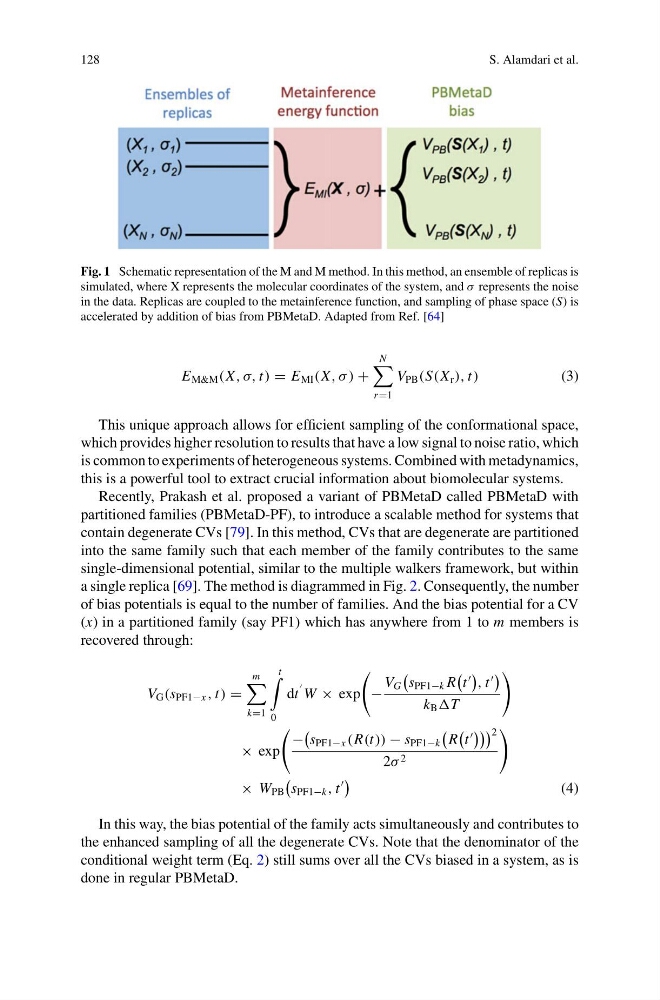
Fig. 1 Schematic representation of the M and M method. In this method, an ensemble of replicas is
simulated, where X represents the molecular coordinates of the system, and σ represents the noise
in the data. Replicas are coupled to the metainference function, and sampling of phase space (S) is
accelerated by addition of bias from PBMetaD. Adapted from Ref. [64]
E M&M (X, σ, t) = E MI (X, σ ) +
N
r =1
V PB (S(X r ), t)
(3)
This unique approach allows for efficient sampling of the conformational space,
which provides higher resolution to results that have a low signal to noise ratio, which
is common to experiments of heterogeneous systems. Combined with metadynamics,
this is a powerful tool to extract crucial information about biomolecular systems.
Recently, Prakash et al. proposed a variant of PBMetaD called PBMetaD with
partitioned families (PBMetaD-PF), to introduce a scalable method for systems that
contain degenerate CVs [79]. In this method, CVs that are degenerate are partitioned
into the same family such that each member of the family contributes to the same
single-dimensional potential, similar to the multiple walkers framework, but within
a single replica [69]. The method is diagrammed in Fig. 2. Consequently, the number
of bias potentials is equal to the number of families. And the bias potential for a CV
(x) in a partitioned family (say PF1) which has anywhere from 1 to m members is
recovered through:
V G (s PF1−x , t) =
m
k=1
t
0
dt
W × exp
−
V G
s PF1−k R
t
, t
k B T
× exp
−
s PF1−x (R(t)) − s PF1−k
R
t
2
2σ 2
× W PB
s PF1−k , t
(4)
In this way, the bias potential of the family acts simultaneously and contributes to
the enhanced sampling of all the degenerate CVs. Note that the denominator of the
conditional weight term (Eq. 2) still sums over all the CVs biased in a system, as is
done in regular PBMetaD.
S. Alamdari et al.
Fig. 1 Schematic representation of the M and M method. In this method, an ensemble of replicas is
simulated, where X represents the molecular coordinates of the system, and σ represents the noise
in the data. Replicas are coupled to the metainference function, and sampling of phase space (S) is
accelerated by addition of bias from PBMetaD. Adapted from Ref. [64]
E M&M (X, σ, t) = E MI (X, σ ) +
N
r =1
V PB (S(X r ), t)
(3)
This unique approach allows for efficient sampling of the conformational space,
which provides higher resolution to results that have a low signal to noise ratio, which
is common to experiments of heterogeneous systems. Combined with metadynamics,
this is a powerful tool to extract crucial information about biomolecular systems.
Recently, Prakash et al. proposed a variant of PBMetaD called PBMetaD with
partitioned families (PBMetaD-PF), to introduce a scalable method for systems that
contain degenerate CVs [79]. In this method, CVs that are degenerate are partitioned
into the same family such that each member of the family contributes to the same
single-dimensional potential, similar to the multiple walkers framework, but within
a single replica [69]. The method is diagrammed in Fig. 2. Consequently, the number
of bias potentials is equal to the number of families. And the bias potential for a CV
(x) in a partitioned family (say PF1) which has anywhere from 1 to m members is
recovered through:
V G (s PF1−x , t) =
m
k=1
t
0
dt
W × exp
−
V G
s PF1−k R
t
, t
k B T
× exp
−
s PF1−x (R(t)) − s PF1−k
R
t
2
2σ 2
× W PB
s PF1−k , t
(4)
In this way, the bias potential of the family acts simultaneously and contributes to
the enhanced sampling of all the degenerate CVs. Note that the denominator of the
conditional weight term (Eq. 2) still sums over all the CVs biased in a system, as is
done in regular PBMetaD.