

Efficient Sampling of High-Dimensional …
127
construction of multiple single-dimensional potentials in lieu of a multi-dimensional
potential, which saves computational resources, by utilizing a conditional weight
term. Thus, the bias potential for the ith CV(s i ), under the PBMetaD framework, is
constructed as following:
V G (s i , t) =
t
0
dt
W × exp
−
V G
s i R
t
, t
k B T
× exp
−
s i R(t) − s i R
t
2
2σ 2
× W PB
s i , t
(1)
W PB (s i , t) =
exp
−
V G (si R(t),t)
k B T
n
j=1 exp
−
V G (sj R(t),t)
k B T
(2)
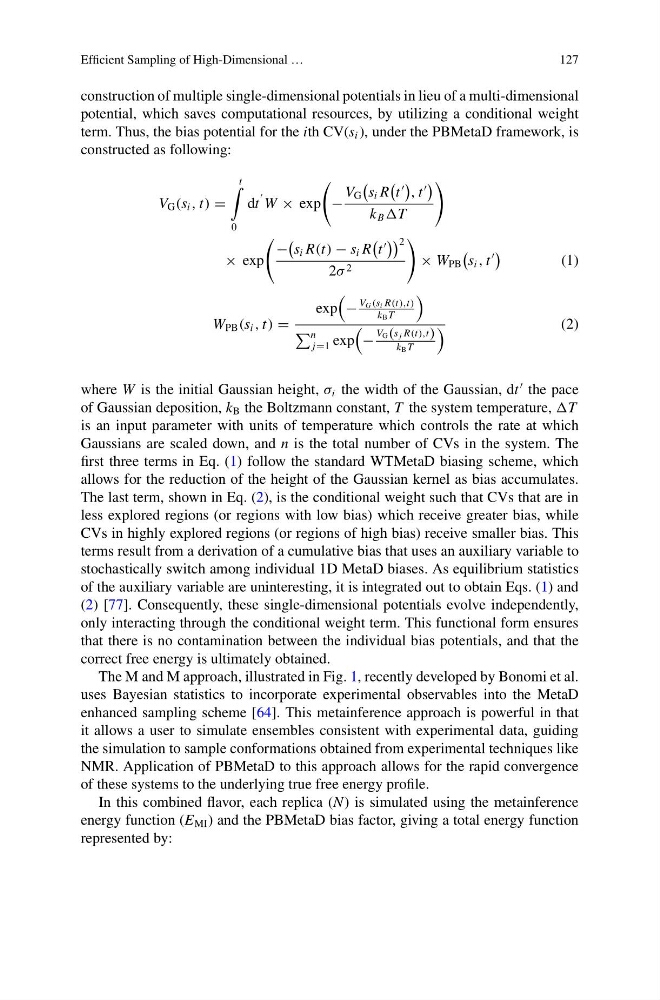
where W is the initial Gaussian height, σ i the width of the Gaussian, dt
the pace
of Gaussian deposition, k B the Boltzmann constant, T the system temperature, T
is an input parameter with units of temperature which controls the rate at which
Gaussians are scaled down, and n is the total number of CVs in the system. The
first three terms in Eq. (1) follow the standard WTMetaD biasing scheme, which
allows for the reduction of the height of the Gaussian kernel as bias accumulates.
The last term, shown in Eq. (2), is the conditional weight such that CVs that are in
less explored regions (or regions with low bias) which receive greater bias, while
CVs in highly explored regions (or regions of high bias) receive smaller bias. This
terms result from a derivation of a cumulative bias that uses an auxiliary variable to
stochastically switch among individual 1D MetaD biases. As equilibrium statistics
of the auxiliary variable are uninteresting, it is integrated out to obtain Eqs. (1) and
(2) [77]. Consequently, these single-dimensional potentials evolve independently,
only interacting through the conditional weight term. This functional form ensures
that there is no contamination between the individual bias potentials, and that the
correct free energy is ultimately obtained.
The M and M approach, illustrated in Fig. 1, recently developed by Bonomi et al.
uses Bayesian statistics to incorporate experimental observables into the MetaD
enhanced sampling scheme [64]. This metainference approach is powerful in that
it allows a user to simulate ensembles consistent with experimental data, guiding
the simulation to sample conformations obtained from experimental techniques like
NMR. Application of PBMetaD to this approach allows for the rapid convergence
of these systems to the underlying true free energy profile.
In this combined flavor, each replica (N) is simulated using the metainference
energy function (E MI ) and the PBMetaD bias factor, giving a total energy function
represented by:
127
construction of multiple single-dimensional potentials in lieu of a multi-dimensional
potential, which saves computational resources, by utilizing a conditional weight
term. Thus, the bias potential for the ith CV(s i ), under the PBMetaD framework, is
constructed as following:
V G (s i , t) =
t
0
dt
W × exp
−
V G
s i R
t
, t
k B T
× exp
−
s i R(t) − s i R
t
2
2σ 2
× W PB
s i , t
(1)
W PB (s i , t) =
exp
−
V G (si R(t),t)
k B T
n
j=1 exp
−
V G (sj R(t),t)
k B T
(2)
where W is the initial Gaussian height, σ i the width of the Gaussian, dt
the pace
of Gaussian deposition, k B the Boltzmann constant, T the system temperature, T
is an input parameter with units of temperature which controls the rate at which
Gaussians are scaled down, and n is the total number of CVs in the system. The
first three terms in Eq. (1) follow the standard WTMetaD biasing scheme, which
allows for the reduction of the height of the Gaussian kernel as bias accumulates.
The last term, shown in Eq. (2), is the conditional weight such that CVs that are in
less explored regions (or regions with low bias) which receive greater bias, while
CVs in highly explored regions (or regions of high bias) receive smaller bias. This
terms result from a derivation of a cumulative bias that uses an auxiliary variable to
stochastically switch among individual 1D MetaD biases. As equilibrium statistics
of the auxiliary variable are uninteresting, it is integrated out to obtain Eqs. (1) and
(2) [77]. Consequently, these single-dimensional potentials evolve independently,
only interacting through the conditional weight term. This functional form ensures
that there is no contamination between the individual bias potentials, and that the
correct free energy is ultimately obtained.
The M and M approach, illustrated in Fig. 1, recently developed by Bonomi et al.
uses Bayesian statistics to incorporate experimental observables into the MetaD
enhanced sampling scheme [64]. This metainference approach is powerful in that
it allows a user to simulate ensembles consistent with experimental data, guiding
the simulation to sample conformations obtained from experimental techniques like
NMR. Application of PBMetaD to this approach allows for the rapid convergence
of these systems to the underlying true free energy profile.
In this combined flavor, each replica (N) is simulated using the metainference
energy function (E MI ) and the PBMetaD bias factor, giving a total energy function
represented by: