

130
S. Alamdari et al.
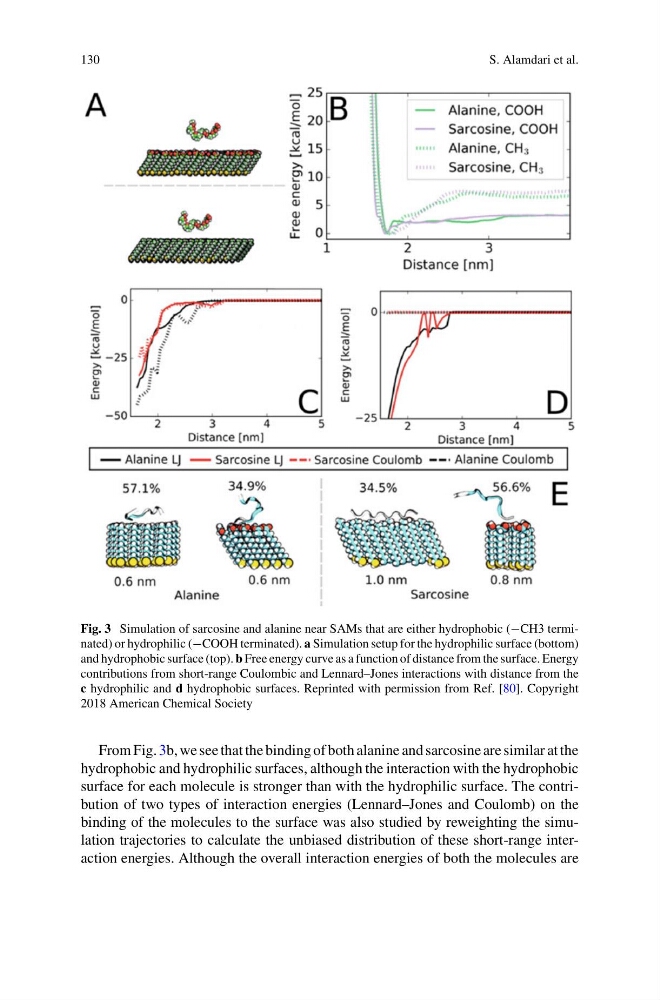
Fig. 3 Simulation of sarcosine and alanine near SAMs that are either hydrophobic (−CH3 terminated) or hydrophilic (−COOH terminated). a Simulation setup for the hydrophilic surface (bottom)
and hydrophobic surface (top). b Free energy curve as a function of distance from the surface. Energy
contributions from short-range Coulombic and Lennard–Jones interactions with distance from the
c hydrophilic and d hydrophobic surfaces. Reprinted with permission from Ref. [80]. Copyright
2018 American Chemical Society
From Fig. 3b, we see that the binding of both alanine and sarcosine are similar at the
hydrophobic and hydrophilic surfaces, although the interaction with the hydrophobic
surface for each molecule is stronger than with the hydrophilic surface. The contribution of two types of interaction energies (Lennard–Jones and Coulomb) on the
binding of the molecules to the surface was also studied by reweighting the simulation trajectories to calculate the unbiased distribution of these short-range interaction energies. Although the overall interaction energies of both the molecules are
S. Alamdari et al.
Fig. 3 Simulation of sarcosine and alanine near SAMs that are either hydrophobic (−CH3 terminated) or hydrophilic (−COOH terminated). a Simulation setup for the hydrophilic surface (bottom)
and hydrophobic surface (top). b Free energy curve as a function of distance from the surface. Energy
contributions from short-range Coulombic and Lennard–Jones interactions with distance from the
c hydrophilic and d hydrophobic surfaces. Reprinted with permission from Ref. [80]. Copyright
2018 American Chemical Society
From Fig. 3b, we see that the binding of both alanine and sarcosine are similar at the
hydrophobic and hydrophilic surfaces, although the interaction with the hydrophobic
surface for each molecule is stronger than with the hydrophilic surface. The contribution of two types of interaction energies (Lennard–Jones and Coulomb) on the
binding of the molecules to the surface was also studied by reweighting the simulation trajectories to calculate the unbiased distribution of these short-range interaction energies. Although the overall interaction energies of both the molecules are