

The Statistical Mechanics of Solution-Phase Nucleation …
111
on gas-to-particle nucleation, we found that larger clusters become less sensitive to
the details of the cluster definition [2]. It will be interesting to see if this extends to
nucleation processes in solution.
3.2 Construction of the Two-Component Solution Model
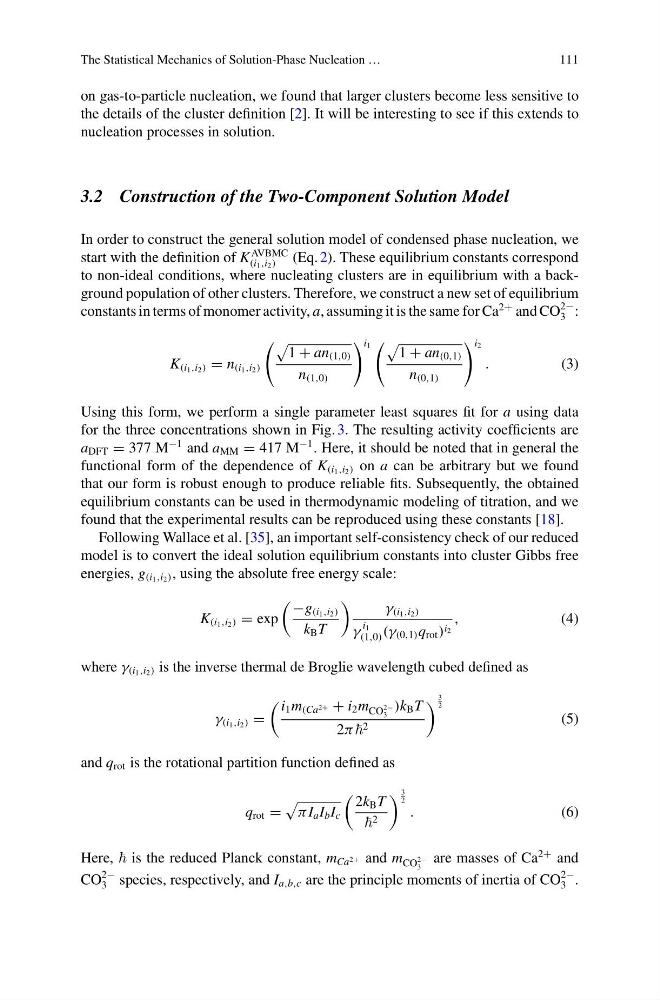
In order to construct the general solution model of condensed phase nucleation, we
start with the definition of K
AVBMC
(i 1 ,i 2 )
(Eq. 2). These equilibrium constants correspond
to non-ideal conditions, where nucleating clusters are in equilibrium with a background population of other clusters. Therefore, we construct a new set of equilibrium
constants in terms of monomer activity, a, assuming it is the same for Ca
2+ and CO
2−
3 :
K (i 1 ,i 2 ) = n (i 1 ,i 2 )
1 + an (1,0)
n (1,0)
i 1
1 + an (0,1)
n (0,1)
i 2
.
(3)
Using this form, we perform a single parameter least squares fit for a using data
for the three concentrations shown in Fig. 3. The resulting activity coefficients are
a DFT = 377 M
−1 and a MM = 417 M
−1 . Here, it should be noted that in general the
functional form of the dependence of K (i 1 ,i 2 ) on a can be arbitrary but we found
that our form is robust enough to produce reliable fits. Subsequently, the obtained
equilibrium constants can be used in thermodynamic modeling of titration, and we
found that the experimental results can be reproduced using these constants [18].
Following Wallace et al. [35], an important self-consistency check of our reduced
model is to convert the ideal solution equilibrium constants into cluster Gibbs free
energies, g (i 1 ,i 2 ) , using the absolute free energy scale:
K (i 1 ,i 2 ) = exp
−g (i 1 ,i 2 )
k B T
γ (i 1 ,i 2 )
γ
i 1
(1,0) (γ (0,1) q rot ) i 2
,
(4)
where γ (i 1 ,i 2 ) is the inverse thermal de Broglie wavelength cubed defined as
γ (i 1 ,i 2 ) =
i 1 m (Ca 2+ + i 2 m CO
2−
3
)k B T
2π 2
3
2
(5)
and q rot is the rotational partition function defined as
q rot =
π I a I b I c
2k B T
2
3
2 .
(6)
Here, is the reduced Planck constant, m Ca 2+ and m CO
2−
3
are masses of Ca
2+ and
CO
2−
3 species, respectively, and I a,b,c are the principle moments of inertia of CO
2−
3 .
111
on gas-to-particle nucleation, we found that larger clusters become less sensitive to
the details of the cluster definition [2]. It will be interesting to see if this extends to
nucleation processes in solution.
3.2 Construction of the Two-Component Solution Model
In order to construct the general solution model of condensed phase nucleation, we
start with the definition of K
AVBMC
(i 1 ,i 2 )
(Eq. 2). These equilibrium constants correspond
to non-ideal conditions, where nucleating clusters are in equilibrium with a background population of other clusters. Therefore, we construct a new set of equilibrium
constants in terms of monomer activity, a, assuming it is the same for Ca
2+ and CO
2−
3 :
K (i 1 ,i 2 ) = n (i 1 ,i 2 )
1 + an (1,0)
n (1,0)
i 1
1 + an (0,1)
n (0,1)
i 2
.
(3)
Using this form, we perform a single parameter least squares fit for a using data
for the three concentrations shown in Fig. 3. The resulting activity coefficients are
a DFT = 377 M
−1 and a MM = 417 M
−1 . Here, it should be noted that in general the
functional form of the dependence of K (i 1 ,i 2 ) on a can be arbitrary but we found
that our form is robust enough to produce reliable fits. Subsequently, the obtained
equilibrium constants can be used in thermodynamic modeling of titration, and we
found that the experimental results can be reproduced using these constants [18].
Following Wallace et al. [35], an important self-consistency check of our reduced
model is to convert the ideal solution equilibrium constants into cluster Gibbs free
energies, g (i 1 ,i 2 ) , using the absolute free energy scale:
K (i 1 ,i 2 ) = exp
−g (i 1 ,i 2 )
k B T
γ (i 1 ,i 2 )
γ
i 1
(1,0) (γ (0,1) q rot ) i 2
,
(4)
where γ (i 1 ,i 2 ) is the inverse thermal de Broglie wavelength cubed defined as
γ (i 1 ,i 2 ) =
i 1 m (Ca 2+ + i 2 m CO
2−
3
)k B T
2π 2
3
2
(5)
and q rot is the rotational partition function defined as
q rot =
π I a I b I c
2k B T
2
3
2 .
(6)
Here, is the reduced Planck constant, m Ca 2+ and m CO
2−
3
are masses of Ca
2+ and
CO
2−
3 species, respectively, and I a,b,c are the principle moments of inertia of CO
2−
3 .