

110
E. O. Fetisov et al.
-20
-19
-18
-17
-16
ΔA
(1,1)
[kcal/mol]
DNT
AVBMC
1
10
100
r cut [Å]
-55
-50
-45
-40
ΔA
(2,2)
[kcal/mol]
1
10
100
r cut [Å]
DFT+MM/CE
MM/CE
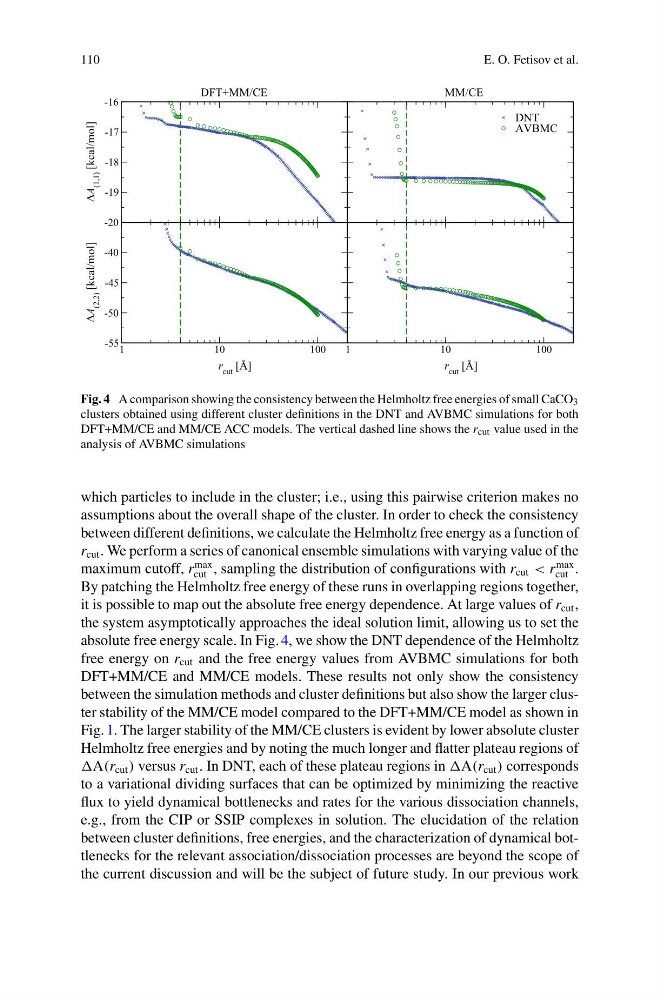
Fig. 4 A comparison showing the consistency between the Helmholtz free energies of small CaCO 3
clusters obtained using different cluster definitions in the DNT and AVBMC simulations for both
DFT+MM/CE and MM/CE ACC models. The vertical dashed line shows the r cut value used in the
analysis of AVBMC simulations
which particles to include in the cluster; i.e., using this pairwise criterion makes no
assumptions about the overall shape of the cluster. In order to check the consistency
between different definitions, we calculate the Helmholtz free energy as a function of
r cut . We perform a series of canonical ensemble simulations with varying value of the
maximum cutoff, r
max
cut , sampling the distribution of configurations with r cut < r
max
cut .
By patching the Helmholtz free energy of these runs in overlapping regions together,
it is possible to map out the absolute free energy dependence. At large values of r cut ,
the system asymptotically approaches the ideal solution limit, allowing us to set the
absolute free energy scale. In Fig. 4, we show the DNT dependence of the Helmholtz
free energy on r cut and the free energy values from AVBMC simulations for both
DFT+MM/CE and MM/CE models. These results not only show the consistency
between the simulation methods and cluster definitions but also show the larger cluster stability of the MM/CE model compared to the DFT+MM/CE model as shown in
Fig. 1. The larger stability of the MM/CE clusters is evident by lower absolute cluster
Helmholtz free energies and by noting the much longer and flatter plateau regions of
cut ) versus r cut . In DNT, each of these plateau regions in cut ) corresponds
to a variational dividing surfaces that can be optimized by minimizing the reactive
flux to yield dynamical bottlenecks and rates for the various dissociation channels,
e.g., from the CIP or SSIP complexes in solution. The elucidation of the relation
between cluster definitions, free energies, and the characterization of dynamical bottlenecks for the relevant association/dissociation processes are beyond the scope of
the current discussion and will be the subject of future study. In our previous work
E. O. Fetisov et al.
-20
-19
-18
-17
-16
ΔA
(1,1)
[kcal/mol]
DNT
AVBMC
1
10
100
r cut [Å]
-55
-50
-45
-40
ΔA
(2,2)
[kcal/mol]
1
10
100
r cut [Å]
DFT+MM/CE
MM/CE
Fig. 4 A comparison showing the consistency between the Helmholtz free energies of small CaCO 3
clusters obtained using different cluster definitions in the DNT and AVBMC simulations for both
DFT+MM/CE and MM/CE ACC models. The vertical dashed line shows the r cut value used in the
analysis of AVBMC simulations
which particles to include in the cluster; i.e., using this pairwise criterion makes no
assumptions about the overall shape of the cluster. In order to check the consistency
between different definitions, we calculate the Helmholtz free energy as a function of
r cut . We perform a series of canonical ensemble simulations with varying value of the
maximum cutoff, r
max
cut , sampling the distribution of configurations with r cut < r
max
cut .
By patching the Helmholtz free energy of these runs in overlapping regions together,
it is possible to map out the absolute free energy dependence. At large values of r cut ,
the system asymptotically approaches the ideal solution limit, allowing us to set the
absolute free energy scale. In Fig. 4, we show the DNT dependence of the Helmholtz
free energy on r cut and the free energy values from AVBMC simulations for both
DFT+MM/CE and MM/CE models. These results not only show the consistency
between the simulation methods and cluster definitions but also show the larger cluster stability of the MM/CE model compared to the DFT+MM/CE model as shown in
Fig. 1. The larger stability of the MM/CE clusters is evident by lower absolute cluster
Helmholtz free energies and by noting the much longer and flatter plateau regions of
cut ) versus r cut . In DNT, each of these plateau regions in cut ) corresponds
to a variational dividing surfaces that can be optimized by minimizing the reactive
flux to yield dynamical bottlenecks and rates for the various dissociation channels,
e.g., from the CIP or SSIP complexes in solution. The elucidation of the relation
between cluster definitions, free energies, and the characterization of dynamical bottlenecks for the relevant association/dissociation processes are beyond the scope of
the current discussion and will be the subject of future study. In our previous work