

The Statistical Mechanics of Solution-Phase Nucleation …
109
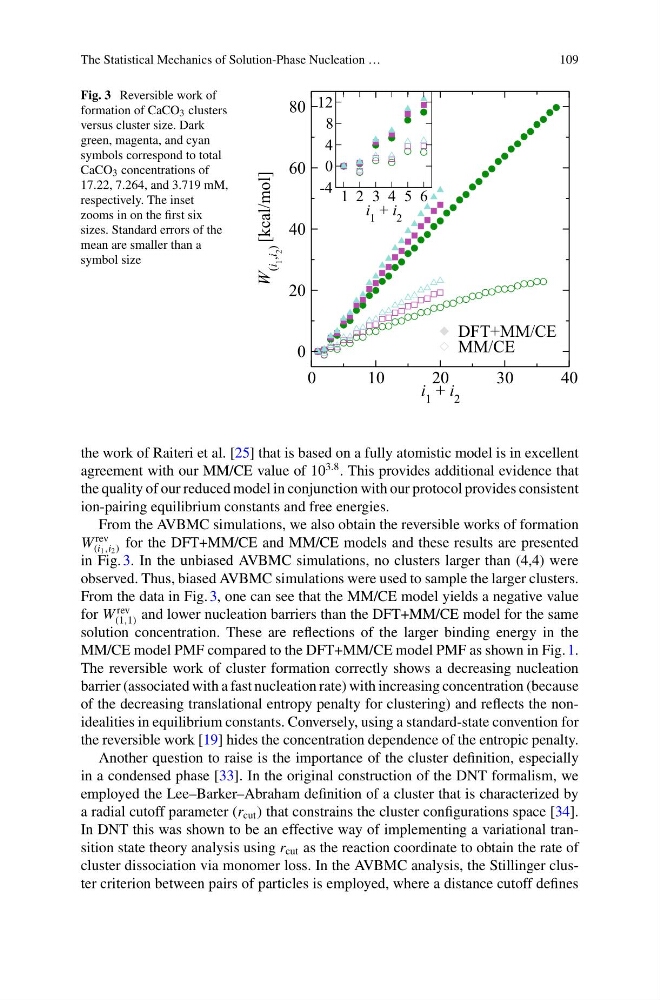
Fig. 3 Reversible work of
formation of CaCO 3 clusters
versus cluster size. Dark
green, magenta, and cyan
symbols correspond to total
CaCO 3 concentrations of
17.22, 7.264, and 3.719 mM,
respectively. The inset
zooms in on the first six
sizes. Standard errors of the
mean are smaller than a
symbol size
0
10
20
30
40
i 1 + i 2
0
20
40
60
80
W
(i
1
,i
2
)
[kcal/mol]
DFT+MM/CE
MM/CE
1 2 3 4 5 6
i 1 + i 2
-4
0
4
8
12
the work of Raiteri et al. [25] that is based on a fully atomistic model is in excellent
agreement with our MM/CE value of 10
3.8 . This provides additional evidence that
the quality of our reduced model in conjunction with our protocol provides consistent
ion-pairing equilibrium constants and free energies.
From the AVBMC simulations, we also obtain the reversible works of formation
W
rev
(i 1 ,i 2 ) for the DFT+MM/CE and MM/CE models and these results are presented
in Fig. 3. In the unbiased AVBMC simulations, no clusters larger than (4,4) were
observed. Thus, biased AVBMC simulations were used to sample the larger clusters.
From the data in Fig. 3, one can see that the MM/CE model yields a negative value
for W
rev
(1,1) and lower nucleation barriers than the DFT+MM/CE model for the same
solution concentration. These are reflections of the larger binding energy in the
MM/CE model PMF compared to the DFT+MM/CE model PMF as shown in Fig. 1.
The reversible work of cluster formation correctly shows a decreasing nucleation
barrier (associated with a fast nucleation rate) with increasing concentration (because
of the decreasing translational entropy penalty for clustering) and reflects the nonidealities in equilibrium constants. Conversely, using a standard-state convention for
the reversible work [19] hides the concentration dependence of the entropic penalty.
Another question to raise is the importance of the cluster definition, especially
in a condensed phase [33]. In the original construction of the DNT formalism, we
employed the Lee–Barker–Abraham definition of a cluster that is characterized by
a radial cutoff parameter (r cut ) that constrains the cluster configurations space [34].
In DNT this was shown to be an effective way of implementing a variational transition state theory analysis using r cut as the reaction coordinate to obtain the rate of
cluster dissociation via monomer loss. In the AVBMC analysis, the Stillinger cluster criterion between pairs of particles is employed, where a distance cutoff defines
109
Fig. 3 Reversible work of
formation of CaCO 3 clusters
versus cluster size. Dark
green, magenta, and cyan
symbols correspond to total
CaCO 3 concentrations of
17.22, 7.264, and 3.719 mM,
respectively. The inset
zooms in on the first six
sizes. Standard errors of the
mean are smaller than a
symbol size
0
10
20
30
40
i 1 + i 2
0
20
40
60
80
W
(i
1
,i
2
)
[kcal/mol]
DFT+MM/CE
MM/CE
1 2 3 4 5 6
i 1 + i 2
-4
0
4
8
12
the work of Raiteri et al. [25] that is based on a fully atomistic model is in excellent
agreement with our MM/CE value of 10
3.8 . This provides additional evidence that
the quality of our reduced model in conjunction with our protocol provides consistent
ion-pairing equilibrium constants and free energies.
From the AVBMC simulations, we also obtain the reversible works of formation
W
rev
(i 1 ,i 2 ) for the DFT+MM/CE and MM/CE models and these results are presented
in Fig. 3. In the unbiased AVBMC simulations, no clusters larger than (4,4) were
observed. Thus, biased AVBMC simulations were used to sample the larger clusters.
From the data in Fig. 3, one can see that the MM/CE model yields a negative value
for W
rev
(1,1) and lower nucleation barriers than the DFT+MM/CE model for the same
solution concentration. These are reflections of the larger binding energy in the
MM/CE model PMF compared to the DFT+MM/CE model PMF as shown in Fig. 1.
The reversible work of cluster formation correctly shows a decreasing nucleation
barrier (associated with a fast nucleation rate) with increasing concentration (because
of the decreasing translational entropy penalty for clustering) and reflects the nonidealities in equilibrium constants. Conversely, using a standard-state convention for
the reversible work [19] hides the concentration dependence of the entropic penalty.
Another question to raise is the importance of the cluster definition, especially
in a condensed phase [33]. In the original construction of the DNT formalism, we
employed the Lee–Barker–Abraham definition of a cluster that is characterized by
a radial cutoff parameter (r cut ) that constrains the cluster configurations space [34].
In DNT this was shown to be an effective way of implementing a variational transition state theory analysis using r cut as the reaction coordinate to obtain the rate of
cluster dissociation via monomer loss. In the AVBMC analysis, the Stillinger cluster criterion between pairs of particles is employed, where a distance cutoff defines