

108
E. O. Fetisov et al.
10
-5
10
-4
10
-3
10
-2
10
-1
n total [M]
10
-12
10
-10
10
-8
10
-6
10
-4
10
-2
n
(i
1 ,i
2 )
[M]
n (1,0)
n (1,1)
n (2,1)
n (2,2)
10
-5
10
-4
10
-3
10
-2
10
-1
n monomer [M]
10
0
10
2
10
4
10
6
10
8
10
10
10
12
K
(i
1
,i
2
)
K (1,1)
K (2,1)
K (2,2)
K (3,2)
K (3,3)
(a)
(b)
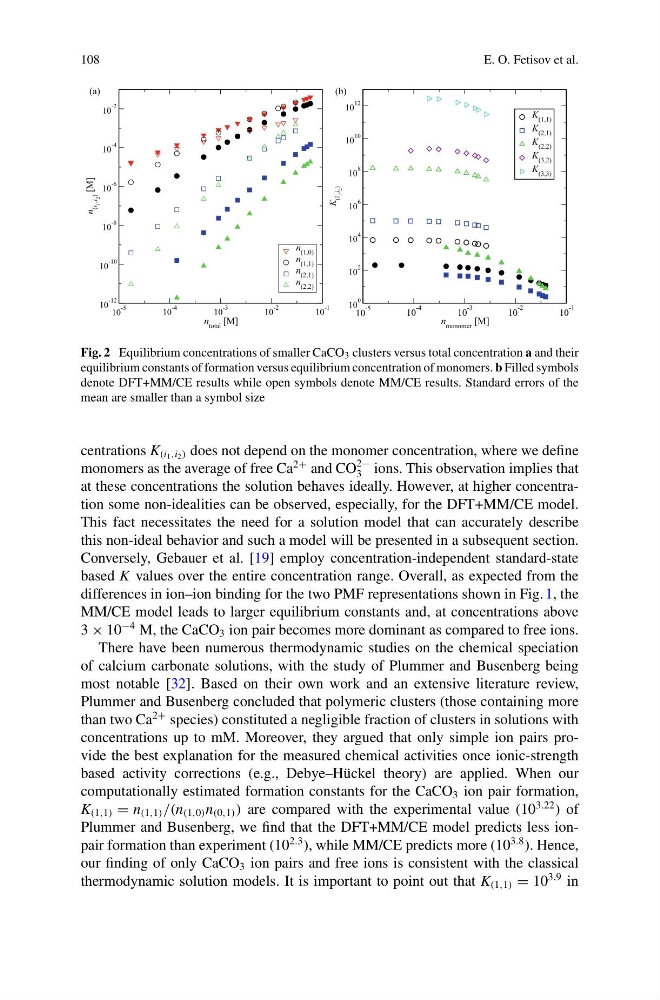
Fig. 2 Equilibrium concentrations of smaller CaCO 3 clusters versus total concentration a and their
equilibrium constants of formation versus equilibrium concentration of monomers. b Filled symbols
denote DFT+MM/CE results while open symbols denote MM/CE results. Standard errors of the
mean are smaller than a symbol size
centrations K (i 1 ,i 2 ) does not depend on the monomer concentration, where we define
monomers as the average of free Ca
2+ and CO
2−
3 ions. This observation implies that
at these concentrations the solution behaves ideally. However, at higher concentration some non-idealities can be observed, especially, for the DFT+MM/CE model.
This fact necessitates the need for a solution model that can accurately describe
this non-ideal behavior and such a model will be presented in a subsequent section.
Conversely, Gebauer et al. [19] employ concentration-independent standard-state
based K values over the entire concentration range. Overall, as expected from the
differences in ion–ion binding for the two PMF representations shown in Fig. 1, the
MM/CE model leads to larger equilibrium constants and, at concentrations above
3 × 10
−4 M, the CaCO 3 ion pair becomes more dominant as compared to free ions.
There have been numerous thermodynamic studies on the chemical speciation
of calcium carbonate solutions, with the study of Plummer and Busenberg being
most notable [32]. Based on their own work and an extensive literature review,
Plummer and Busenberg concluded that polymeric clusters (those containing more
than two Ca
2+ species) constituted a negligible fraction of clusters in solutions with
concentrations up to mM. Moreover, they argued that only simple ion pairs provide the best explanation for the measured chemical activities once ionic-strength
based activity corrections (e.g., Debye–Hückel theory) are applied. When our
computationally estimated formation constants for the CaCO 3 ion pair formation,
K (1,1) = n (1,1) /(n (1,0) n (0,1) ) are compared with the experimental value (10
3.22 ) of
Plummer and Busenberg, we find that the DFT+MM/CE model predicts less ionpair formation than experiment (10
2.3 ), while MM/CE predicts more (10
3.8 ). Hence,
our finding of only CaCO 3 ion pairs and free ions is consistent with the classical
thermodynamic solution models. It is important to point out that K (1,1) = 10
3.9 in
E. O. Fetisov et al.
10
-5
10
-4
10
-3
10
-2
10
-1
n total [M]
10
-12
10
-10
10
-8
10
-6
10
-4
10
-2
n
(i
1 ,i
2 )
[M]
n (1,0)
n (1,1)
n (2,1)
n (2,2)
10
-5
10
-4
10
-3
10
-2
10
-1
n monomer [M]
10
0
10
2
10
4
10
6
10
8
10
10
10
12
K
(i
1
,i
2
)
K (1,1)
K (2,1)
K (2,2)
K (3,2)
K (3,3)
(a)
(b)
Fig. 2 Equilibrium concentrations of smaller CaCO 3 clusters versus total concentration a and their
equilibrium constants of formation versus equilibrium concentration of monomers. b Filled symbols
denote DFT+MM/CE results while open symbols denote MM/CE results. Standard errors of the
mean are smaller than a symbol size
centrations K (i 1 ,i 2 ) does not depend on the monomer concentration, where we define
monomers as the average of free Ca
2+ and CO
2−
3 ions. This observation implies that
at these concentrations the solution behaves ideally. However, at higher concentration some non-idealities can be observed, especially, for the DFT+MM/CE model.
This fact necessitates the need for a solution model that can accurately describe
this non-ideal behavior and such a model will be presented in a subsequent section.
Conversely, Gebauer et al. [19] employ concentration-independent standard-state
based K values over the entire concentration range. Overall, as expected from the
differences in ion–ion binding for the two PMF representations shown in Fig. 1, the
MM/CE model leads to larger equilibrium constants and, at concentrations above
3 × 10
−4 M, the CaCO 3 ion pair becomes more dominant as compared to free ions.
There have been numerous thermodynamic studies on the chemical speciation
of calcium carbonate solutions, with the study of Plummer and Busenberg being
most notable [32]. Based on their own work and an extensive literature review,
Plummer and Busenberg concluded that polymeric clusters (those containing more
than two Ca
2+ species) constituted a negligible fraction of clusters in solutions with
concentrations up to mM. Moreover, they argued that only simple ion pairs provide the best explanation for the measured chemical activities once ionic-strength
based activity corrections (e.g., Debye–Hückel theory) are applied. When our
computationally estimated formation constants for the CaCO 3 ion pair formation,
K (1,1) = n (1,1) /(n (1,0) n (0,1) ) are compared with the experimental value (10
3.22 ) of
Plummer and Busenberg, we find that the DFT+MM/CE model predicts less ionpair formation than experiment (10
2.3 ), while MM/CE predicts more (10
3.8 ). Hence,
our finding of only CaCO 3 ion pairs and free ions is consistent with the classical
thermodynamic solution models. It is important to point out that K (1,1) = 10
3.9 in