

66
Chapter 4 · There is More to Oleochemistry - Reactions at the Fatty Acid Alkyl Chain
4
tle cultivated in Sardinia. In a first reactor, the
corresponding methyl esters are converted with
hydrogen peroxide to diol (see . Fig. 4.5) using
tungstic acid. The process is carried out continuously so that the mixture already contains
a high proportion of diol. In the second step,
the diol is split using cobalt acetate and oxygen
(see . Fig. 4.5). This process step is also carried
out continuously so that the mixture is enriched
with cleaved products. Both catalysts are recovered only after the second reaction step. A
phase separation takes place, and the aqueous
phase is first passed over a cation exchanger,
whereby the cobalt ions are retained and the
tungstic acid is returned to the first reaction
step. The cobalt ions are then desorbed and
returned to the second reaction step.
4.2.2 Linkage of New C–C Bonds
Over the past decade, numerous reactions have
been developed for C–C bond formation with
unsaturated oleochemicals which have led to
completely new fat derivatives. In particular,
the use of homogeneous transition metal catalysts has opened up interesting possibilities.
. Figure 4.7 provides an initial rough overview:
A monounsaturated oleochemical RX (with
X=COOH, COOR, CH 2 OH, et al.) can, for
example, be hydroformylated, hydroxycarbonylated, alkoxycarbonylated or hydroaminomethylated at the C=C double bond. In all cases,
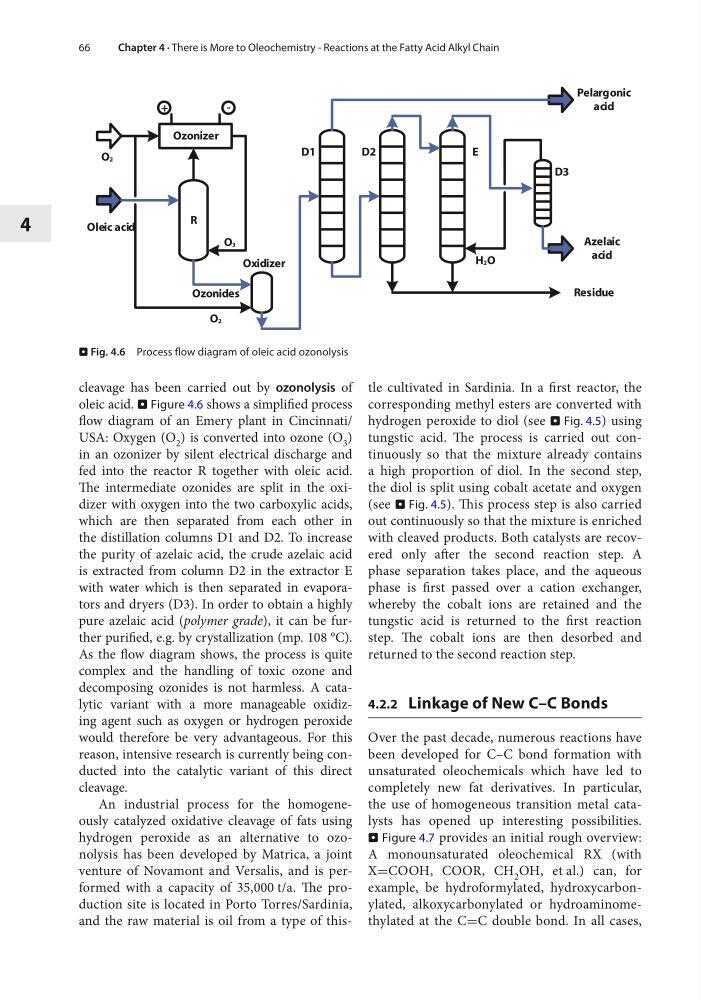
cleavage has been carried out by ozonolysis of
oleic acid. . Figure 4.6 shows a simplified process
flow diagram of an Emery plant in Cincinnati/
USA: Oxygen (O 2 ) is converted into ozone (O 3 )
in an ozonizer by silent electrical discharge and
fed into the reactor R together with oleic acid.
The intermediate ozonides are split in the oxidizer with oxygen into the two carboxylic acids,
which are then separated from each other in
the distillation columns D1 and D2. To increase
the purity of azelaic acid, the crude azelaic acid
is extracted from column D2 in the extractor E
with water which is then separated in evaporators and dryers (D3). In order to obtain a highly
pure azelaic acid (polymer grade), it can be further purified, e.g. by crystallization (mp. 108 °C).
As the flow diagram shows, the process is quite
complex and the handling of toxic ozone and
decomposing ozonides is not harmless. A catalytic variant with a more manageable oxidizing agent such as oxygen or hydrogen peroxide
would therefore be very advantageous. For this
reason, intensive research is currently being conducted into the catalytic variant of this direct
cleavage.
An industrial process for the homogeneously catalyzed oxidative cleavage of fats using
hydrogen peroxide as an alternative to ozonolysis has been developed by Matrica, a joint
venture of Novamont and Versalis, and is performed with a capacity of 35,000 t/a. The production site is located in Porto Torres/Sardinia,
and the raw material is oil from a type of thisOzonizer
+
-
R
O3
Ozonides
Oxidizer
O2
Oleic acid
O2
Azelaic
acid
Pelargonic
acid
Residue
H2O
E
D1
D2
D3
. Fig. 4.6 Process flow diagram of oleic acid ozonolysis
Chapter 4 · There is More to Oleochemistry - Reactions at the Fatty Acid Alkyl Chain
4
tle cultivated in Sardinia. In a first reactor, the
corresponding methyl esters are converted with
hydrogen peroxide to diol (see . Fig. 4.5) using
tungstic acid. The process is carried out continuously so that the mixture already contains
a high proportion of diol. In the second step,
the diol is split using cobalt acetate and oxygen
(see . Fig. 4.5). This process step is also carried
out continuously so that the mixture is enriched
with cleaved products. Both catalysts are recovered only after the second reaction step. A
phase separation takes place, and the aqueous
phase is first passed over a cation exchanger,
whereby the cobalt ions are retained and the
tungstic acid is returned to the first reaction
step. The cobalt ions are then desorbed and
returned to the second reaction step.
4.2.2 Linkage of New C–C Bonds
Over the past decade, numerous reactions have
been developed for C–C bond formation with
unsaturated oleochemicals which have led to
completely new fat derivatives. In particular,
the use of homogeneous transition metal catalysts has opened up interesting possibilities.
. Figure 4.7 provides an initial rough overview:
A monounsaturated oleochemical RX (with
X=COOH, COOR, CH 2 OH, et al.) can, for
example, be hydroformylated, hydroxycarbonylated, alkoxycarbonylated or hydroaminomethylated at the C=C double bond. In all cases,
cleavage has been carried out by ozonolysis of
oleic acid. . Figure 4.6 shows a simplified process
flow diagram of an Emery plant in Cincinnati/
USA: Oxygen (O 2 ) is converted into ozone (O 3 )
in an ozonizer by silent electrical discharge and
fed into the reactor R together with oleic acid.
The intermediate ozonides are split in the oxidizer with oxygen into the two carboxylic acids,
which are then separated from each other in
the distillation columns D1 and D2. To increase
the purity of azelaic acid, the crude azelaic acid
is extracted from column D2 in the extractor E
with water which is then separated in evaporators and dryers (D3). In order to obtain a highly
pure azelaic acid (polymer grade), it can be further purified, e.g. by crystallization (mp. 108 °C).
As the flow diagram shows, the process is quite
complex and the handling of toxic ozone and
decomposing ozonides is not harmless. A catalytic variant with a more manageable oxidizing agent such as oxygen or hydrogen peroxide
would therefore be very advantageous. For this
reason, intensive research is currently being conducted into the catalytic variant of this direct
cleavage.
An industrial process for the homogeneously catalyzed oxidative cleavage of fats using
hydrogen peroxide as an alternative to ozonolysis has been developed by Matrica, a joint
venture of Novamont and Versalis, and is performed with a capacity of 35,000 t/a. The production site is located in Porto Torres/Sardinia,
and the raw material is oil from a type of thisOzonizer
+
-
R
O3
Ozonides
Oxidizer
O2
Oleic acid
O2
Azelaic
acid
Pelargonic
acid
Residue
H2O
E
D1
D2
D3
. Fig. 4.6 Process flow diagram of oleic acid ozonolysis