

65
4
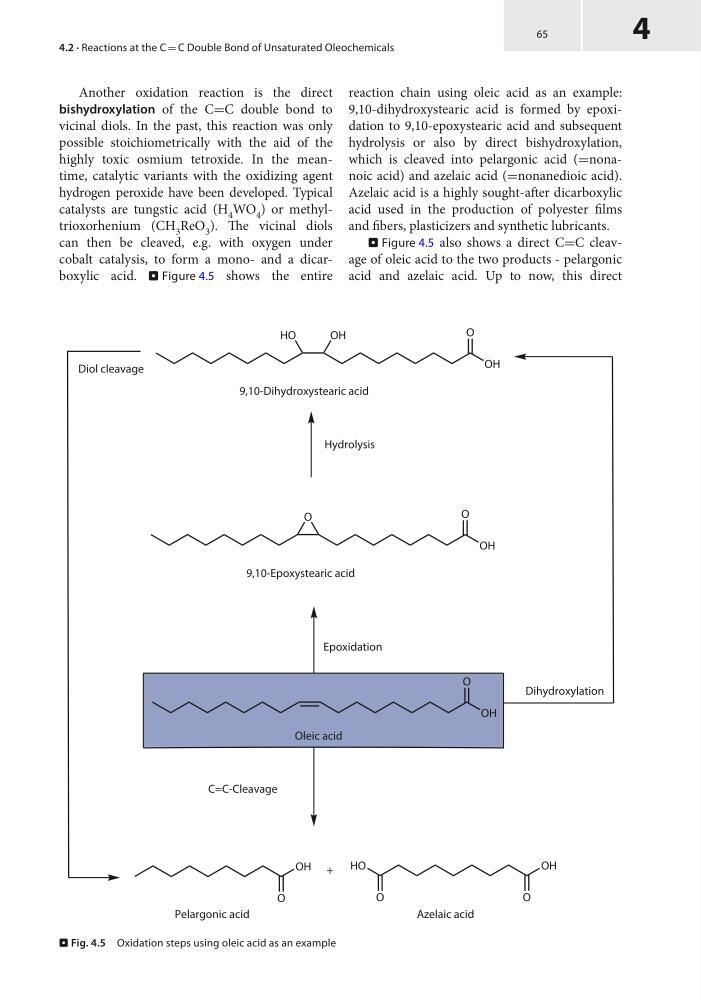
reaction chain using oleic acid as an example:
9,10-dihydroxystearic acid is formed by epoxidation to 9,10-epoxystearic acid and subsequent
hydrolysis or also by direct bishydroxylation,
which is cleaved into pelargonic acid (=nonanoic acid) and azelaic acid (=nonanedioic acid).
Azelaic acid is a highly sought-after dicarboxylic
acid used in the production of polyester films
and fibers, plasticizers and synthetic lubricants.
. Figure 4.5 also shows a direct C=C cleavage of oleic acid to the two products - pelargonic
acid and azelaic acid. Up to now, this direct
Another oxidation reaction is the direct
bishydroxylation of the C=C double bond to
vicinal diols. In the past, this reaction was only
possible stoichiometrically with the aid of the
highly toxic osmium tetroxide. In the meantime, catalytic variants with the oxidizing agent
hydrogen peroxide have been developed. Typical
catalysts are tungstic acid (H 4 WO 4 ) or methyltrioxorhenium (CH 3 ReO 3 ). The vicinal diols
can then be cleaved, e.g. with oxygen under
cobalt catalysis, to form a mono- and a dicarboxylic acid. . Figure 4.5 shows the entire
OH
O
OH
O
Epoxidation
O
9,10-Epoxystearic acid
Hydrolysis
OH
O
OH
HO
9,10-Dihydroxystearic acid
Diol cleavage
OH
O
OH
O
HO
O
+
Oleic acid
d
i
c
a
c
i
a
l
e
z
A
d
i
c
a
c
i
n
o
g
r
a
l
e
P
Dihydroxylation
C=C-Cleavage
. Fig. 4.5 Oxidation steps using oleic acid as an example
4.2 · Reactions at the C = C Double Bond of Unsaturated Oleochemicals
4
reaction chain using oleic acid as an example:
9,10-dihydroxystearic acid is formed by epoxidation to 9,10-epoxystearic acid and subsequent
hydrolysis or also by direct bishydroxylation,
which is cleaved into pelargonic acid (=nonanoic acid) and azelaic acid (=nonanedioic acid).
Azelaic acid is a highly sought-after dicarboxylic
acid used in the production of polyester films
and fibers, plasticizers and synthetic lubricants.
. Figure 4.5 also shows a direct C=C cleavage of oleic acid to the two products - pelargonic
acid and azelaic acid. Up to now, this direct
Another oxidation reaction is the direct
bishydroxylation of the C=C double bond to
vicinal diols. In the past, this reaction was only
possible stoichiometrically with the aid of the
highly toxic osmium tetroxide. In the meantime, catalytic variants with the oxidizing agent
hydrogen peroxide have been developed. Typical
catalysts are tungstic acid (H 4 WO 4 ) or methyltrioxorhenium (CH 3 ReO 3 ). The vicinal diols
can then be cleaved, e.g. with oxygen under
cobalt catalysis, to form a mono- and a dicarboxylic acid. . Figure 4.5 shows the entire
OH
O
OH
O
Epoxidation
O
9,10-Epoxystearic acid
Hydrolysis
OH
O
OH
HO
9,10-Dihydroxystearic acid
Diol cleavage
OH
O
OH
O
HO
O
+
Oleic acid
d
i
c
a
c
i
a
l
e
z
A
d
i
c
a
c
i
n
o
g
r
a
l
e
P
Dihydroxylation
C=C-Cleavage
. Fig. 4.5 Oxidation steps using oleic acid as an example
4.2 · Reactions at the C = C Double Bond of Unsaturated Oleochemicals