

346
Chapter 20 · Refined Raw Materials! – Biorefineries
20
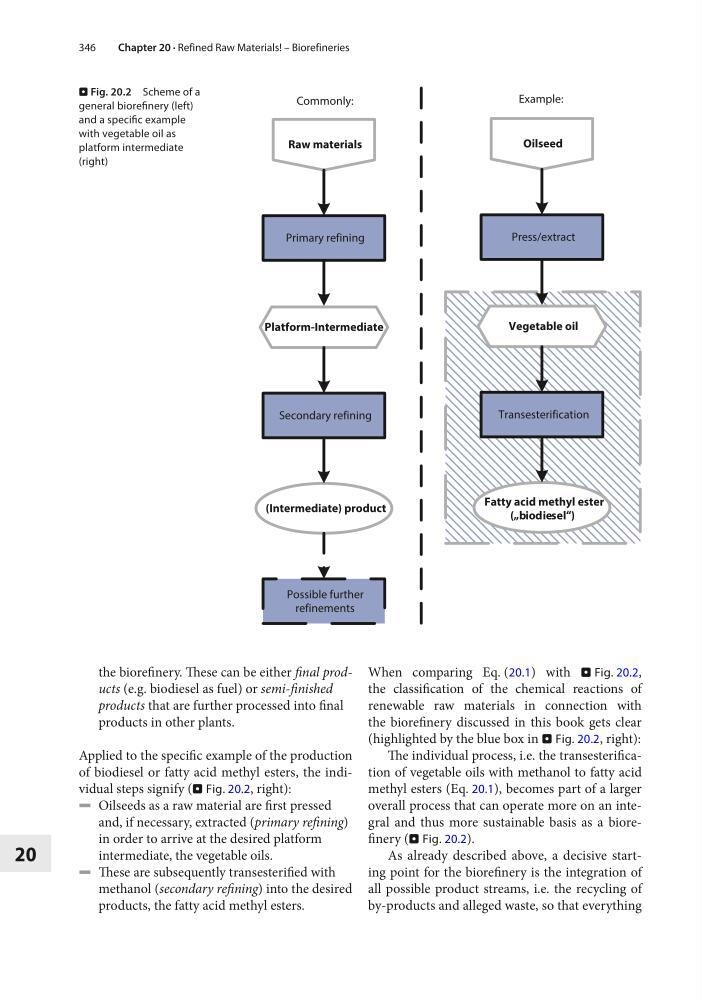
When comparing Eq. (20.1) with . Fig. 20.2,
the classification of the chemical reactions of
renewable raw materials in connection with
the biorefinery discussed in this book gets clear
(highlighted by the blue box in . Fig. 20.2, right):
The individual process, i.e. the transesterification of vegetable oils with methanol to fatty acid
methyl esters (Eq. 20.1), becomes part of a larger
overall process that can operate more on an integral and thus more sustainable basis as a biorefinery (. Fig. 20.2).
As already described above, a decisive starting point for the biorefinery is the integration of
all possible product streams, i.e. the recycling of
by-products and alleged waste, so that everything
the biorefinery. These can be either final products (e.g. biodiesel as fuel) or semi-finished
products that are further processed into final
products in other plants.
Applied to the specific example of the production
of biodiesel or fatty acid methyl esters, the individual steps signify (. Fig. 20.2, right):
5 Oilseeds as a raw material are first pressed
and, if necessary, extracted (primary refining)
in order to arrive at the desired platform
intermediate, the vegetable oils.
5 These are subsequently transesterified with
methanol (secondary refining) into the desired
products, the fatty acid methyl esters.
. Fig. 20.2 Scheme of a
general biorefinery (left)
and a specific example
with vegetable oil as
platform intermediate
(right)
Raw materials
Primary refining
Platform-Intermediate
Secondary refining
(Intermediate) product
Possible further
refinements
Commonly:
Oilseed
Press/extract
Vegetable oil
Transesterification
Example:
Fatty acid methyl ester
( biodiesel“)
”
Chapter 20 · Refined Raw Materials! – Biorefineries
20
When comparing Eq. (20.1) with . Fig. 20.2,
the classification of the chemical reactions of
renewable raw materials in connection with
the biorefinery discussed in this book gets clear
(highlighted by the blue box in . Fig. 20.2, right):
The individual process, i.e. the transesterification of vegetable oils with methanol to fatty acid
methyl esters (Eq. 20.1), becomes part of a larger
overall process that can operate more on an integral and thus more sustainable basis as a biorefinery (. Fig. 20.2).
As already described above, a decisive starting point for the biorefinery is the integration of
all possible product streams, i.e. the recycling of
by-products and alleged waste, so that everything
the biorefinery. These can be either final products (e.g. biodiesel as fuel) or semi-finished
products that are further processed into final
products in other plants.
Applied to the specific example of the production
of biodiesel or fatty acid methyl esters, the individual steps signify (. Fig. 20.2, right):
5 Oilseeds as a raw material are first pressed
and, if necessary, extracted (primary refining)
in order to arrive at the desired platform
intermediate, the vegetable oils.
5 These are subsequently transesterified with
methanol (secondary refining) into the desired
products, the fatty acid methyl esters.
. Fig. 20.2 Scheme of a
general biorefinery (left)
and a specific example
with vegetable oil as
platform intermediate
(right)
Raw materials
Primary refining
Platform-Intermediate
Secondary refining
(Intermediate) product
Possible further
refinements
Commonly:
Oilseed
Press/extract
Vegetable oil
Transesterification
Example:
Fatty acid methyl ester
( biodiesel“)
”