

345
20
It is often proposed to classify biorefineries
based on platform intermediates, which link the
actual raw materials on the way to the products
to be manufactured. In the above example, these
are vegetable oils. The number of possible platform intermediates is clearly limited in comparison to all possible raw materials or plants and the
further process steps, which makes this classification appropriate. The most frequently discussed
biorefineries - classified according to the corresponding platform intermediates - are:
5 Vegetable oil biorefinery,
5 Sugar or starch biorefinery,
5 Synthesis gas biorefinery,
5 Biogas biorefinery,
5 Lignocellulose or green biorefinery.
In all these biorefineries, the process chain can
be composed of three basic material building
blocks. These are categorized in a scheme with
different boxes and in principle follow a logical
hierarchy. Thus, a general biorefinery consists of
(. Fig. 20.2, left):
5 Raw materials,
5 Platform intermediates,
5 (Intermediate) products.
The processes play a crucial role within the process chain of a biorefinery because they are the
connecting elements between two basic material building blocks. They thus convert one basic
material building block into another. A distinction is made as follows:
5 In primary refining, the raw materials are used
to form platform intermediates. These processes
are primarily crushing, sorting and separating
processes. This includes, for example, the separation of the raw material into the corresponding
biomass components (intermediates) including
any pretreatment and conditioning steps.
5 Secondary refining refers to the conversion of platform intermediates into a larger
number of precursors and intermediates.
These conversion and refining steps can be
chemically, thermally or biotechnologically.
Industrial biotechnology, i.e. the targeted
production of products using biotechnological processes, is considered to be of particular
importance concerning biorefineries. It is also
referred to as white biotechnology.
5 These two steps may be followed by further
process steps until the desired products leave
20.2 Classification of Biorefineries
In addition to a uniform definition of biorefineries, there is now also a uniform classification that
takes different concepts into account and allows
existing and new biorefineries to be classified.
In addition, some plants based on biomass (i.e.
renewable raw materials) are excluded from the
context of biorefineries. This applies to many of
the processes described in this book for the conversion of renewable raw materials!
In the development of biorefineries, three different concepts can be distinguished:
5 Phase-I-biorefinery: Only one raw material;
one process; one main product,
5 Phase-II-biorefinery: Only one raw material; but
diverse processes and diverse main products,
5 Phase-III-biorefinery: Diverse raw material
base; diverse processes; diverse main products.
Phase-I-biorefineries are no longer regarded as
biorefineries in the narrower sense because they
are not sufficiently dedicated to the concept of sustainability and the integration of all product flows.
Phase-I-biorefineries have been known for a long
time, and many of these plants have been discussed
in this book: In principle, all industrial plants that
produce a valuable product from a renewable raw
material by means of (chemical) conversion can
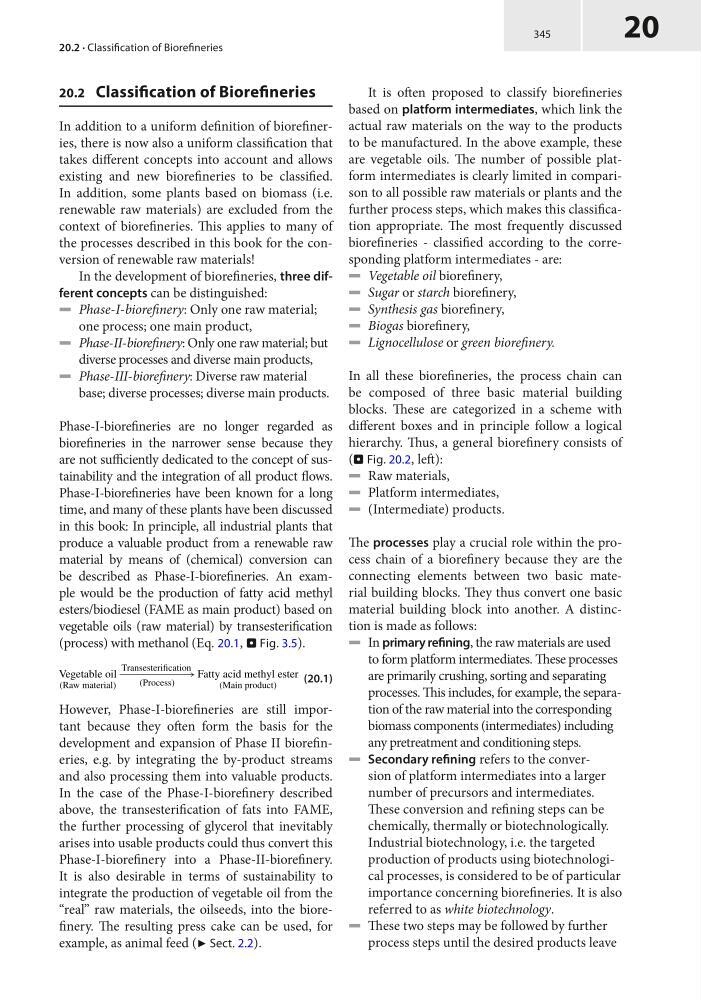
be described as Phase-I-biorefineries. An example would be the production of fatty acid methyl
esters/biodiesel (FAME as main product) based on
vegetable oils (raw material) by transesterification
(process) with methanol (Eq. 20.1, . Fig. 3.5).
However, Phase-I-biorefineries are still important because they often form the basis for the
development and expansion of Phase II biorefineries, e.g. by integrating the by-product streams
and also processing them into valuable products.
In the case of the Phase-I-biorefinery described
above, the transesterification of fats into FAME,
the further processing of glycerol that inevitably
arises into usable products could thus convert this
Phase-I-biorefinery into a Phase-II-biorefinery.
It is also desirable in terms of sustainability to
integrate the production of vegetable oil from the
“real” raw materials, the oilseeds, into the biorefinery. The resulting press cake can be used, for
example, as animal feed (7 Sect. 2.2).
(20.1)
Vegetable oil
(Raw material)
Transesterification
− −−−−−−−−−− →
(Process)
Fatty acid methyl ester
(Main product)
20.2 · Classification of Biorefineries
20
It is often proposed to classify biorefineries
based on platform intermediates, which link the
actual raw materials on the way to the products
to be manufactured. In the above example, these
are vegetable oils. The number of possible platform intermediates is clearly limited in comparison to all possible raw materials or plants and the
further process steps, which makes this classification appropriate. The most frequently discussed
biorefineries - classified according to the corresponding platform intermediates - are:
5 Vegetable oil biorefinery,
5 Sugar or starch biorefinery,
5 Synthesis gas biorefinery,
5 Biogas biorefinery,
5 Lignocellulose or green biorefinery.
In all these biorefineries, the process chain can
be composed of three basic material building
blocks. These are categorized in a scheme with
different boxes and in principle follow a logical
hierarchy. Thus, a general biorefinery consists of
(. Fig. 20.2, left):
5 Raw materials,
5 Platform intermediates,
5 (Intermediate) products.
The processes play a crucial role within the process chain of a biorefinery because they are the
connecting elements between two basic material building blocks. They thus convert one basic
material building block into another. A distinction is made as follows:
5 In primary refining, the raw materials are used
to form platform intermediates. These processes
are primarily crushing, sorting and separating
processes. This includes, for example, the separation of the raw material into the corresponding
biomass components (intermediates) including
any pretreatment and conditioning steps.
5 Secondary refining refers to the conversion of platform intermediates into a larger
number of precursors and intermediates.
These conversion and refining steps can be
chemically, thermally or biotechnologically.
Industrial biotechnology, i.e. the targeted
production of products using biotechnological processes, is considered to be of particular
importance concerning biorefineries. It is also
referred to as white biotechnology.
5 These two steps may be followed by further
process steps until the desired products leave
20.2 Classification of Biorefineries
In addition to a uniform definition of biorefineries, there is now also a uniform classification that
takes different concepts into account and allows
existing and new biorefineries to be classified.
In addition, some plants based on biomass (i.e.
renewable raw materials) are excluded from the
context of biorefineries. This applies to many of
the processes described in this book for the conversion of renewable raw materials!
In the development of biorefineries, three different concepts can be distinguished:
5 Phase-I-biorefinery: Only one raw material;
one process; one main product,
5 Phase-II-biorefinery: Only one raw material; but
diverse processes and diverse main products,
5 Phase-III-biorefinery: Diverse raw material
base; diverse processes; diverse main products.
Phase-I-biorefineries are no longer regarded as
biorefineries in the narrower sense because they
are not sufficiently dedicated to the concept of sustainability and the integration of all product flows.
Phase-I-biorefineries have been known for a long
time, and many of these plants have been discussed
in this book: In principle, all industrial plants that
produce a valuable product from a renewable raw
material by means of (chemical) conversion can
be described as Phase-I-biorefineries. An example would be the production of fatty acid methyl
esters/biodiesel (FAME as main product) based on
vegetable oils (raw material) by transesterification
(process) with methanol (Eq. 20.1, . Fig. 3.5).
However, Phase-I-biorefineries are still important because they often form the basis for the
development and expansion of Phase II biorefineries, e.g. by integrating the by-product streams
and also processing them into valuable products.
In the case of the Phase-I-biorefinery described
above, the transesterification of fats into FAME,
the further processing of glycerol that inevitably
arises into usable products could thus convert this
Phase-I-biorefinery into a Phase-II-biorefinery.
It is also desirable in terms of sustainability to
integrate the production of vegetable oil from the
“real” raw materials, the oilseeds, into the biorefinery. The resulting press cake can be used, for
example, as animal feed (7 Sect. 2.2).
(20.1)
Vegetable oil
(Raw material)
Transesterification
− −−−−−−−−−− →
(Process)
Fatty acid methyl ester
(Main product)
20.2 · Classification of Biorefineries