

344
Chapter 20 · Refined Raw Materials! – Biorefineries
20
waste. All material and energy flows should
thus be integrated as far as possible. In addition,
some biorefineries will also be able to contribute
to the supply of food and feed in the future.
The concept of biorefinery has been discussed
for a long time, but it has not always been clear
exactly which aspects fall under this concept.
Some institutions have since attempted to define
it clearly and uniformly. The US Department of
Energy defined:
Chapter Timetable
5 We will discuss the term “biorefineries” in
more detail and place it in the context of
renewable raw materials.
5 Using examples, we will get to know the
classification of the different biorefinery
concepts.
20.1 Definition of Biorefineries
The term refinery is derived from the French
word “raffiner” (French: fin = fine). Concerning
biomass and renewable raw materials, this means
that a biorefinery should provide a wide range
of products such as energy, materials, fuels and
chemicals sustainably.
The chemist is very familiar with the oil refinery, in which fossil oil is separated (refined) into
its various components in order to provide energy
sources such as kerosene and diesel and chemical
raw materials such as aromatics and olefins. Nowadays, modern oil refineries are designed to produce
virtually no waste: All streams are used, from bitumen for road construction to liquefied petroleum
gas for fuel applications. All the material and energy
flows are integrated to make the plant as efficient as
possible. Oil refineries have only one decisive disadvantage: Their raw material, crude oil (7 Chap. 1), is
limited, so oil refineries cannot work sustainably in
the long term! A change to sustainable raw materials is thus essential in the medium term.
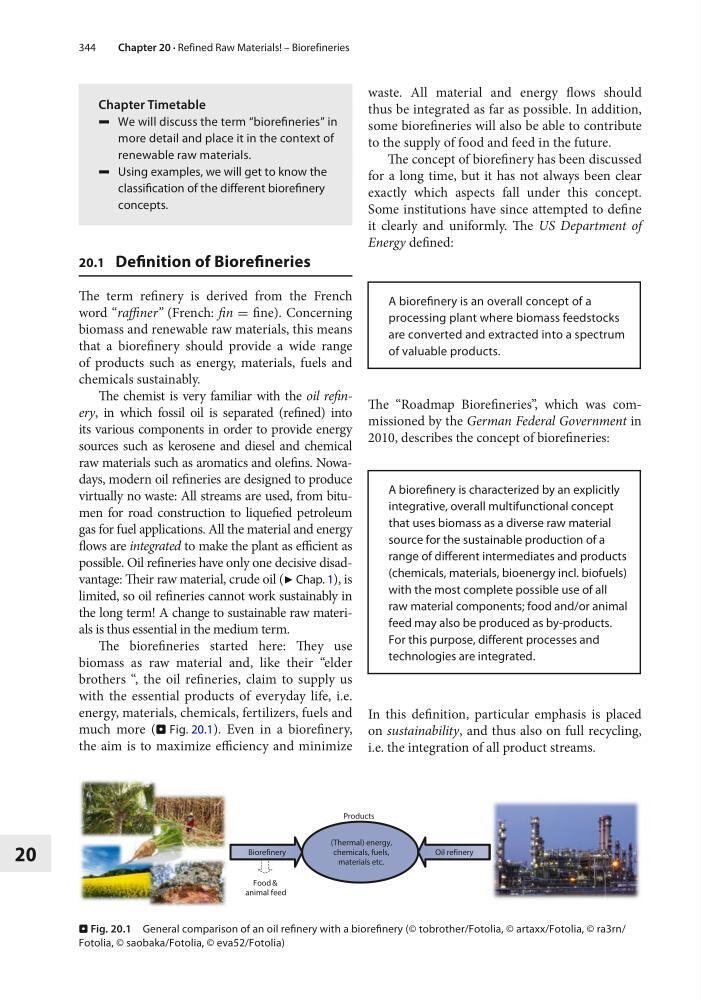
The biorefineries started here: They use
biomass as raw material and, like their “elder
brothers “, the oil refineries, claim to supply us
with the essential products of everyday life, i.e.
energy, materials, chemicals, fertilizers, fuels and
much more (. Fig. 20.1). Even in a biorefinery,
the aim is to maximize efficiency and minimize
(Thermal) energy,
chemicals, fuels,
materials etc.
Oil refinery
Food &
animal feed
Biorefinery
Products
. Fig. 20.1 General comparison of an oil refinery with a biorefinery (© tobrother/Fotolia, © artaxx/Fotolia, © ra3rn/
Fotolia, © saobaka/Fotolia, © eva52/Fotolia)
A biorefinery is an overall concept of a
processing plant where biomass feedstocks
are converted and extracted into a spectrum
of valuable products.
The “Roadmap Biorefineries”, which was commissioned by the German Federal Government in
2010, describes the concept of biorefineries:
A biorefinery is characterized by an explicitly
integrative, overall multifunctional concept
that uses biomass as a diverse raw material
source for the sustainable production of a
range of different intermediates and products
(chemicals, materials, bioenergy incl. biofuels)
with the most complete possible use of all
raw material components; food and/or animal
feed may also be produced as by-products.
For this purpose, different processes and
technologies are integrated.
In this definition, particular emphasis is placed
on sustainability, and thus also on full recycling,
i.e. the integration of all product streams.
Chapter 20 · Refined Raw Materials! – Biorefineries
20
waste. All material and energy flows should
thus be integrated as far as possible. In addition,
some biorefineries will also be able to contribute
to the supply of food and feed in the future.
The concept of biorefinery has been discussed
for a long time, but it has not always been clear
exactly which aspects fall under this concept.
Some institutions have since attempted to define
it clearly and uniformly. The US Department of
Energy defined:
Chapter Timetable
5 We will discuss the term “biorefineries” in
more detail and place it in the context of
renewable raw materials.
5 Using examples, we will get to know the
classification of the different biorefinery
concepts.
20.1 Definition of Biorefineries
The term refinery is derived from the French
word “raffiner” (French: fin = fine). Concerning
biomass and renewable raw materials, this means
that a biorefinery should provide a wide range
of products such as energy, materials, fuels and
chemicals sustainably.
The chemist is very familiar with the oil refinery, in which fossil oil is separated (refined) into
its various components in order to provide energy
sources such as kerosene and diesel and chemical
raw materials such as aromatics and olefins. Nowadays, modern oil refineries are designed to produce
virtually no waste: All streams are used, from bitumen for road construction to liquefied petroleum
gas for fuel applications. All the material and energy
flows are integrated to make the plant as efficient as
possible. Oil refineries have only one decisive disadvantage: Their raw material, crude oil (7 Chap. 1), is
limited, so oil refineries cannot work sustainably in
the long term! A change to sustainable raw materials is thus essential in the medium term.
The biorefineries started here: They use
biomass as raw material and, like their “elder
brothers “, the oil refineries, claim to supply us
with the essential products of everyday life, i.e.
energy, materials, chemicals, fertilizers, fuels and
much more (. Fig. 20.1). Even in a biorefinery,
the aim is to maximize efficiency and minimize
(Thermal) energy,
chemicals, fuels,
materials etc.
Oil refinery
Food &
animal feed
Biorefinery
Products
. Fig. 20.1 General comparison of an oil refinery with a biorefinery (© tobrother/Fotolia, © artaxx/Fotolia, © ra3rn/
Fotolia, © saobaka/Fotolia, © eva52/Fotolia)
A biorefinery is an overall concept of a
processing plant where biomass feedstocks
are converted and extracted into a spectrum
of valuable products.
The “Roadmap Biorefineries”, which was commissioned by the German Federal Government in
2010, describes the concept of biorefineries:
A biorefinery is characterized by an explicitly
integrative, overall multifunctional concept
that uses biomass as a diverse raw material
source for the sustainable production of a
range of different intermediates and products
(chemicals, materials, bioenergy incl. biofuels)
with the most complete possible use of all
raw material components; food and/or animal
feed may also be produced as by-products.
For this purpose, different processes and
technologies are integrated.
In this definition, particular emphasis is placed
on sustainability, and thus also on full recycling,
i.e. the integration of all product streams.