

347
20
produce lignocellulose-containing waste.
These can be a valuable raw material for a
lignocellulose biorefinery and can thus be
used there (7 Sect. 20.3).
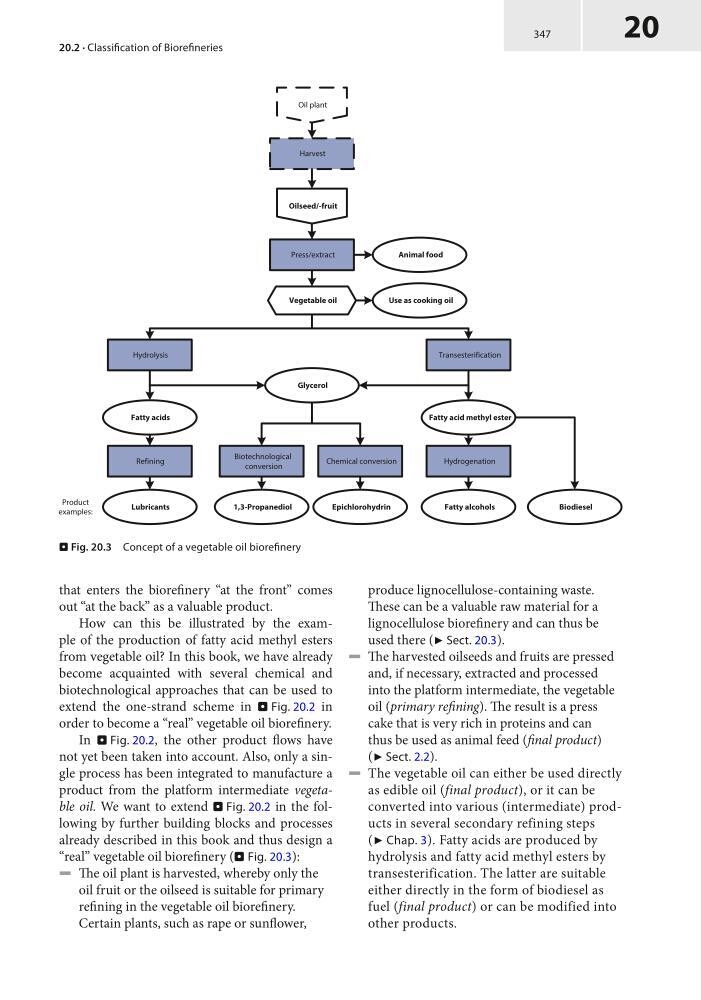
5 The harvested oilseeds and fruits are pressed
and, if necessary, extracted and processed
into the platform intermediate, the vegetable
oil (primary refining). The result is a press
cake that is very rich in proteins and can
thus be used as animal feed (final product)
(7 Sect. 2.2).
5 The vegetable oil can either be used directly
as edible oil (final product), or it can be
converted into various (intermediate) products in several secondary refining steps
(7 Chap. 3). Fatty acids are produced by
hydrolysis and fatty acid methyl esters by
transesterification. The latter are suitable
either directly in the form of biodiesel as
fuel (final product) or can be modified into
other products.
that enters the biorefinery “at the front” comes
out “at the back” as a valuable product.
How can this be illustrated by the example of the production of fatty acid methyl esters
from vegetable oil? In this book, we have already
become acquainted with several chemical and
biotechnological approaches that can be used to
extend the one-strand scheme in . Fig. 20.2 in
order to become a “real” vegetable oil biorefinery.
In . Fig. 20.2, the other product flows have
not yet been taken into account. Also, only a single process has been integrated to manufacture a
product from the platform intermediate vegetable oil. We want to extend . Fig. 20.2 in the following by further building blocks and processes
already described in this book and thus design a
“real” vegetable oil biorefinery (. Fig. 20.3):
5 The oil plant is harvested, whereby only the
oil fruit or the oilseed is suitable for primary
refining in the vegetable oil biorefinery.
Certain plants, such as rape or sunflower,
Oil plant
Harvest
Vegetable oil
Hydrolysis
Glycerol
Oilseed/-fruit
Press/extract
Transesterification
Fatty acids
Fatty acid methyl ester
Refining
Biotechnological
conversion
Chemical conversion
Hydrogenation
Lubricants
1,3-Propanediol
Epichlorohydrin
Fatty alcohols
Biodiesel
Product
examples:
Animal food
Use as cooking oil
. Fig. 20.3 Concept of a vegetable oil biorefinery
20.2 · Classification of Biorefineries
20
produce lignocellulose-containing waste.
These can be a valuable raw material for a
lignocellulose biorefinery and can thus be
used there (7 Sect. 20.3).
5 The harvested oilseeds and fruits are pressed
and, if necessary, extracted and processed
into the platform intermediate, the vegetable
oil (primary refining). The result is a press
cake that is very rich in proteins and can
thus be used as animal feed (final product)
(7 Sect. 2.2).
5 The vegetable oil can either be used directly
as edible oil (final product), or it can be
converted into various (intermediate) products in several secondary refining steps
(7 Chap. 3). Fatty acids are produced by
hydrolysis and fatty acid methyl esters by
transesterification. The latter are suitable
either directly in the form of biodiesel as
fuel (final product) or can be modified into
other products.
that enters the biorefinery “at the front” comes
out “at the back” as a valuable product.
How can this be illustrated by the example of the production of fatty acid methyl esters
from vegetable oil? In this book, we have already
become acquainted with several chemical and
biotechnological approaches that can be used to
extend the one-strand scheme in . Fig. 20.2 in
order to become a “real” vegetable oil biorefinery.
In . Fig. 20.2, the other product flows have
not yet been taken into account. Also, only a single process has been integrated to manufacture a
product from the platform intermediate vegetable oil. We want to extend . Fig. 20.2 in the following by further building blocks and processes
already described in this book and thus design a
“real” vegetable oil biorefinery (. Fig. 20.3):
5 The oil plant is harvested, whereby only the
oil fruit or the oilseed is suitable for primary
refining in the vegetable oil biorefinery.
Certain plants, such as rape or sunflower,
Oil plant
Harvest
Vegetable oil
Hydrolysis
Glycerol
Oilseed/-fruit
Press/extract
Transesterification
Fatty acids
Fatty acid methyl ester
Refining
Biotechnological
conversion
Chemical conversion
Hydrogenation
Lubricants
1,3-Propanediol
Epichlorohydrin
Fatty alcohols
Biodiesel
Product
examples:
Animal food
Use as cooking oil
. Fig. 20.3 Concept of a vegetable oil biorefinery
20.2 · Classification of Biorefineries