

327
19
BOX: Composting of Bioplastics
The compostability of
bioplastics is clearly regulated
and there are certification
marks for compostable
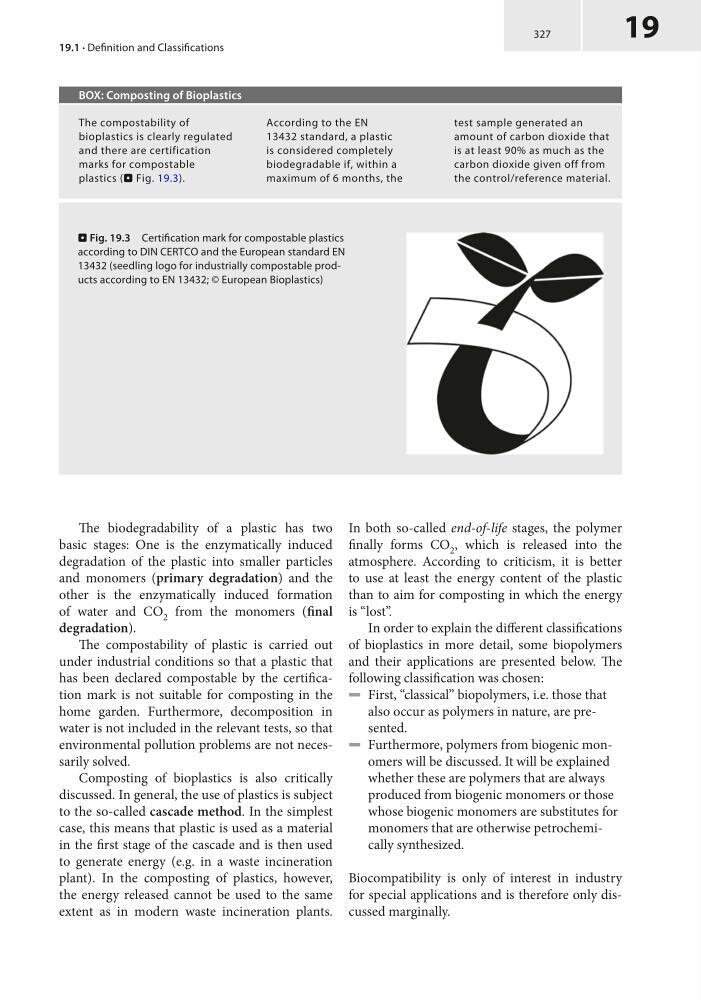
plastics (. Fig. 19.3).
According to the EN
13432 standard, a plastic
is considered completely
biodegradable if, within a
maximum of 6 months, the
test sample generated an
amount of carbon dioxide that
is at least 90% as much as the
carbon dioxide given off from
the control/reference material.
. Fig. 19.3 Certification mark for compostable plastics
according to DIN CERTCO and the European standard EN
13432 (seedling logo for industrially compostable products according to EN 13432; © European Bioplastics)
19.1 · Definition and Classifications
The biodegradability of a plastic has two
basic stages: One is the enzymatically induced
degradation of the plastic into smaller particles
and monomers (primary degradation) and the
other is the enzymatically induced formation
of water and CO 2 from the monomers (final
degradation).
The compostability of plastic is carried out
under industrial conditions so that a plastic that
has been declared compostable by the certification mark is not suitable for composting in the
home garden. Furthermore, decomposition in
water is not included in the relevant tests, so that
environmental pollution problems are not necessarily solved.
Composting of bioplastics is also critically
discussed. In general, the use of plastics is subject
to the so-called cascade method. In the simplest
case, this means that plastic is used as a material
in the first stage of the cascade and is then used
to generate energy (e.g. in a waste incineration
plant). In the composting of plastics, however,
the energy released cannot be used to the same
extent as in modern waste incineration plants.
In both so-called end-of-life stages, the polymer
finally forms CO 2 , which is released into the
atmosphere. According to criticism, it is better
to use at least the energy content of the plastic
than to aim for composting in which the energy
is “lost”.
In order to explain the different classifications
of bioplastics in more detail, some biopolymers
and their applications are presented below. The
following classification was chosen:
5 First, “classical” biopolymers, i.e. those that
also occur as polymers in nature, are presented.
5 Furthermore, polymers from biogenic monomers will be discussed. It will be explained
whether these are polymers that are always
produced from biogenic monomers or those
whose biogenic monomers are substitutes for
monomers that are otherwise petrochemically synthesized.
Biocompatibility is only of interest in industry
for special applications and is therefore only discussed marginally.
19
BOX: Composting of Bioplastics
The compostability of
bioplastics is clearly regulated
and there are certification
marks for compostable
plastics (. Fig. 19.3).
According to the EN
13432 standard, a plastic
is considered completely
biodegradable if, within a
maximum of 6 months, the
test sample generated an
amount of carbon dioxide that
is at least 90% as much as the
carbon dioxide given off from
the control/reference material.
. Fig. 19.3 Certification mark for compostable plastics
according to DIN CERTCO and the European standard EN
13432 (seedling logo for industrially compostable products according to EN 13432; © European Bioplastics)
19.1 · Definition and Classifications
The biodegradability of a plastic has two
basic stages: One is the enzymatically induced
degradation of the plastic into smaller particles
and monomers (primary degradation) and the
other is the enzymatically induced formation
of water and CO 2 from the monomers (final
degradation).
The compostability of plastic is carried out
under industrial conditions so that a plastic that
has been declared compostable by the certification mark is not suitable for composting in the
home garden. Furthermore, decomposition in
water is not included in the relevant tests, so that
environmental pollution problems are not necessarily solved.
Composting of bioplastics is also critically
discussed. In general, the use of plastics is subject
to the so-called cascade method. In the simplest
case, this means that plastic is used as a material
in the first stage of the cascade and is then used
to generate energy (e.g. in a waste incineration
plant). In the composting of plastics, however,
the energy released cannot be used to the same
extent as in modern waste incineration plants.
In both so-called end-of-life stages, the polymer
finally forms CO 2 , which is released into the
atmosphere. According to criticism, it is better
to use at least the energy content of the plastic
than to aim for composting in which the energy
is “lost”.
In order to explain the different classifications
of bioplastics in more detail, some biopolymers
and their applications are presented below. The
following classification was chosen:
5 First, “classical” biopolymers, i.e. those that
also occur as polymers in nature, are presented.
5 Furthermore, polymers from biogenic monomers will be discussed. It will be explained
whether these are polymers that are always
produced from biogenic monomers or those
whose biogenic monomers are substitutes for
monomers that are otherwise petrochemically synthesized.
Biocompatibility is only of interest in industry
for special applications and is therefore only discussed marginally.