

326
Chapter 19 · Plastics from Nature - Biopolymers
19
their stabilizing function in the body but do not
have to be removed by further surgery.
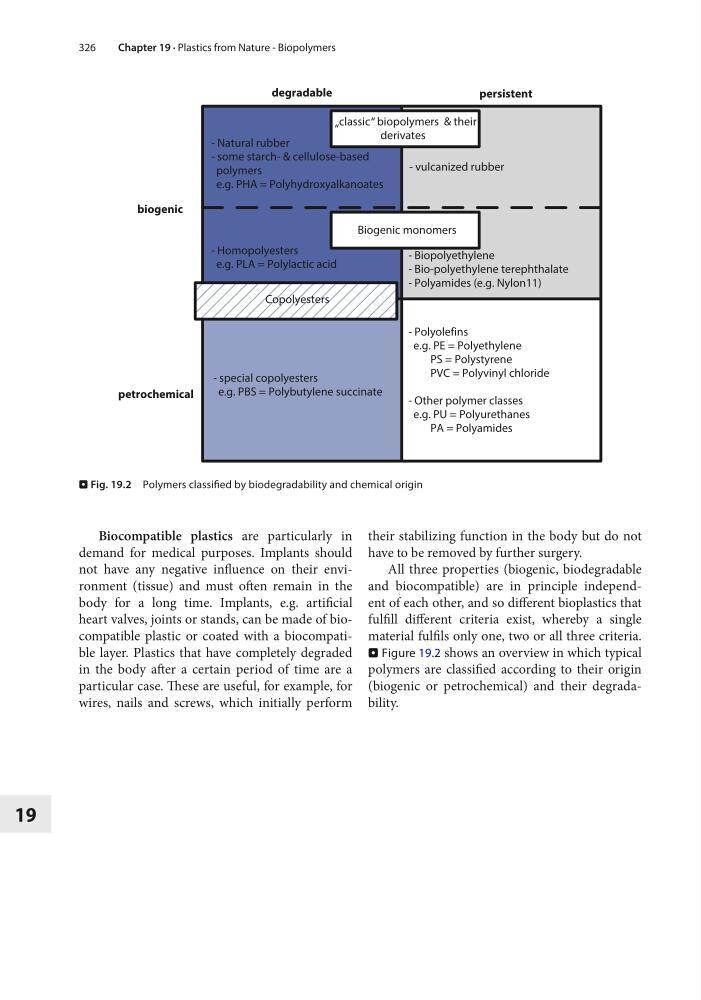
All three properties (biogenic, biodegradable
and biocompatible) are in principle independent of each other, and so different bioplastics that
fulfill different criteria exist, whereby a single
material fulfils only one, two or all three criteria.
. Figure 19.2 shows an overview in which typical
polymers are classified according to their origin
(biogenic or petrochemical) and their degradability.
Biocompatible plastics are particularly in
demand for medical purposes. Implants should
not have any negative influence on their environment (tissue) and must often remain in the
body for a long time. Implants, e.g. artificial
heart valves, joints or stands, can be made of biocompatible plastic or coated with a biocompatible layer. Plastics that have completely degraded
in the body after a certain period of time are a
particular case. These are useful, for example, for
wires, nails and screws, which initially perform
degradable
persistent
- Natural rubber
- some starch- & cellulose-based
polymers
e.g. PHA = Polyhydroxyalkanoates
- Homopolyesters
e.g. PLA = Polylactic acid
Copolyesters
- special copolyesters
e.g. PBS = Polybutylene succinate
biogenic
petrochemical
classic biopolymers & their
derivates
Biogenic monomers
- vulcanized rubber
- Biopolyethylene
- Bio-polyethylene terephthalate
- Polyamides (e.g. Nylon11)
- Polyolefins
e.g. PE = Polyethylene
PS = Polystyrene
PVC = Polyvinyl chloride
- Other polymer classes
e.g. PU = Polyurethanes
PA = Polyamides
“
“
. Fig. 19.2 Polymers classified by biodegradability and chemical origin
Chapter 19 · Plastics from Nature - Biopolymers
19
their stabilizing function in the body but do not
have to be removed by further surgery.
All three properties (biogenic, biodegradable
and biocompatible) are in principle independent of each other, and so different bioplastics that
fulfill different criteria exist, whereby a single
material fulfils only one, two or all three criteria.
. Figure 19.2 shows an overview in which typical
polymers are classified according to their origin
(biogenic or petrochemical) and their degradability.
Biocompatible plastics are particularly in
demand for medical purposes. Implants should
not have any negative influence on their environment (tissue) and must often remain in the
body for a long time. Implants, e.g. artificial
heart valves, joints or stands, can be made of biocompatible plastic or coated with a biocompatible layer. Plastics that have completely degraded
in the body after a certain period of time are a
particular case. These are useful, for example, for
wires, nails and screws, which initially perform
degradable
persistent
- Natural rubber
- some starch- & cellulose-based
polymers
e.g. PHA = Polyhydroxyalkanoates
- Homopolyesters
e.g. PLA = Polylactic acid
Copolyesters
- special copolyesters
e.g. PBS = Polybutylene succinate
biogenic
petrochemical
classic biopolymers & their
derivates
Biogenic monomers
- vulcanized rubber
- Biopolyethylene
- Bio-polyethylene terephthalate
- Polyamides (e.g. Nylon11)
- Polyolefins
e.g. PE = Polyethylene
PS = Polystyrene
PVC = Polyvinyl chloride
- Other polymer classes
e.g. PU = Polyurethanes
PA = Polyamides
“
“
. Fig. 19.2 Polymers classified by biodegradability and chemical origin