

328
Chapter 19 · Plastics from Nature - Biopolymers
19
5 The two polyterpenes from 7 Chap. 13,
natural rubber and gutta-percha, also have
a special position. Both the material use of
lignin and natural rubber were presented in
7 Chaps. 11 and 13, respectively, and thus will
not be discussed any further.
Cellulose
The occurrence and structure of cellulose have
already been discussed in detail in 7 Chap. 7.
Principally, three groups can be distinguished
within the material use of cellulose:
5 Native cellulose, especially from cotton, jute,
flax and hemp, is used for the production of a
wide variety of textiles. For paper production,
cellulose is obtained from wood using specific
pulping processes so that cellulose is used in
a particularly pure form. Composite materials
of cellulose-containing fibers such as hemp,
flax, cotton, sisal, etc. with petrochemical
resins, e.g. phenolic and acrylic resins, are
also important concerning the material use
of cellulose. These can be used, e.g. for the
construction of stable molded parts in car or
furniture construction.
5 Regenerated cellulose is used for the production of filaments, so-called artificial silk or
19.2 Biopolymer Representatives
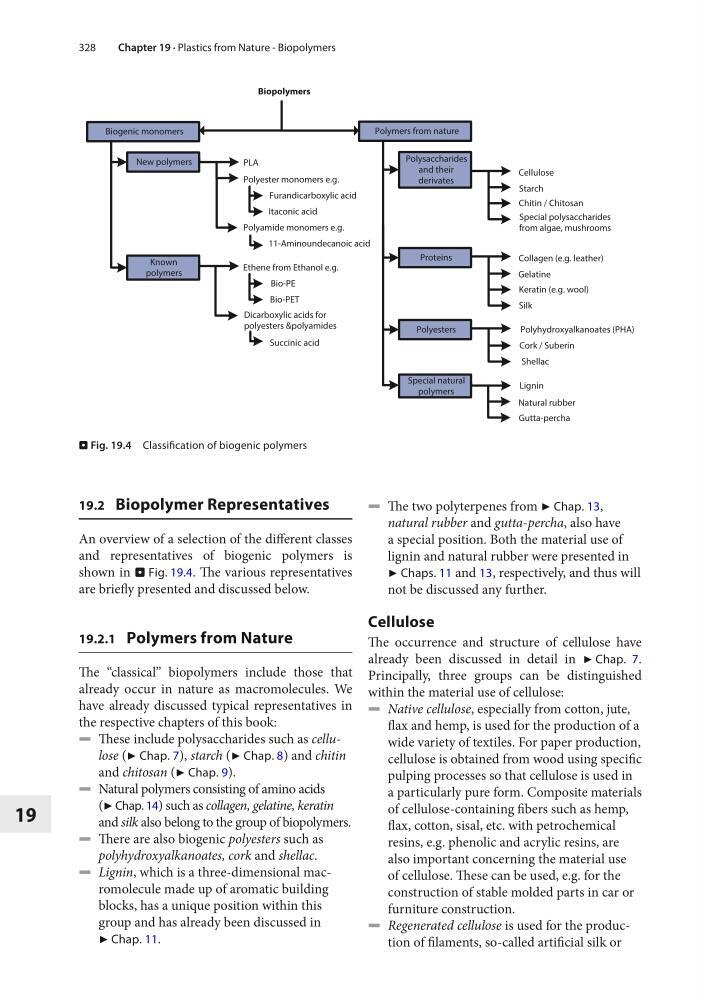
An overview of a selection of the different classes
and representatives of biogenic polymers is
shown in . Fig. 19.4. The various representatives
are briefly presented and discussed below.
19.2.1 Polymers from Nature
The “classical” biopolymers include those that
already occur in nature as macromolecules. We
have already discussed typical representatives in
the respective chapters of this book:
5 These include polysaccharides such as cellulose (7 Chap. 7), starch (7 Chap. 8) and chitin
and chitosan (7 Chap. 9).
5 Natural polymers consisting of amino acids
(7 Chap. 14) such as collagen, gelatine, keratin
and silk also belong to the group of biopolymers.
5 There are also biogenic polyesters such as
polyhydroxyalkanoates, cork and shellac.
5 Lignin, which is a three-dimensional macromolecule made up of aromatic building
blocks, has a unique position within this
group and has already been discussed in
7 Chap. 11.
Biopolymers
Polymers from nature
Polysaccharides
and their
derivates
Proteins
Polyesters
Special natural
polymers
Biogenic monomers
New polymers
Known
polymers
Cellulose
Starch
Chitin / Chitosan
Special polysaccharides
from algae, mushrooms
Collagen (e.g. leather)
Gelatine
Keratin (e.g. wool)
Silk
Polyhydroxyalkanoates (PHA)
Cork / Suberin
Shellac
Lignin
Natural rubber
PLA
Polyester monomers e.g.
Ethene from Ethanol e.g.
Furandicarboxylic acid
Itaconic acid
Polyamide monomers e.g.
11-Aminoundecanoic acid
Bio-PE
Bio-PET
Dicarboxylic acids for
polyesters &polyamides
Succinic acid
Gutta-percha
. Fig. 19.4 Classification of biogenic polymers
Chapter 19 · Plastics from Nature - Biopolymers
19
5 The two polyterpenes from 7 Chap. 13,
natural rubber and gutta-percha, also have
a special position. Both the material use of
lignin and natural rubber were presented in
7 Chaps. 11 and 13, respectively, and thus will
not be discussed any further.
Cellulose
The occurrence and structure of cellulose have
already been discussed in detail in 7 Chap. 7.
Principally, three groups can be distinguished
within the material use of cellulose:
5 Native cellulose, especially from cotton, jute,
flax and hemp, is used for the production of a
wide variety of textiles. For paper production,
cellulose is obtained from wood using specific
pulping processes so that cellulose is used in
a particularly pure form. Composite materials
of cellulose-containing fibers such as hemp,
flax, cotton, sisal, etc. with petrochemical
resins, e.g. phenolic and acrylic resins, are
also important concerning the material use
of cellulose. These can be used, e.g. for the
construction of stable molded parts in car or
furniture construction.
5 Regenerated cellulose is used for the production of filaments, so-called artificial silk or
19.2 Biopolymer Representatives
An overview of a selection of the different classes
and representatives of biogenic polymers is
shown in . Fig. 19.4. The various representatives
are briefly presented and discussed below.
19.2.1 Polymers from Nature
The “classical” biopolymers include those that
already occur in nature as macromolecules. We
have already discussed typical representatives in
the respective chapters of this book:
5 These include polysaccharides such as cellulose (7 Chap. 7), starch (7 Chap. 8) and chitin
and chitosan (7 Chap. 9).
5 Natural polymers consisting of amino acids
(7 Chap. 14) such as collagen, gelatine, keratin
and silk also belong to the group of biopolymers.
5 There are also biogenic polyesters such as
polyhydroxyalkanoates, cork and shellac.
5 Lignin, which is a three-dimensional macromolecule made up of aromatic building
blocks, has a unique position within this
group and has already been discussed in
7 Chap. 11.
Biopolymers
Polymers from nature
Polysaccharides
and their
derivates
Proteins
Polyesters
Special natural
polymers
Biogenic monomers
New polymers
Known
polymers
Cellulose
Starch
Chitin / Chitosan
Special polysaccharides
from algae, mushrooms
Collagen (e.g. leather)
Gelatine
Keratin (e.g. wool)
Silk
Polyhydroxyalkanoates (PHA)
Cork / Suberin
Shellac
Lignin
Natural rubber
PLA
Polyester monomers e.g.
Ethene from Ethanol e.g.
Furandicarboxylic acid
Itaconic acid
Polyamide monomers e.g.
11-Aminoundecanoic acid
Bio-PE
Bio-PET
Dicarboxylic acids for
polyesters &polyamides
Succinic acid
Gutta-percha
. Fig. 19.4 Classification of biogenic polymers