

320
Chapter 18 · Enchanting Chemistry - Natural Flavors and Fragrances
18
time without handling large volumes of potentially hazardous solvents. A disadvantage of
steam distillation is the possibility that the fragrances are destroyed and converted under the
influence of water and heat. However, today the
largest volumes of essential oils are produced by
steam distillation.
Summary (Take-Home Messages)
5 Aromatic substances are chemical
compounds, which are recognized by
the sense of smell and therefore have a
characteristic scent. The scent is not a
physical property of the substance, but
is produced in the brain of the smelling
person.
5 Aromatic substances can be pleasant
as well as malodorous. The pleasantly
smelling compounds are much more
important in industry. They are divided
into fragrances for the cosmetics,
detergent and perfume manufacturers
and flavors for food industry.
5 Humans have been using fragrances for
a long time to mask unpleasant odors.
Perfume production originated in
Grasse, France, in the sixteenth century.
In Germany, “genuine Eau de Cologne”
(Echt Kölnisch Wasser), developed at the
beginning of the eighteenth century and
consisting exclusively of essential oils,
was the dominant fragrance for a long
time.
5 The modern fragrance and flavor industry
has its origin in the middle of the
nineteenth century, when it succeeded
for the first time to produce single
synthetic fragrance and flavor materials,
which are to be distinguished from the
natural fragrance and flavor materials.
5 Natural flavoring substances are isolated
from natural sources (e.g. extracted)
or obtained from them using legally
established processes (e.g. fermentation).
5 Synthetic fragrances and aromas are
based on chemical reactions. These either
aim to synthesize a naturally occurring
fragrance from readily available raw
materials (nature-identical fragrance or
flavor) or to imitate a characteristic scent
(artificial fragrance or flavor).
There are basically two types of steam distillation:
5 With the indirect method (A and C open, B
and D closed, . Fig. 18.8), the distillation
vessel is filled with water and the plant components to be extracted are boiled in liquid
water. The rising steam is taken from the top
and condensed.
5 In the direct method (A and C closed, B and
D open, . Fig. 18.8), the distillation vessel
is filled with the plant components to be
extracted, often using a wire basket. At the
bottom of the vessel, hot steam is introduced,
which rises through the material and carries
the volatile essential oils along its way. The
steam mixture arrives at the head of the vessel
and is then condensed and separated.
Indirect steam distillation is preferred nowadays
because it is less energy- and time-intensive and
also allows higher yields of essential oils. However, the typical yields of essential oils from
flowers are very low: From 52,000 tons of roses
(mainly Damask and May Rose), only about
15 tons of rose blossom oil are produced annually. Rose blossom oil is therefore one of the most
expensive raw materials in perfume production.
Compared to extraction, steam distillation is
less labor-intensive and time-consuming. Large
quantities of material can be treated in a short
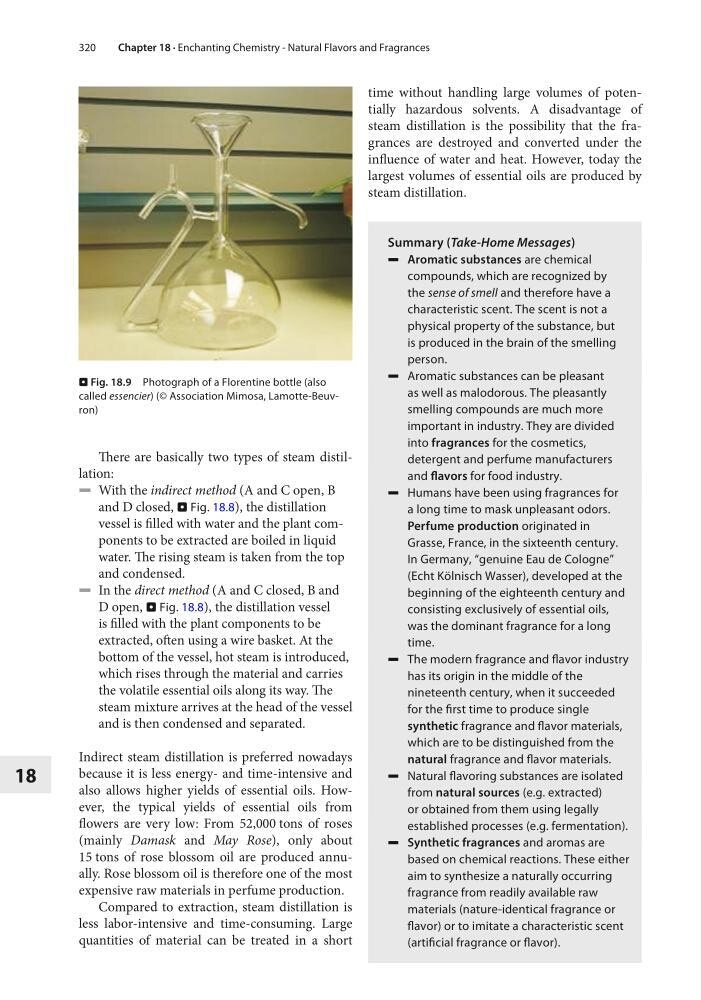
. Fig. 18.9 Photograph of a Florentine bottle (also
called essencier) (© Association Mimosa, Lamotte-Beuvron)
Chapter 18 · Enchanting Chemistry - Natural Flavors and Fragrances
18
time without handling large volumes of potentially hazardous solvents. A disadvantage of
steam distillation is the possibility that the fragrances are destroyed and converted under the
influence of water and heat. However, today the
largest volumes of essential oils are produced by
steam distillation.
Summary (Take-Home Messages)
5 Aromatic substances are chemical
compounds, which are recognized by
the sense of smell and therefore have a
characteristic scent. The scent is not a
physical property of the substance, but
is produced in the brain of the smelling
person.
5 Aromatic substances can be pleasant
as well as malodorous. The pleasantly
smelling compounds are much more
important in industry. They are divided
into fragrances for the cosmetics,
detergent and perfume manufacturers
and flavors for food industry.
5 Humans have been using fragrances for
a long time to mask unpleasant odors.
Perfume production originated in
Grasse, France, in the sixteenth century.
In Germany, “genuine Eau de Cologne”
(Echt Kölnisch Wasser), developed at the
beginning of the eighteenth century and
consisting exclusively of essential oils,
was the dominant fragrance for a long
time.
5 The modern fragrance and flavor industry
has its origin in the middle of the
nineteenth century, when it succeeded
for the first time to produce single
synthetic fragrance and flavor materials,
which are to be distinguished from the
natural fragrance and flavor materials.
5 Natural flavoring substances are isolated
from natural sources (e.g. extracted)
or obtained from them using legally
established processes (e.g. fermentation).
5 Synthetic fragrances and aromas are
based on chemical reactions. These either
aim to synthesize a naturally occurring
fragrance from readily available raw
materials (nature-identical fragrance or
flavor) or to imitate a characteristic scent
(artificial fragrance or flavor).
There are basically two types of steam distillation:
5 With the indirect method (A and C open, B
and D closed, . Fig. 18.8), the distillation
vessel is filled with water and the plant components to be extracted are boiled in liquid
water. The rising steam is taken from the top
and condensed.
5 In the direct method (A and C closed, B and
D open, . Fig. 18.8), the distillation vessel
is filled with the plant components to be
extracted, often using a wire basket. At the
bottom of the vessel, hot steam is introduced,
which rises through the material and carries
the volatile essential oils along its way. The
steam mixture arrives at the head of the vessel
and is then condensed and separated.
Indirect steam distillation is preferred nowadays
because it is less energy- and time-intensive and
also allows higher yields of essential oils. However, the typical yields of essential oils from
flowers are very low: From 52,000 tons of roses
(mainly Damask and May Rose), only about
15 tons of rose blossom oil are produced annually. Rose blossom oil is therefore one of the most
expensive raw materials in perfume production.
Compared to extraction, steam distillation is
less labor-intensive and time-consuming. Large
quantities of material can be treated in a short
. Fig. 18.9 Photograph of a Florentine bottle (also
called essencier) (© Association Mimosa, Lamotte-Beuvron)