

319
18
Like pressing, extraction is a mild and gentle
process; the oils obtained in this way have a finer
and better fragrance than the products obtained by
distillation. However, they are usually still colored
and do not always evaporate without leaving residues. Extraction is often the method of choice for
plant material with a comparatively low content of
essential oils, e.g. for some flowers.
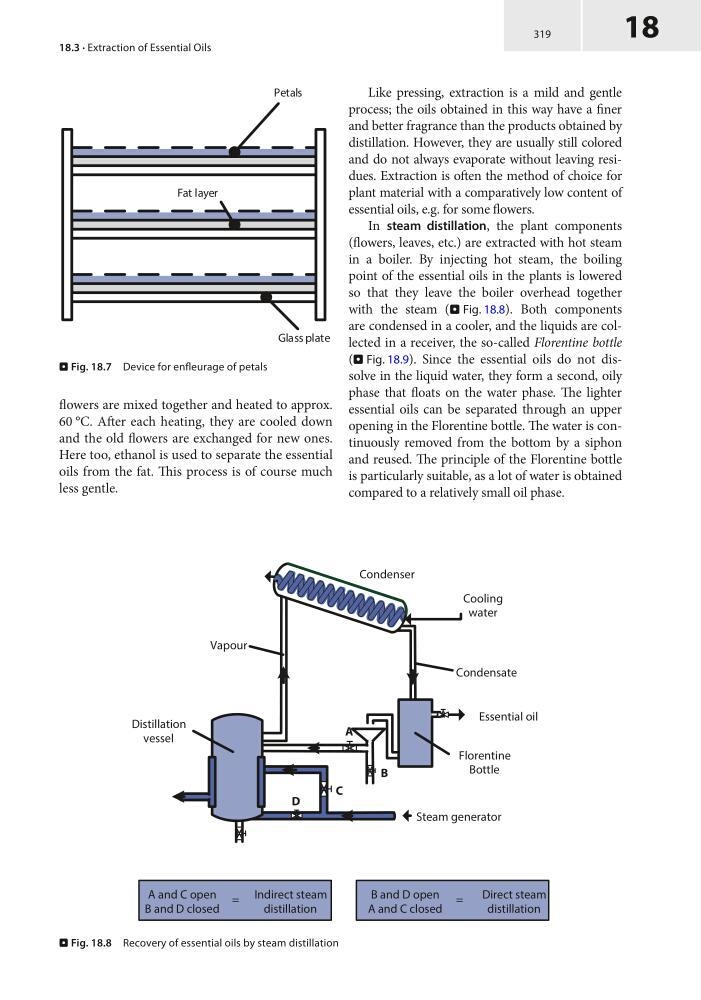
In steam distillation, the plant components
(flowers, leaves, etc.) are extracted with hot steam
in a boiler. By injecting hot steam, the boiling
point of the essential oils in the plants is lowered
so that they leave the boiler overhead together
with the steam (. Fig. 18.8). Both components
are condensed in a cooler, and the liquids are collected in a receiver, the so-called Florentine bottle
(. Fig. 18.9). Since the essential oils do not dissolve in the liquid water, they form a second, oily
phase that floats on the water phase. The lighter
essential oils can be separated through an upper
opening in the Florentine bottle. The water is continuously removed from the bottom by a siphon
and reused. The principle of the Florentine bottle
is particularly suitable, as a lot of water is obtained
compared to a relatively small oil phase.
flowers are mixed together and heated to approx.
60 °C. After each heating, they are cooled down
and the old flowers are exchanged for new ones.
Here too, ethanol is used to separate the essential
oils from the fat. This process is of course much
less gentle.
Condenser
Cooling
water
Essential oil
Florentine
Bottle
A
B
C
D
Steam generator
Vapour
Distillation
vessel
A and C open
B and D closed
= Indirect steam
distillation
B and D open
A and C closed
=
Direct steam
distillation
Condensate
. Fig. 18.8 Recovery of essential oils by steam distillation
18.3 · Extraction of Essential Oils
Petals
Fat layer
Glass plate
. Fig. 18.7 Device for enfleurage of petals
18
Like pressing, extraction is a mild and gentle
process; the oils obtained in this way have a finer
and better fragrance than the products obtained by
distillation. However, they are usually still colored
and do not always evaporate without leaving residues. Extraction is often the method of choice for
plant material with a comparatively low content of
essential oils, e.g. for some flowers.
In steam distillation, the plant components
(flowers, leaves, etc.) are extracted with hot steam
in a boiler. By injecting hot steam, the boiling
point of the essential oils in the plants is lowered
so that they leave the boiler overhead together
with the steam (. Fig. 18.8). Both components
are condensed in a cooler, and the liquids are collected in a receiver, the so-called Florentine bottle
(. Fig. 18.9). Since the essential oils do not dissolve in the liquid water, they form a second, oily
phase that floats on the water phase. The lighter
essential oils can be separated through an upper
opening in the Florentine bottle. The water is continuously removed from the bottom by a siphon
and reused. The principle of the Florentine bottle
is particularly suitable, as a lot of water is obtained
compared to a relatively small oil phase.
flowers are mixed together and heated to approx.
60 °C. After each heating, they are cooled down
and the old flowers are exchanged for new ones.
Here too, ethanol is used to separate the essential
oils from the fat. This process is of course much
less gentle.
Condenser
Cooling
water
Essential oil
Florentine
Bottle
A
B
C
D
Steam generator
Vapour
Distillation
vessel
A and C open
B and D closed
= Indirect steam
distillation
B and D open
A and C closed
=
Direct steam
distillation
Condensate
. Fig. 18.8 Recovery of essential oils by steam distillation
18.3 · Extraction of Essential Oils
Petals
Fat layer
Glass plate
. Fig. 18.7 Device for enfleurage of petals