

305
17
5 The 13 vitamins can be divided into the
fat-soluble vitamins A, D, E and K and the
water-soluble vitamins B and C.
5 Vitamin A, retinol, is a diterpene alcohol
with an ionon ring. It is important for the
prevention of eye and skin diseases. It
is found in fish liver, egg yolk and dairy
products.
5 There are a number of important B
vitamins which are further numbered B 1 ,
B 2 , B 3 , B 5 , B 6 , B 7 , B 9 and B 12 . All contain
nitrogen-containing heterocycles in their
molecular structure. Functional groups
(hydroxyl, carboxy and amide groups)
are bound to these, which make all B
vitamins water soluble.
5 Vitamin B 1 , the thiamine, prevents
beriberi disease. Vitamin B 2 , riboflavin, is
an essential coenzyme that is supplied in
cases of hypersensitivity to light. A lack
of vitamin B 3 , niacin, leads to pellagra
disease.
5 Pantothenic acid (vitamin B 5 ), a
derivative of alanine, is widespread in
foods. It is an important growth factor.
Pyridoxine (vitamin B 6 ) is a coenzyme
in the amino acid metabolism. Biotin
(vitamin B 7 ) is important for the functions
of the skin.
5 Folic acid (vitamin B 9 ) is a glutamic acid
derivative. As a leukocyte growth factor,
it influences blood formation. A folic acid
deficiency leads to anaemia.
5 Cobalamin (vitamin B 12 ) is a cobalt
complex with a corrin ligand on which
there are numerous side groups. It is an
important cofactor in enzymatic reactions
A total of about one hundred compounds
with the efficacy of vitamin K are known. The
three most important representatives are:
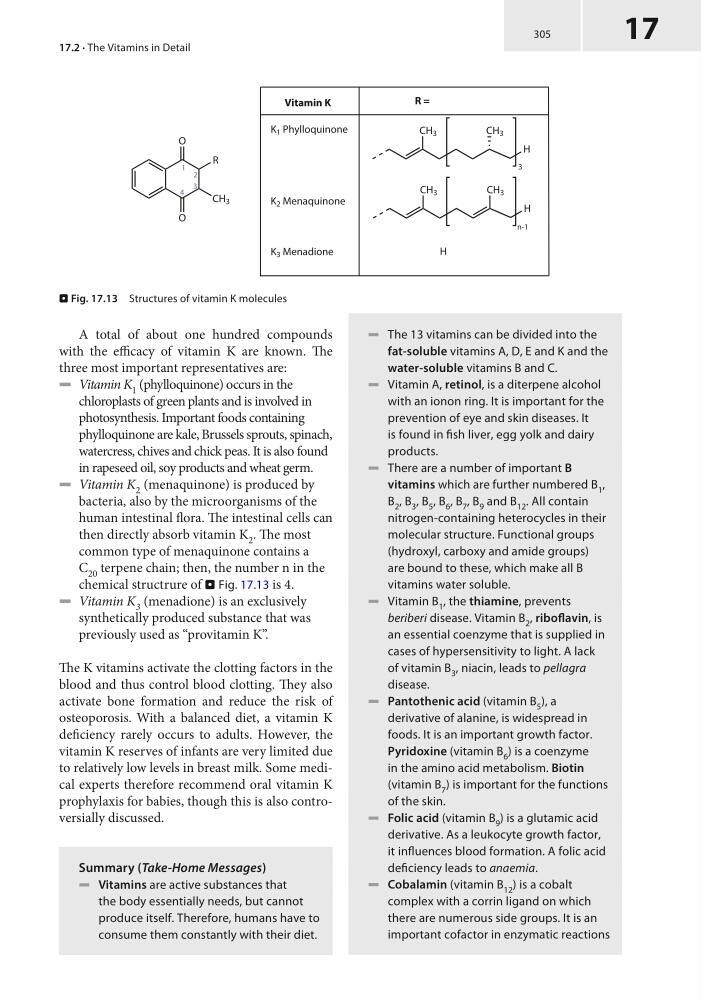
5 Vitamin K 1 (phylloquinone) occurs in the
chloroplasts of green plants and is involved in
photosynthesis. Important foods containing
phylloquinone are kale, Brussels sprouts, spinach,
watercress, chives and chick peas. It is also found
in rapeseed oil, soy products and wheat germ.
5 Vitamin K 2 (menaquinone) is produced by
bacteria, also by the microorganisms of the
human intestinal flora. The intestinal cells can
then directly absorb vitamin K 2 . The most
common type of menaquinone contains a
C 20 terpene chain; then, the number n in the
chemical structrure of . Fig. 17.13 is 4.
5 Vitamin K 3 (menadione) is an exclusively
synthetically produced substance that was
previously used as “provitamin K”.
The K vitamins activate the clotting factors in the
blood and thus control blood clotting. They also
activate bone formation and reduce the risk of
osteoporosis. With a balanced diet, a vitamin K
deficiency rarely occurs to adults. However, the
vitamin K reserves of infants are very limited due
to relatively low levels in breast milk. Some medical experts therefore recommend oral vitamin K
prophylaxis for babies, though this is also controversially discussed.
Summary (Take-Home Messages)
5 Vitamins are active substances that
the body essentially needs, but cannot
produce itself. Therefore, humans have to
consume them constantly with their diet.
Vitamin K
1 2
3
4
O
O
R
CH 3
R =
K 1 Phylloquinone
K 2 Menaquinone
K 3 Menadione
H
CH 3
CH 3
H
CH 3
CH 3
3
n-1
H
. Fig. 17.13 Structures of vitamin K molecules
17.2 · The Vitamins in Detail
17
5 The 13 vitamins can be divided into the
fat-soluble vitamins A, D, E and K and the
water-soluble vitamins B and C.
5 Vitamin A, retinol, is a diterpene alcohol
with an ionon ring. It is important for the
prevention of eye and skin diseases. It
is found in fish liver, egg yolk and dairy
products.
5 There are a number of important B
vitamins which are further numbered B 1 ,
B 2 , B 3 , B 5 , B 6 , B 7 , B 9 and B 12 . All contain
nitrogen-containing heterocycles in their
molecular structure. Functional groups
(hydroxyl, carboxy and amide groups)
are bound to these, which make all B
vitamins water soluble.
5 Vitamin B 1 , the thiamine, prevents
beriberi disease. Vitamin B 2 , riboflavin, is
an essential coenzyme that is supplied in
cases of hypersensitivity to light. A lack
of vitamin B 3 , niacin, leads to pellagra
disease.
5 Pantothenic acid (vitamin B 5 ), a
derivative of alanine, is widespread in
foods. It is an important growth factor.
Pyridoxine (vitamin B 6 ) is a coenzyme
in the amino acid metabolism. Biotin
(vitamin B 7 ) is important for the functions
of the skin.
5 Folic acid (vitamin B 9 ) is a glutamic acid
derivative. As a leukocyte growth factor,
it influences blood formation. A folic acid
deficiency leads to anaemia.
5 Cobalamin (vitamin B 12 ) is a cobalt
complex with a corrin ligand on which
there are numerous side groups. It is an
important cofactor in enzymatic reactions
A total of about one hundred compounds
with the efficacy of vitamin K are known. The
three most important representatives are:
5 Vitamin K 1 (phylloquinone) occurs in the
chloroplasts of green plants and is involved in
photosynthesis. Important foods containing
phylloquinone are kale, Brussels sprouts, spinach,
watercress, chives and chick peas. It is also found
in rapeseed oil, soy products and wheat germ.
5 Vitamin K 2 (menaquinone) is produced by
bacteria, also by the microorganisms of the
human intestinal flora. The intestinal cells can
then directly absorb vitamin K 2 . The most
common type of menaquinone contains a
C 20 terpene chain; then, the number n in the
chemical structrure of . Fig. 17.13 is 4.
5 Vitamin K 3 (menadione) is an exclusively
synthetically produced substance that was
previously used as “provitamin K”.
The K vitamins activate the clotting factors in the
blood and thus control blood clotting. They also
activate bone formation and reduce the risk of
osteoporosis. With a balanced diet, a vitamin K
deficiency rarely occurs to adults. However, the
vitamin K reserves of infants are very limited due
to relatively low levels in breast milk. Some medical experts therefore recommend oral vitamin K
prophylaxis for babies, though this is also controversially discussed.
Summary (Take-Home Messages)
5 Vitamins are active substances that
the body essentially needs, but cannot
produce itself. Therefore, humans have to
consume them constantly with their diet.
Vitamin K
1 2
3
4
O
O
R
CH 3
R =
K 1 Phylloquinone
K 2 Menaquinone
K 3 Menadione
H
CH 3
CH 3
H
CH 3
CH 3
3
n-1
H
. Fig. 17.13 Structures of vitamin K molecules
17.2 · The Vitamins in Detail