

304
Chapter 17 · Vital Amines - Vitamins
17
these additives have the designations E 306 to E
309. In addition to food, vitamin E is also added
to paints and cosmetics, especially sunscreens.
For condoms, a coating with vitamin E is supposed to increase the tensile strength.
The main producers of vitamin E today are
BASF and DSM as well as some Chinese companies. The production of synthetic vitamin
E is currently estimated at over 30,000 t a −1 .
In addition, natural vitamin E is also isolated
from edible oils such as sunflower, soy and
palm oils.
17.2.13 Vitamin K (Phylloquinone
and Others)
K vitamins are also fat-soluble compounds. They
are derived from 2-methyl-1,4-naphthoquinone,
also known as menadione or vitamin K 3 . In vitamin K 1 , the phylloquinone, and vitamin K 2 , the
menaquinone, there are still oligoterpene rests
of different chain lengths on the C2 atom of the
naphthoquinone skeleton (. Fig. 17.13).
Vitamin K was discovered in 1929 by the
Danish researcher Henrik Dam when chicks
were fed in different ways. If this active ingredient was lacking, the chicks would bleed under
the skin. In 1939, the American biochemist
Edward Adelbert Doisy isolated phyllochinone
from alfalfa and developed a chemical synthesis.
In 1943, Dam and Doisy received the Nobel Prize
for Physiology or Medicine for their work.
covered “fertility vitamin” was given the name
vitamin E. In 1938, the structure of α-tocopherol was determined. In the same year, the Swiss
chemist Paul Karrer at the University of Zurich
succeeded in producing the first chemical synthesis; a year later, the Roche company launched
α-tocopherol acetate on the market. In 1937,
Paul Karrer and Walter Norman Haworth were
awarded the Nobel Prize in Chemistry for their
work in the field of carotenoids and vitamins.
Vitamin E is of great importance for human
health: It is a lipid-soluble antioxidant and
ensures the chain termination of radical reactions. The polyunsaturated fatty acids in the
membrane lipids are thus protected against oxidative destruction. Tocopherol acts as a scavenger of radicals, converting it into a mesomerically
stabilized and thus inert radical. With the help
of ascorbic acid (vitamin C), the tocopherol can
then be regenerated. Vitamin E also plays a role
in immune functions and in the control of the
gonads. Tocopherol owes its name to this property as an “antisterility vitamin”: The Greek words
tocos and pherein mean “birth” and “to produce”.
Nowadays, vitamin E deficiency diseases are
very rare when nutrition is balanced. Tocopherols are present in numerous foods and can be
stored well in the liver and in human fatty tissue.
A deficiency (hypovitaminosis) of vitamin E is
recognized by the doctor in dry, wrinkled skin,
poorly healing wounds and severe fatigue.
Tocopherols are also used in the food industry because of their antioxidant effect. In the EU,
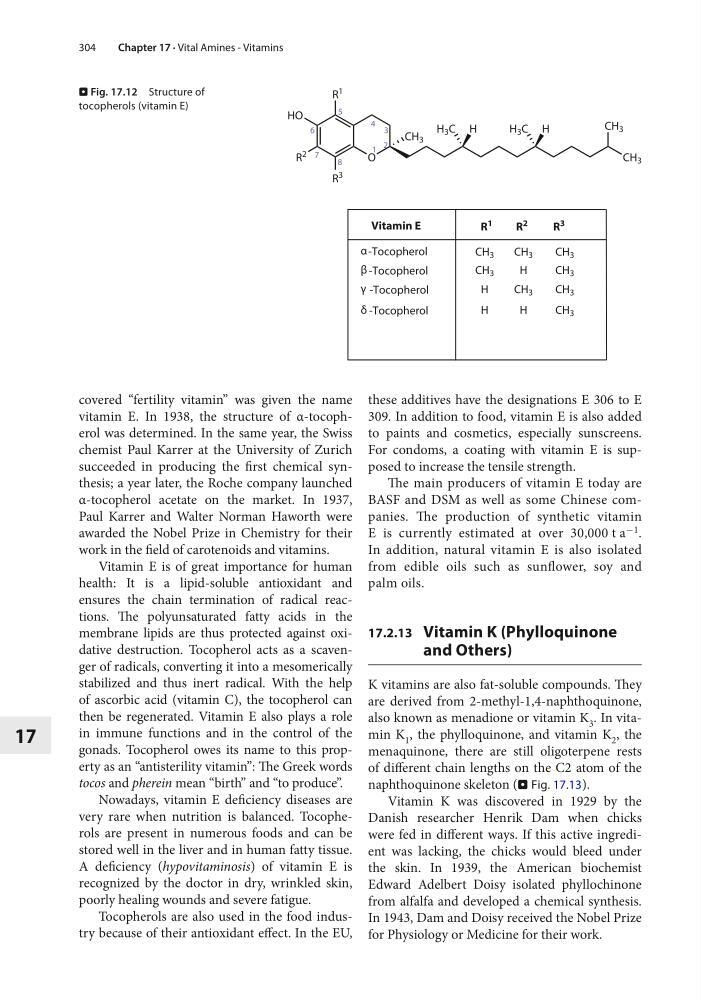
. Fig. 17.12 Structure of
tocopherols (vitamin E)
Vitamin E
O
R 1
HO
R 2
R
3
CH 3
CH 3
CH 3
H 3 C
H 3 C
H
H
1
2
3
4
5
6
7
8
-Tocopherol
R
1
R
2
R
3
CH 3
CH 3
CH 3
CH 3
CH 3
CH 3
H
H
H
H
CH 3
CH 3
-Tocopherol
-Tocopherol
-Tocopherol
α
β
γ
δ
Chapter 17 · Vital Amines - Vitamins
17
these additives have the designations E 306 to E
309. In addition to food, vitamin E is also added
to paints and cosmetics, especially sunscreens.
For condoms, a coating with vitamin E is supposed to increase the tensile strength.
The main producers of vitamin E today are
BASF and DSM as well as some Chinese companies. The production of synthetic vitamin
E is currently estimated at over 30,000 t a −1 .
In addition, natural vitamin E is also isolated
from edible oils such as sunflower, soy and
palm oils.
17.2.13 Vitamin K (Phylloquinone
and Others)
K vitamins are also fat-soluble compounds. They
are derived from 2-methyl-1,4-naphthoquinone,
also known as menadione or vitamin K 3 . In vitamin K 1 , the phylloquinone, and vitamin K 2 , the
menaquinone, there are still oligoterpene rests
of different chain lengths on the C2 atom of the
naphthoquinone skeleton (. Fig. 17.13).
Vitamin K was discovered in 1929 by the
Danish researcher Henrik Dam when chicks
were fed in different ways. If this active ingredient was lacking, the chicks would bleed under
the skin. In 1939, the American biochemist
Edward Adelbert Doisy isolated phyllochinone
from alfalfa and developed a chemical synthesis.
In 1943, Dam and Doisy received the Nobel Prize
for Physiology or Medicine for their work.
covered “fertility vitamin” was given the name
vitamin E. In 1938, the structure of α-tocopherol was determined. In the same year, the Swiss
chemist Paul Karrer at the University of Zurich
succeeded in producing the first chemical synthesis; a year later, the Roche company launched
α-tocopherol acetate on the market. In 1937,
Paul Karrer and Walter Norman Haworth were
awarded the Nobel Prize in Chemistry for their
work in the field of carotenoids and vitamins.
Vitamin E is of great importance for human
health: It is a lipid-soluble antioxidant and
ensures the chain termination of radical reactions. The polyunsaturated fatty acids in the
membrane lipids are thus protected against oxidative destruction. Tocopherol acts as a scavenger of radicals, converting it into a mesomerically
stabilized and thus inert radical. With the help
of ascorbic acid (vitamin C), the tocopherol can
then be regenerated. Vitamin E also plays a role
in immune functions and in the control of the
gonads. Tocopherol owes its name to this property as an “antisterility vitamin”: The Greek words
tocos and pherein mean “birth” and “to produce”.
Nowadays, vitamin E deficiency diseases are
very rare when nutrition is balanced. Tocopherols are present in numerous foods and can be
stored well in the liver and in human fatty tissue.
A deficiency (hypovitaminosis) of vitamin E is
recognized by the doctor in dry, wrinkled skin,
poorly healing wounds and severe fatigue.
Tocopherols are also used in the food industry because of their antioxidant effect. In the EU,
. Fig. 17.12 Structure of
tocopherols (vitamin E)
Vitamin E
O
R 1
HO
R 2
R
3
CH 3
CH 3
CH 3
H 3 C
H 3 C
H
H
1
2
3
4
5
6
7
8
-Tocopherol
R
1
R
2
R
3
CH 3
CH 3
CH 3
CH 3
CH 3
CH 3
H
H
H
H
CH 3
CH 3
-Tocopherol
-Tocopherol
-Tocopherol
α
β
γ
δ