

303
17
ever, cholecalciferol can also be produced from
7-dehydrocholesterol by UV-B radiation of
human skin. Strictly speaking, vitamin D is
therefore not a vitamin because under favorable
conditions people can produce it themselves.
Vitamin D 3 is produced by the company
DSM in a semi-synthetic way. For this, cholesterol (. Fig. 16.18) is extracted from wool fat and
converted in a few reaction steps into 7-dehydrocholesterol, also known as “provitamin D”.
Photolysis with a mercury vapor lamp opens the
B-ring of the steroid and when heated to 80 °C
the cholecalciferol is formed. The world annual
production of vitamin D 3 in 2006 amounted to
approx. 37 tons, a large part of which is added to
animal feed.
17.2.12 Vitamin E (Tocopherols)
Tocopherols, i.e. vitamin E, also belong to the
fat-soluble vitamins. Their structure results from
the chroman skeleton, with a branched saturated
alkyl chain in position 2 and a hydroxyl group
in position 6. The four different tocopherols differ in whether further methyl groups are bound
at positions 5, 7 and 8. In the most biologically
effective tocopherol, α-tocopherol, all three positions have a methyl group (. Fig. 17.12).
As early as 1922, the American researcher
Herbert M. Evans and his assistant Katherine
Scott Bishop discovered a “factor” that is essential for the reproduction of rats. This compound
was later found in wheat germ oil, rapeseed oil
and sunflower oil; it also exists in meat, egg yolk,
dairy products and leafy vegetables (cabbage,
spinach, lettuce). Since vitamins A, B, C and D
were already known at that time, the newly dis17.2.11 Vitamin D (Calciferols)
Already in ancient times a deficiency disease
was known, which leads to growth disturbances
and bone deformations of children. This disease, called rickets “English disease”, gained
importance at the time of industrialization in
the nineteenth century, because the population
was partly insufficiently fed and had to live in
dark houses due to urbanization. In search of the
cause, it was found that rickets can be cured by
cod liver oil as well as by regular exposure to the
sun.
The reason for the rickets is a lack of vitamin
D. Several fat-soluble compounds derived from
steroids (7 Chap. 16) are grouped under this
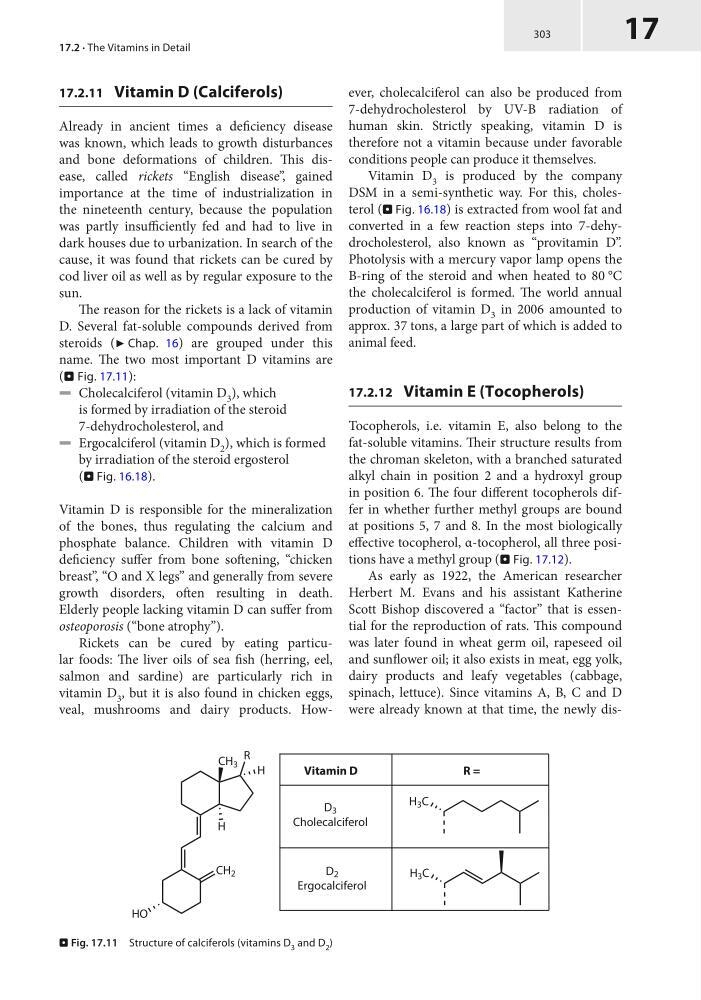
name. The two most important D vitamins are
(. Fig. 17.11):
5 Cholecalciferol (vitamin D 3 ), which
is formed by irradiation of the steroid
7-dehydrocholesterol, and
5 Ergocalciferol (vitamin D 2 ), which is formed
by irradiation of the steroid ergosterol
(. Fig. 16.18).
Vitamin D is responsible for the mineralization
of the bones, thus regulating the calcium and
phosphate balance. Children with vitamin D
deficiency suffer from bone softening, “chicken
breast”, “O and X legs” and generally from severe
growth disorders, often resulting in death.
Elderly people lacking vitamin D can suffer from
osteoporosis (“bone atrophy”).
Rickets can be cured by eating particular foods: The liver oils of sea fish (herring, eel,
salmon and sardine) are particularly rich in
vitamin D 3 , but it is also found in chicken eggs,
veal, mushrooms and dairy products. HowCH 2
HO
H
CH 3
R
H
Vitamin D
R =
H 3 C
H 3 C
D 3
Cholecalciferol
D 2
Ergocalciferol
. Fig. 17.11 Structure of calciferols (vitamins D 3 and D 2 )
17.2 · The Vitamins in Detail
17
ever, cholecalciferol can also be produced from
7-dehydrocholesterol by UV-B radiation of
human skin. Strictly speaking, vitamin D is
therefore not a vitamin because under favorable
conditions people can produce it themselves.
Vitamin D 3 is produced by the company
DSM in a semi-synthetic way. For this, cholesterol (. Fig. 16.18) is extracted from wool fat and
converted in a few reaction steps into 7-dehydrocholesterol, also known as “provitamin D”.
Photolysis with a mercury vapor lamp opens the
B-ring of the steroid and when heated to 80 °C
the cholecalciferol is formed. The world annual
production of vitamin D 3 in 2006 amounted to
approx. 37 tons, a large part of which is added to
animal feed.
17.2.12 Vitamin E (Tocopherols)
Tocopherols, i.e. vitamin E, also belong to the
fat-soluble vitamins. Their structure results from
the chroman skeleton, with a branched saturated
alkyl chain in position 2 and a hydroxyl group
in position 6. The four different tocopherols differ in whether further methyl groups are bound
at positions 5, 7 and 8. In the most biologically
effective tocopherol, α-tocopherol, all three positions have a methyl group (. Fig. 17.12).
As early as 1922, the American researcher
Herbert M. Evans and his assistant Katherine
Scott Bishop discovered a “factor” that is essential for the reproduction of rats. This compound
was later found in wheat germ oil, rapeseed oil
and sunflower oil; it also exists in meat, egg yolk,
dairy products and leafy vegetables (cabbage,
spinach, lettuce). Since vitamins A, B, C and D
were already known at that time, the newly dis17.2.11 Vitamin D (Calciferols)
Already in ancient times a deficiency disease
was known, which leads to growth disturbances
and bone deformations of children. This disease, called rickets “English disease”, gained
importance at the time of industrialization in
the nineteenth century, because the population
was partly insufficiently fed and had to live in
dark houses due to urbanization. In search of the
cause, it was found that rickets can be cured by
cod liver oil as well as by regular exposure to the
sun.
The reason for the rickets is a lack of vitamin
D. Several fat-soluble compounds derived from
steroids (7 Chap. 16) are grouped under this
name. The two most important D vitamins are
(. Fig. 17.11):
5 Cholecalciferol (vitamin D 3 ), which
is formed by irradiation of the steroid
7-dehydrocholesterol, and
5 Ergocalciferol (vitamin D 2 ), which is formed
by irradiation of the steroid ergosterol
(. Fig. 16.18).
Vitamin D is responsible for the mineralization
of the bones, thus regulating the calcium and
phosphate balance. Children with vitamin D
deficiency suffer from bone softening, “chicken
breast”, “O and X legs” and generally from severe
growth disorders, often resulting in death.
Elderly people lacking vitamin D can suffer from
osteoporosis (“bone atrophy”).
Rickets can be cured by eating particular foods: The liver oils of sea fish (herring, eel,
salmon and sardine) are particularly rich in
vitamin D 3 , but it is also found in chicken eggs,
veal, mushrooms and dairy products. HowCH 2
HO
H
CH 3
R
H
Vitamin D
R =
H 3 C
H 3 C
D 3
Cholecalciferol
D 2
Ergocalciferol
. Fig. 17.11 Structure of calciferols (vitamins D 3 and D 2 )
17.2 · The Vitamins in Detail