

298
Chapter 17 · Vital Amines - Vitamins
17
The nicotinic acid present in these two foods
is bound in a way that the human body cannot utilize. Synthetically, nicotinic acid is easily
accessible through oxidation of β-picoline, i.e.
3-methylpyridine. Production is estimated at
several thousand tons per year.
17.2.5 Vitamin B 5 (Pantothenic Acid)
Pantothenic acid, which is also water soluble, is
chemically dihydroxydimethylbutanoic acid,
which is linked via an amide bridge to the amino
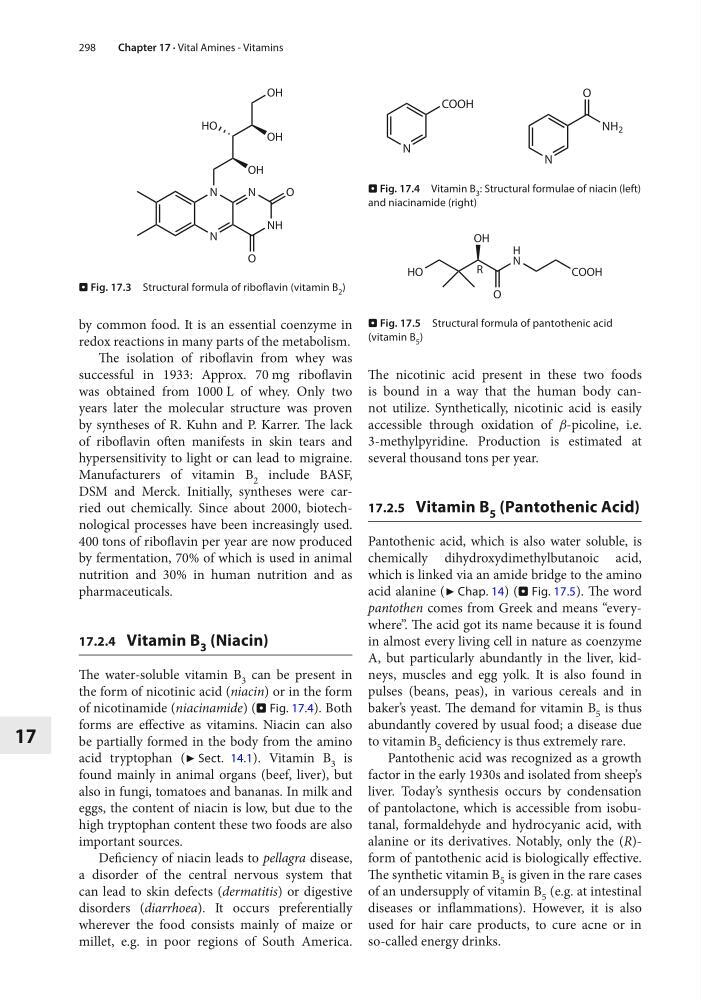
acid alanine (7 Chap. 14) (. Fig. 17.5). The word
pantothen comes from Greek and means “everywhere”. The acid got its name because it is found
in almost every living cell in nature as coenzyme
A, but particularly abundantly in the liver, kidneys, muscles and egg yolk. It is also found in
pulses (beans, peas), in various cereals and in
baker’s yeast. The demand for vitamin B 5 is thus
abundantly covered by usual food; a disease due
to vitamin B 5 deficiency is thus extremely rare.
Pantothenic acid was recognized as a growth
factor in the early 1930s and isolated from sheep’s
liver. Today’s synthesis occurs by condensation
of pantolactone, which is accessible from isobutanal, formaldehyde and hydrocyanic acid, with
alanine or its derivatives. Notably, only the (R)form of pantothenic acid is biologically effective.
The synthetic vitamin B 5 is given in the rare cases
of an undersupply of vitamin B 5 (e.g. at intestinal
diseases or inflammations). However, it is also
used for hair care products, to cure acne or in
so-called energy drinks.
by common food. It is an essential coenzyme in
redox reactions in many parts of the metabolism.
The isolation of riboflavin from whey was
successful in 1933: Approx. 70 mg riboflavin
was obtained from 1000 L of whey. Only two
years later the molecular structure was proven
by syntheses of R. Kuhn and P. Karrer. The lack
of riboflavin often manifests in skin tears and
hypersensitivity to light or can lead to migraine.
Manufacturers of vitamin B 2 include BASF,
DSM and Merck. Initially, syntheses were carried out chemically. Since about 2000, biotechnological processes have been increasingly used.
400 tons of riboflavin per year are now produced
by fermentation, 70% of which is used in animal
nutrition and 30% in human nutrition and as
pharmaceuticals.
17.2.4 Vitamin B 3 (Niacin)
The water-soluble vitamin B 3 can be present in
the form of nicotinic acid (niacin) or in the form
of nicotinamide (niacinamide) (. Fig. 17.4). Both
forms are effective as vitamins. Niacin can also
be partially formed in the body from the amino
acid tryptophan (7 Sect. 14.1). Vitamin B 3 is
found mainly in animal organs (beef, liver), but
also in fungi, tomatoes and bananas. In milk and
eggs, the content of niacin is low, but due to the
high tryptophan content these two foods are also
important sources.
Deficiency of niacin leads to pellagra disease,
a disorder of the central nervous system that
can lead to skin defects (dermatitis) or digestive
disorders (diarrhoea). It occurs preferentially
wherever the food consists mainly of maize or
millet, e.g. in poor regions of South America.
N
N
NH
N
O
O
OH
OH
OH
HO
. Fig. 17.3 Structural formula of riboflavin (vitamin B 2 )
N
N
COOH
NH 2
O
. Fig. 17.4 Vitamin B 3 : Structural formulae of niacin (left)
and niacinamide (right)
HO
H
N
COOH
O
OH
R
. Fig. 17.5 Structural formula of pantothenic acid
(vitamin B 5 )
Chapter 17 · Vital Amines - Vitamins
17
The nicotinic acid present in these two foods
is bound in a way that the human body cannot utilize. Synthetically, nicotinic acid is easily
accessible through oxidation of β-picoline, i.e.
3-methylpyridine. Production is estimated at
several thousand tons per year.
17.2.5 Vitamin B 5 (Pantothenic Acid)
Pantothenic acid, which is also water soluble, is
chemically dihydroxydimethylbutanoic acid,
which is linked via an amide bridge to the amino
acid alanine (7 Chap. 14) (. Fig. 17.5). The word
pantothen comes from Greek and means “everywhere”. The acid got its name because it is found
in almost every living cell in nature as coenzyme
A, but particularly abundantly in the liver, kidneys, muscles and egg yolk. It is also found in
pulses (beans, peas), in various cereals and in
baker’s yeast. The demand for vitamin B 5 is thus
abundantly covered by usual food; a disease due
to vitamin B 5 deficiency is thus extremely rare.
Pantothenic acid was recognized as a growth
factor in the early 1930s and isolated from sheep’s
liver. Today’s synthesis occurs by condensation
of pantolactone, which is accessible from isobutanal, formaldehyde and hydrocyanic acid, with
alanine or its derivatives. Notably, only the (R)form of pantothenic acid is biologically effective.
The synthetic vitamin B 5 is given in the rare cases
of an undersupply of vitamin B 5 (e.g. at intestinal
diseases or inflammations). However, it is also
used for hair care products, to cure acne or in
so-called energy drinks.
by common food. It is an essential coenzyme in
redox reactions in many parts of the metabolism.
The isolation of riboflavin from whey was
successful in 1933: Approx. 70 mg riboflavin
was obtained from 1000 L of whey. Only two
years later the molecular structure was proven
by syntheses of R. Kuhn and P. Karrer. The lack
of riboflavin often manifests in skin tears and
hypersensitivity to light or can lead to migraine.
Manufacturers of vitamin B 2 include BASF,
DSM and Merck. Initially, syntheses were carried out chemically. Since about 2000, biotechnological processes have been increasingly used.
400 tons of riboflavin per year are now produced
by fermentation, 70% of which is used in animal
nutrition and 30% in human nutrition and as
pharmaceuticals.
17.2.4 Vitamin B 3 (Niacin)
The water-soluble vitamin B 3 can be present in
the form of nicotinic acid (niacin) or in the form
of nicotinamide (niacinamide) (. Fig. 17.4). Both
forms are effective as vitamins. Niacin can also
be partially formed in the body from the amino
acid tryptophan (7 Sect. 14.1). Vitamin B 3 is
found mainly in animal organs (beef, liver), but
also in fungi, tomatoes and bananas. In milk and
eggs, the content of niacin is low, but due to the
high tryptophan content these two foods are also
important sources.
Deficiency of niacin leads to pellagra disease,
a disorder of the central nervous system that
can lead to skin defects (dermatitis) or digestive
disorders (diarrhoea). It occurs preferentially
wherever the food consists mainly of maize or
millet, e.g. in poor regions of South America.
N
N
NH
N
O
O
OH
OH
OH
HO
. Fig. 17.3 Structural formula of riboflavin (vitamin B 2 )
N
N
COOH
NH 2
O
. Fig. 17.4 Vitamin B 3 : Structural formulae of niacin (left)
and niacinamide (right)
HO
H
N
COOH
O
OH
R
. Fig. 17.5 Structural formula of pantothenic acid
(vitamin B 5 )