

297
17
In early 2015, BASF announced to increase its
vitamin A production in Ludwigshafen by a further 25% (i.e. 1.500 t) going on stream in 2020.
17.2.2 Vitamin B 1 (Thiamine)
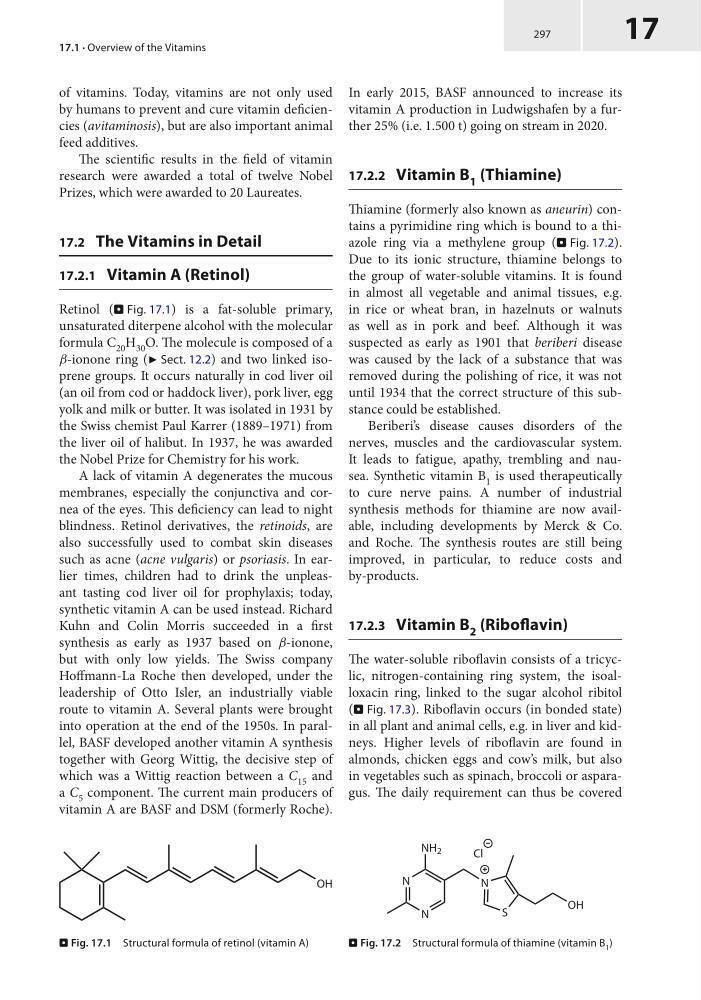
Thiamine (formerly also known as aneurin) contains a pyrimidine ring which is bound to a thiazole ring via a methylene group (. Fig. 17.2).
Due to its ionic structure, thiamine belongs to
the group of water-soluble vitamins. It is found
in almost all vegetable and animal tissues, e.g.
in rice or wheat bran, in hazelnuts or walnuts
as well as in pork and beef. Although it was
suspected as early as 1901 that beriberi disease
was caused by the lack of a substance that was
removed during the polishing of rice, it was not
until 1934 that the correct structure of this substance could be established.
Beriberi’s disease causes disorders of the
nerves, muscles and the cardiovascular system.
It leads to fatigue, apathy, trembling and nausea. Synthetic vitamin B 1 is used therapeutically
to cure nerve pains. A number of industrial
synthesis methods for thiamine are now available, including developments by Merck & Co.
and Roche. The synthesis routes are still being
improved, in particular, to reduce costs and
by-products.
17.2.3 Vitamin B 2 (Riboflavin)
The water-soluble riboflavin consists of a tricyclic, nitrogen-containing ring system, the isoalloxacin ring, linked to the sugar alcohol ribitol
(. Fig. 17.3). Riboflavin occurs (in bonded state)
in all plant and animal cells, e.g. in liver and kidneys. Higher levels of riboflavin are found in
almonds, chicken eggs and cow’s milk, but also
in vegetables such as spinach, broccoli or asparagus. The daily requirement can thus be covered
of vitamins. Today, vitamins are not only used
by humans to prevent and cure vitamin deficiencies (avitaminosis), but are also important animal
feed additives.
The scientific results in the field of vitamin
research were awarded a total of twelve Nobel
Prizes, which were awarded to 20 Laureates.
17.2 The Vitamins in Detail
17.2.1 Vitamin A (Retinol)
Retinol (. Fig. 17.1) is a fat-soluble primary,
unsaturated diterpene alcohol with the molecular
formula C 20 H 30 O. The molecule is composed of a
β-ionone ring (7 Sect. 12.2) and two linked isoprene groups. It occurs naturally in cod liver oil
(an oil from cod or haddock liver), pork liver, egg
yolk and milk or butter. It was isolated in 1931 by
the Swiss chemist Paul Karrer (1889–1971) from
the liver oil of halibut. In 1937, he was awarded
the Nobel Prize for Chemistry for his work.
A lack of vitamin A degenerates the mucous
membranes, especially the conjunctiva and cornea of the eyes. This deficiency can lead to night
blindness. Retinol derivatives, the retinoids, are
also successfully used to combat skin diseases
such as acne (acne vulgaris) or psoriasis. In earlier times, children had to drink the unpleasant tasting cod liver oil for prophylaxis; today,
synthetic vitamin A can be used instead. Richard
Kuhn and Colin Morris succeeded in a first
synthesis as early as 1937 based on β-ionone,
but with only low yields. The Swiss company
Hoffmann-La Roche then developed, under the
leadership of Otto Isler, an industrially viable
route to vitamin A. Several plants were brought
into operation at the end of the 1950s. In parallel, BASF developed another vitamin A synthesis
together with Georg Wittig, the decisive step of
which was a Wittig reaction between a C 15 and
a C 5 component. The current main producers of
vitamin A are BASF and DSM (formerly Roche).
OH
. Fig. 17.1 Structural formula of retinol (vitamin A)
N
N
NH 2
N
S
OH
Cl
. Fig. 17.2 Structural formula of thiamine (vitamin B 1 )
17.1 · Overview of the Vitamins
17
In early 2015, BASF announced to increase its
vitamin A production in Ludwigshafen by a further 25% (i.e. 1.500 t) going on stream in 2020.
17.2.2 Vitamin B 1 (Thiamine)
Thiamine (formerly also known as aneurin) contains a pyrimidine ring which is bound to a thiazole ring via a methylene group (. Fig. 17.2).
Due to its ionic structure, thiamine belongs to
the group of water-soluble vitamins. It is found
in almost all vegetable and animal tissues, e.g.
in rice or wheat bran, in hazelnuts or walnuts
as well as in pork and beef. Although it was
suspected as early as 1901 that beriberi disease
was caused by the lack of a substance that was
removed during the polishing of rice, it was not
until 1934 that the correct structure of this substance could be established.
Beriberi’s disease causes disorders of the
nerves, muscles and the cardiovascular system.
It leads to fatigue, apathy, trembling and nausea. Synthetic vitamin B 1 is used therapeutically
to cure nerve pains. A number of industrial
synthesis methods for thiamine are now available, including developments by Merck & Co.
and Roche. The synthesis routes are still being
improved, in particular, to reduce costs and
by-products.
17.2.3 Vitamin B 2 (Riboflavin)
The water-soluble riboflavin consists of a tricyclic, nitrogen-containing ring system, the isoalloxacin ring, linked to the sugar alcohol ribitol
(. Fig. 17.3). Riboflavin occurs (in bonded state)
in all plant and animal cells, e.g. in liver and kidneys. Higher levels of riboflavin are found in
almonds, chicken eggs and cow’s milk, but also
in vegetables such as spinach, broccoli or asparagus. The daily requirement can thus be covered
of vitamins. Today, vitamins are not only used
by humans to prevent and cure vitamin deficiencies (avitaminosis), but are also important animal
feed additives.
The scientific results in the field of vitamin
research were awarded a total of twelve Nobel
Prizes, which were awarded to 20 Laureates.
17.2 The Vitamins in Detail
17.2.1 Vitamin A (Retinol)
Retinol (. Fig. 17.1) is a fat-soluble primary,
unsaturated diterpene alcohol with the molecular
formula C 20 H 30 O. The molecule is composed of a
β-ionone ring (7 Sect. 12.2) and two linked isoprene groups. It occurs naturally in cod liver oil
(an oil from cod or haddock liver), pork liver, egg
yolk and milk or butter. It was isolated in 1931 by
the Swiss chemist Paul Karrer (1889–1971) from
the liver oil of halibut. In 1937, he was awarded
the Nobel Prize for Chemistry for his work.
A lack of vitamin A degenerates the mucous
membranes, especially the conjunctiva and cornea of the eyes. This deficiency can lead to night
blindness. Retinol derivatives, the retinoids, are
also successfully used to combat skin diseases
such as acne (acne vulgaris) or psoriasis. In earlier times, children had to drink the unpleasant tasting cod liver oil for prophylaxis; today,
synthetic vitamin A can be used instead. Richard
Kuhn and Colin Morris succeeded in a first
synthesis as early as 1937 based on β-ionone,
but with only low yields. The Swiss company
Hoffmann-La Roche then developed, under the
leadership of Otto Isler, an industrially viable
route to vitamin A. Several plants were brought
into operation at the end of the 1950s. In parallel, BASF developed another vitamin A synthesis
together with Georg Wittig, the decisive step of
which was a Wittig reaction between a C 15 and
a C 5 component. The current main producers of
vitamin A are BASF and DSM (formerly Roche).
OH
. Fig. 17.1 Structural formula of retinol (vitamin A)
N
N
NH 2
N
S
OH
Cl
. Fig. 17.2 Structural formula of thiamine (vitamin B 1 )
17.1 · Overview of the Vitamins