

296
Chapter 17 · Vital Amines - Vitamins
17
salt and water. Therefore, other substances that
are essential for health had to exist in food. If
these substances are absent, “deficiency diseases” occur. For example, the outbreak of a beriberi-like disease in chickens could be prevented
by adding rice bran to the feed. The Polish biochemist Casimir Funk finally proved in 1912 that
the bioactive substance in rice bran is thiamine,
which was later called vitamin B 1 . This distinction of vitamins with the capital letters A, B, C,
D, E and K was introduced in 1916. Since it later
turned out that vitamin B consisted of several
components, a further subdivision into B 1 , B 2 ,
etc. was introduced.
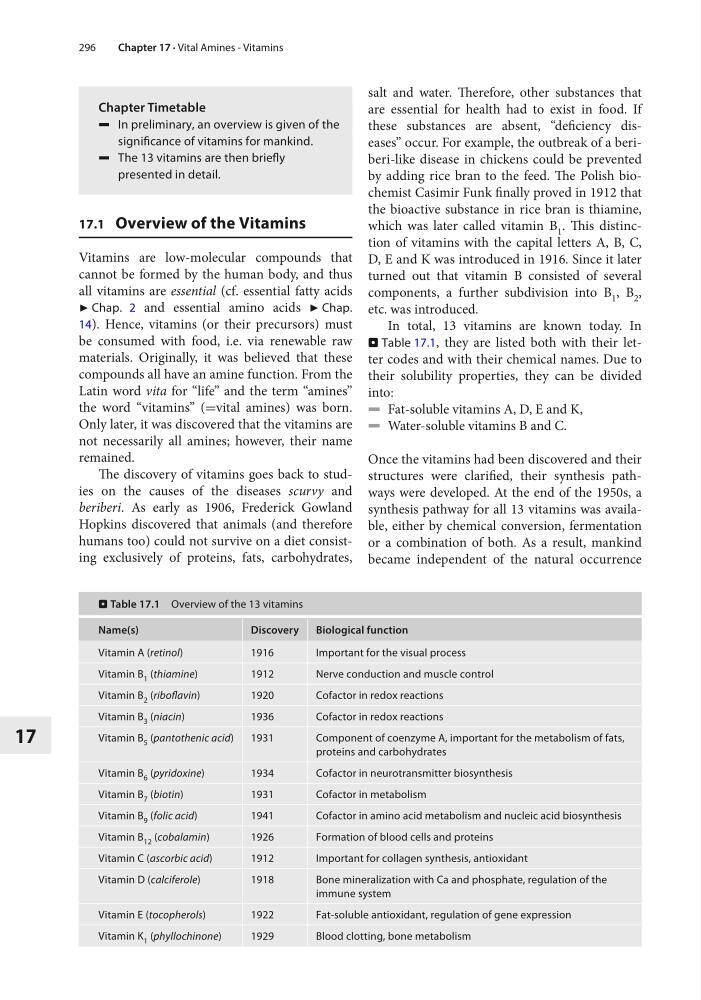
In total, 13 vitamins are known today. In
. Table 17.1, they are listed both with their letter codes and with their chemical names. Due to
their solubility properties, they can be divided
into:
5 Fat-soluble vitamins A, D, E and K,
5 Water-soluble vitamins B and C.
Once the vitamins had been discovered and their
structures were clarified, their synthesis pathways were developed. At the end of the 1950s, a
synthesis pathway for all 13 vitamins was available, either by chemical conversion, fermentation
or a combination of both. As a result, mankind
became independent of the natural occurrence
Chapter Timetable
5 In preliminary, an overview is given of the
significance of vitamins for mankind.
5 The 13 vitamins are then briefly
presented in detail.
17.1 Overview of the Vitamins
Vitamins are low-molecular compounds that
cannot be formed by the human body, and thus
all vitamins are essential (cf. essential fatty acids
7 Chap. 2 and essential amino acids 7 Chap.
14). Hence, vitamins (or their precursors) must
be consumed with food, i.e. via renewable raw
materials. Originally, it was believed that these
compounds all have an amine function. From the
Latin word vita for “life” and the term “amines”
the word “vitamins” (=vital amines) was born.
Only later, it was discovered that the vitamins are
not necessarily all amines; however, their name
remained.
The discovery of vitamins goes back to studies on the causes of the diseases scurvy and
beriberi. As early as 1906, Frederick Gowland
Hopkins discovered that animals (and therefore
humans too) could not survive on a diet consisting exclusively of proteins, fats, carbohydrates,
. Table 17.1 Overview of the 13 vitamins
Name(s)
Discovery
Biological function
Vitamin A (retinol)
1916
Important for the visual process
Vitamin B 1 (thiamine)
1912
Nerve conduction and muscle control
Vitamin B 2 (riboflavin)
1920
Cofactor in redox reactions
Vitamin B 3 (niacin)
1936
Cofactor in redox reactions
Vitamin B 5 (pantothenic acid)
1931
Component of coenzyme A, important for the metabolism of fats,
proteins and carbohydrates
Vitamin B 6 (pyridoxine)
1934
Cofactor in neurotransmitter biosynthesis
Vitamin B 7 (biotin)
1931
Cofactor in metabolism
Vitamin B 9 (folic acid)
1941
Cofactor in amino acid metabolism and nucleic acid biosynthesis
Vitamin B 12 (cobalamin)
1926
Formation of blood cells and proteins
Vitamin C (ascorbic acid)
1912
Important for collagen synthesis, antioxidant
Vitamin D (calciferole)
1918
Bone mineralization with Ca and phosphate, regulation of the
immune system
Vitamin E (tocopherols)
1922
Fat-soluble antioxidant, regulation of gene expression
Vitamin K 1 (phyllochinone)
1929
Blood clotting, bone metabolism
Chapter 17 · Vital Amines - Vitamins
17
salt and water. Therefore, other substances that
are essential for health had to exist in food. If
these substances are absent, “deficiency diseases” occur. For example, the outbreak of a beriberi-like disease in chickens could be prevented
by adding rice bran to the feed. The Polish biochemist Casimir Funk finally proved in 1912 that
the bioactive substance in rice bran is thiamine,
which was later called vitamin B 1 . This distinction of vitamins with the capital letters A, B, C,
D, E and K was introduced in 1916. Since it later
turned out that vitamin B consisted of several
components, a further subdivision into B 1 , B 2 ,
etc. was introduced.
In total, 13 vitamins are known today. In
. Table 17.1, they are listed both with their letter codes and with their chemical names. Due to
their solubility properties, they can be divided
into:
5 Fat-soluble vitamins A, D, E and K,
5 Water-soluble vitamins B and C.
Once the vitamins had been discovered and their
structures were clarified, their synthesis pathways were developed. At the end of the 1950s, a
synthesis pathway for all 13 vitamins was available, either by chemical conversion, fermentation
or a combination of both. As a result, mankind
became independent of the natural occurrence
Chapter Timetable
5 In preliminary, an overview is given of the
significance of vitamins for mankind.
5 The 13 vitamins are then briefly
presented in detail.
17.1 Overview of the Vitamins
Vitamins are low-molecular compounds that
cannot be formed by the human body, and thus
all vitamins are essential (cf. essential fatty acids
7 Chap. 2 and essential amino acids 7 Chap.
14). Hence, vitamins (or their precursors) must
be consumed with food, i.e. via renewable raw
materials. Originally, it was believed that these
compounds all have an amine function. From the
Latin word vita for “life” and the term “amines”
the word “vitamins” (=vital amines) was born.
Only later, it was discovered that the vitamins are
not necessarily all amines; however, their name
remained.
The discovery of vitamins goes back to studies on the causes of the diseases scurvy and
beriberi. As early as 1906, Frederick Gowland
Hopkins discovered that animals (and therefore
humans too) could not survive on a diet consisting exclusively of proteins, fats, carbohydrates,
. Table 17.1 Overview of the 13 vitamins
Name(s)
Discovery
Biological function
Vitamin A (retinol)
1916
Important for the visual process
Vitamin B 1 (thiamine)
1912
Nerve conduction and muscle control
Vitamin B 2 (riboflavin)
1920
Cofactor in redox reactions
Vitamin B 3 (niacin)
1936
Cofactor in redox reactions
Vitamin B 5 (pantothenic acid)
1931
Component of coenzyme A, important for the metabolism of fats,
proteins and carbohydrates
Vitamin B 6 (pyridoxine)
1934
Cofactor in neurotransmitter biosynthesis
Vitamin B 7 (biotin)
1931
Cofactor in metabolism
Vitamin B 9 (folic acid)
1941
Cofactor in amino acid metabolism and nucleic acid biosynthesis
Vitamin B 12 (cobalamin)
1926
Formation of blood cells and proteins
Vitamin C (ascorbic acid)
1912
Important for collagen synthesis, antioxidant
Vitamin D (calciferole)
1918
Bone mineralization with Ca and phosphate, regulation of the
immune system
Vitamin E (tocopherols)
1922
Fat-soluble antioxidant, regulation of gene expression
Vitamin K 1 (phyllochinone)
1929
Blood clotting, bone metabolism