

299
17
The first total biotin synthesis was published by Merck in 1943, followed by patents
from Hoffmann-La Roche in 1946. Today, about
40 multistage chemical syntheses do exist. The
world market is approximately 100 t a −1 . These
are mainly used for animal nutrition, followed
by application in multivitamin preparations and
pharmaceuticals. The main producers are DSM,
the Japanese companies Tanabe and Sumitomo
as well as Chinese manufacturers.
17.2.8 Vitamin B 9 (Folic Acid)
The structural formula of folic acid consists
of the two structural elements pteroic acid
and l-glutamic acid. Pteroic acid in turn consists of p-aminobenzoic acid and the pteridine
ring (. Fig. 17.8). However, the term “folates”
also refers to other folic acid derivatives that
have peptidically bound up to six glutamic acid
groups. Initially, folic acid was isolated from liver
extracts and spinach leaves (lat. folium, leaf).
Folic acid can be produced in a multistage synthesis from relatively simple starting components
on a ton scale.
Many foods contain relatively high levels
of folic acid, e.g. yeasts, wheat germ, calf, poultry and beef liver, legumes (especially lentils),
asparagus, chicken eggs, salad and oranges. As
a growth factor of leukocytes, folic acid influences blood formation. A lack of folic acid leads
to anaemia, i.e. there is too little haemoglobin
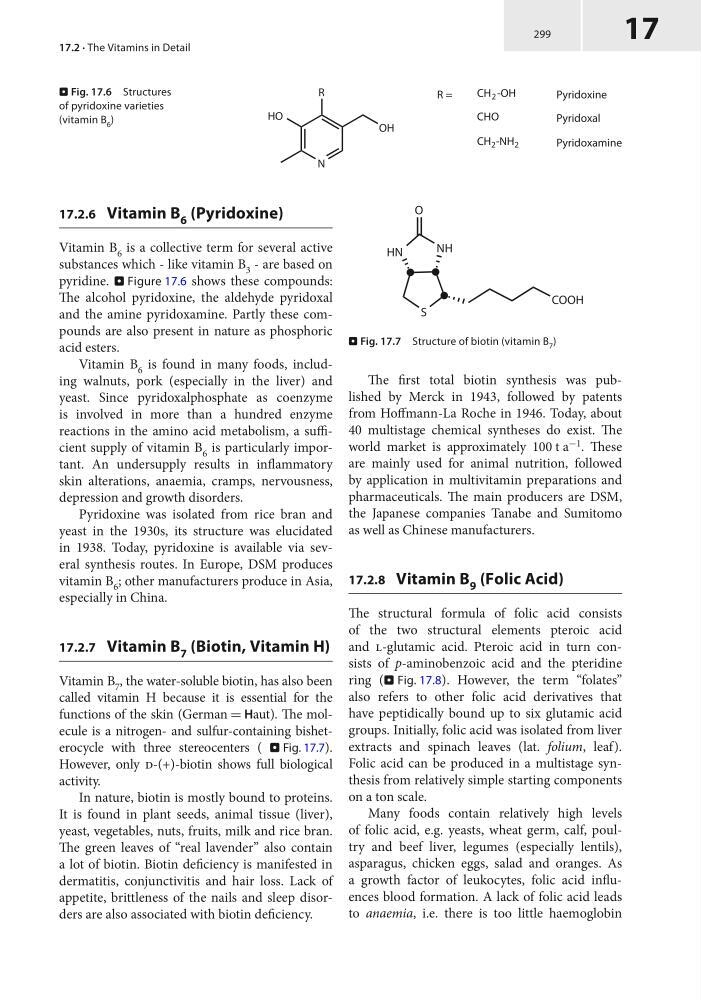
17.2.6 Vitamin B 6 (Pyridoxine)
Vitamin B 6 is a collective term for several active
substances which - like vitamin B 3 - are based on
pyridine. . Figure 17.6 shows these compounds:
The alcohol pyridoxine, the aldehyde pyridoxal
and the amine pyridoxamine. Partly these compounds are also present in nature as phosphoric
acid esters.
Vitamin B 6 is found in many foods, including walnuts, pork (especially in the liver) and
yeast. Since pyridoxalphosphate as coenzyme
is involved in more than a hundred enzyme
reactions in the amino acid metabolism, a sufficient supply of vitamin B 6 is particularly important. An undersupply results in inflammatory
skin alterations, anaemia, cramps, nervousness,
depression and growth disorders.
Pyridoxine was isolated from rice bran and
yeast in the 1930s, its structure was elucidated
in 1938. Today, pyridoxine is available via several synthesis routes. In Europe, DSM produces
vitamin B 6 ; other manufacturers produce in Asia,
especially in China.
17.2.7 Vitamin B 7 (Biotin, Vitamin H)
Vitamin B 7 , the water-soluble biotin, has also been
called vitamin H because it is essential for the
functions of the skin (German = Haut). The molecule is a nitrogen- and sulfur-containing bisheterocycle with three stereocenters ( . Fig. 17.7).
However, only d-(+)-biotin shows full biological
activity.
In nature, biotin is mostly bound to proteins.
It is found in plant seeds, animal tissue (liver),
yeast, vegetables, nuts, fruits, milk and rice bran.
The green leaves of “real lavender” also contain
a lot of biotin. Biotin deficiency is manifested in
dermatitis, conjunctivitis and hair loss. Lack of
appetite, brittleness of the nails and sleep disorders are also associated with biotin deficiency.
. Fig. 17.6 Structures
of pyridoxine varieties
(vitamin B 6 )
N
HO
R
OH
R =
CHO
Pyridoxine
CH 2 -OH
Pyridoxal
CH 2 -NH 2
Pyridoxamine
S
NH
HN
COOH
O
. Fig. 17.7 Structure of biotin (vitamin B 7 )
17.2 · The Vitamins in Detail
17
The first total biotin synthesis was published by Merck in 1943, followed by patents
from Hoffmann-La Roche in 1946. Today, about
40 multistage chemical syntheses do exist. The
world market is approximately 100 t a −1 . These
are mainly used for animal nutrition, followed
by application in multivitamin preparations and
pharmaceuticals. The main producers are DSM,
the Japanese companies Tanabe and Sumitomo
as well as Chinese manufacturers.
17.2.8 Vitamin B 9 (Folic Acid)
The structural formula of folic acid consists
of the two structural elements pteroic acid
and l-glutamic acid. Pteroic acid in turn consists of p-aminobenzoic acid and the pteridine
ring (. Fig. 17.8). However, the term “folates”
also refers to other folic acid derivatives that
have peptidically bound up to six glutamic acid
groups. Initially, folic acid was isolated from liver
extracts and spinach leaves (lat. folium, leaf).
Folic acid can be produced in a multistage synthesis from relatively simple starting components
on a ton scale.
Many foods contain relatively high levels
of folic acid, e.g. yeasts, wheat germ, calf, poultry and beef liver, legumes (especially lentils),
asparagus, chicken eggs, salad and oranges. As
a growth factor of leukocytes, folic acid influences blood formation. A lack of folic acid leads
to anaemia, i.e. there is too little haemoglobin
17.2.6 Vitamin B 6 (Pyridoxine)
Vitamin B 6 is a collective term for several active
substances which - like vitamin B 3 - are based on
pyridine. . Figure 17.6 shows these compounds:
The alcohol pyridoxine, the aldehyde pyridoxal
and the amine pyridoxamine. Partly these compounds are also present in nature as phosphoric
acid esters.
Vitamin B 6 is found in many foods, including walnuts, pork (especially in the liver) and
yeast. Since pyridoxalphosphate as coenzyme
is involved in more than a hundred enzyme
reactions in the amino acid metabolism, a sufficient supply of vitamin B 6 is particularly important. An undersupply results in inflammatory
skin alterations, anaemia, cramps, nervousness,
depression and growth disorders.
Pyridoxine was isolated from rice bran and
yeast in the 1930s, its structure was elucidated
in 1938. Today, pyridoxine is available via several synthesis routes. In Europe, DSM produces
vitamin B 6 ; other manufacturers produce in Asia,
especially in China.
17.2.7 Vitamin B 7 (Biotin, Vitamin H)
Vitamin B 7 , the water-soluble biotin, has also been
called vitamin H because it is essential for the
functions of the skin (German = Haut). The molecule is a nitrogen- and sulfur-containing bisheterocycle with three stereocenters ( . Fig. 17.7).
However, only d-(+)-biotin shows full biological
activity.
In nature, biotin is mostly bound to proteins.
It is found in plant seeds, animal tissue (liver),
yeast, vegetables, nuts, fruits, milk and rice bran.
The green leaves of “real lavender” also contain
a lot of biotin. Biotin deficiency is manifested in
dermatitis, conjunctivitis and hair loss. Lack of
appetite, brittleness of the nails and sleep disorders are also associated with biotin deficiency.
. Fig. 17.6 Structures
of pyridoxine varieties
(vitamin B 6 )
N
HO
R
OH
R =
CHO
Pyridoxine
CH 2 -OH
Pyridoxal
CH 2 -NH 2
Pyridoxamine
S
NH
HN
COOH
O
. Fig. 17.7 Structure of biotin (vitamin B 7 )
17.2 · The Vitamins in Detail