

285
16
16.5 Morphine
Morphine was - as already briefly mentioned
in 7 Sect. 16.1 - already isolated from opium
in 1804 by the German pharmacist Friedrich
Sertürner. Opium is the dried latex of the opium
poppy (Papaver somniferum, . Fig. 16.12)
Sertürner first called the alkaloid morphium;
today the name morphine is common. Some substances are derived from morphine, e.g. codeine,
which is the 3-monomethyl ester of morphine
used as a cough suppressant. Heroin is also a
derivative of morphine, the 3,6-diacetylmorphine.
These compounds are collectively referred to as
“morphine group” or “opiates”.
The seeds of the poppy plant were used early
in human history for nutrition, e.g. as a spice, for
baking bread or for oil production. However, the
pharmacological properties of opium poppy have
also been known for a long time: Morphine has
BOX: Shaken or Stirred?
Some cocktails containing
quinine have brought it to
fame:
5 Queen Mum’s Cocktail:
During her lifetime, the
British Queen Mother
preferred a drink consisting
of two parts of the
quinine-containing aperitif
“Quinquina Dubonnet” and
one part gin, served with a
lemon wedge and two ice
cubes.
5 Vesper Martini: At Casino
Royal, Daniel Craig alias
James Bond ordered this
cocktail consisting of three
parts of gin, one part of
vodka and a half part of
“Kina Lillet”, an aperitif
based on white wine,
mixed with cinchona bark,
of course shaken and not
stirred.
N
N
H
N
N
N
Pyridine
Tropane
Quinoline
Isoquinoline
Indole
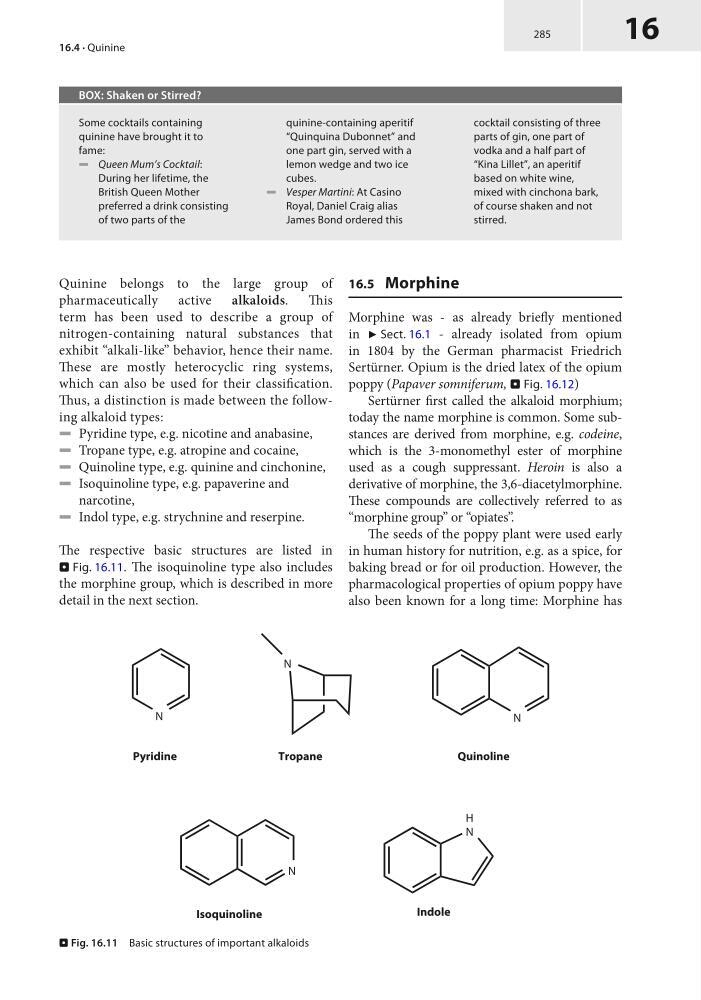
. Fig. 16.11 Basic structures of important alkaloids
16.4 · Quinine
Quinine belongs to the large group of
pharmaceutically active alkaloids. This
term has been used to describe a group of
nitrogen-containing natural substances that
exhibit “alkali-like” behavior, hence their name.
These are mostly heterocyclic ring systems,
which can also be used for their classification.
Thus, a distinction is made between the following alkaloid types:
5 Pyridine type, e.g. nicotine and anabasine,
5 Tropane type, e.g. atropine and cocaine,
5 Quinoline type, e.g. quinine and cinchonine,
5 Isoquinoline type, e.g. papaverine and
narcotine,
5 Indol type, e.g. strychnine and reserpine.
The respective basic structures are listed in
. Fig. 16.11. The isoquinoline type also includes
the morphine group, which is described in more
detail in the next section.
16
16.5 Morphine
Morphine was - as already briefly mentioned
in 7 Sect. 16.1 - already isolated from opium
in 1804 by the German pharmacist Friedrich
Sertürner. Opium is the dried latex of the opium
poppy (Papaver somniferum, . Fig. 16.12)
Sertürner first called the alkaloid morphium;
today the name morphine is common. Some substances are derived from morphine, e.g. codeine,
which is the 3-monomethyl ester of morphine
used as a cough suppressant. Heroin is also a
derivative of morphine, the 3,6-diacetylmorphine.
These compounds are collectively referred to as
“morphine group” or “opiates”.
The seeds of the poppy plant were used early
in human history for nutrition, e.g. as a spice, for
baking bread or for oil production. However, the
pharmacological properties of opium poppy have
also been known for a long time: Morphine has
BOX: Shaken or Stirred?
Some cocktails containing
quinine have brought it to
fame:
5 Queen Mum’s Cocktail:
During her lifetime, the
British Queen Mother
preferred a drink consisting
of two parts of the
quinine-containing aperitif
“Quinquina Dubonnet” and
one part gin, served with a
lemon wedge and two ice
cubes.
5 Vesper Martini: At Casino
Royal, Daniel Craig alias
James Bond ordered this
cocktail consisting of three
parts of gin, one part of
vodka and a half part of
“Kina Lillet”, an aperitif
based on white wine,
mixed with cinchona bark,
of course shaken and not
stirred.
N
N
H
N
N
N
Pyridine
Tropane
Quinoline
Isoquinoline
Indole
. Fig. 16.11 Basic structures of important alkaloids
16.4 · Quinine
Quinine belongs to the large group of
pharmaceutically active alkaloids. This
term has been used to describe a group of
nitrogen-containing natural substances that
exhibit “alkali-like” behavior, hence their name.
These are mostly heterocyclic ring systems,
which can also be used for their classification.
Thus, a distinction is made between the following alkaloid types:
5 Pyridine type, e.g. nicotine and anabasine,
5 Tropane type, e.g. atropine and cocaine,
5 Quinoline type, e.g. quinine and cinchonine,
5 Isoquinoline type, e.g. papaverine and
narcotine,
5 Indol type, e.g. strychnine and reserpine.
The respective basic structures are listed in
. Fig. 16.11. The isoquinoline type also includes
the morphine group, which is described in more
detail in the next section.