

286
Chapter 16 · Nature’s Pharmacy - Natural Pharmaceuticals
16
from the total production of opiates, an annual
production volume is difficult to determine. In
Afghanistan alone, responsible for over 90% of
illegal heroin production, more than 8000 tons of
opium are produced annually.
16.6 Penicillins and Cephalosporins
Antibiotics are among the most important chemotherapeutic agents. They are metabolic products
of fungi that are able to kill microorganisms even
in low concentrations. Because of this antimicrobial effect, they are used to treat numerous infectious diseases. They can be divided into different
classes according to their chemical structure; the
two most important classes are penicillins and
cephalosporins.
The Scottish bacteriologist Alexander Fleming (. Fig. 16.14, left) is regarded as the discoverer of penicillins, although there were
indications of this group of substances even
before he discovered them. Fleming worked
at St. Mary’s Hospital in London. In the summer of 1928, he inoculated an agar plate with
staphylococci, which he only picked up again
after his holidays. He discovered that a mould
had settled on the agar culture medium in the
vicinity of which the staphylococci had not
reproduced. Fleming called this bactericidal
mould Penicillium notatum (today: Penicillium
chrysogenum).
an analgesic and sedative effect, even on chronic
or very severe pains. At the same time, a state of
intoxication occurs that is deliberately induced
by many users. Great celebrities such as the
Roman Emperor Hadrian, the writer Heinrich
Heine or the musicians Jimmy Hendrix and Janis
Joplin have taken this drug. The great danger of
morphine is that it makes people very addicted.
In addition, there are many drug deaths due to
overdose of opiates.
Although Sertürner isolated it in crystalline form as early as 1804, the correct molecular
formula was not determined until 1848 by the
French chemist Auguste Laurent. It took another
77 years until the exact constitutional chemical
structure of the morphine was established.
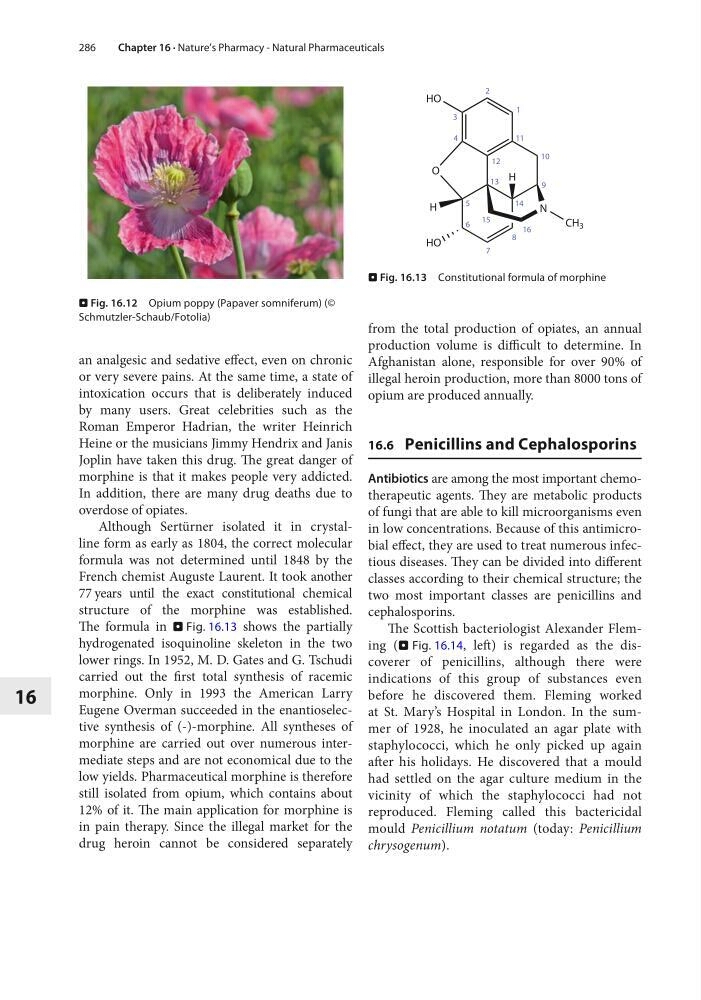
The formula in . Fig. 16.13 shows the partially
hydrogenated isoquinoline skeleton in the two
lower rings. In 1952, M. D. Gates and G. Tschudi
carried out the first total synthesis of racemic
morphine. Only in 1993 the American Larry
Eugene Overman succeeded in the enantioselective synthesis of (-)-morphine. All syntheses of
morphine are carried out over numerous intermediate steps and are not economical due to the
low yields. Pharmaceutical morphine is therefore
still isolated from opium, which contains about
12% of it. The main application for morphine is
in pain therapy. Since the illegal market for the
drug heroin cannot be considered separately
O
HO
N
CH 3
H
HO
H
1
2
3
4
5
6
7
8
9
10
11
12
13
14
15
16
. Fig. 16.13 Constitutional formula of morphine
. Fig. 16.12 Opium poppy (Papaver somniferum) (©
Schmutzler-Schaub/Fotolia)
Chapter 16 · Nature’s Pharmacy - Natural Pharmaceuticals
16
from the total production of opiates, an annual
production volume is difficult to determine. In
Afghanistan alone, responsible for over 90% of
illegal heroin production, more than 8000 tons of
opium are produced annually.
16.6 Penicillins and Cephalosporins
Antibiotics are among the most important chemotherapeutic agents. They are metabolic products
of fungi that are able to kill microorganisms even
in low concentrations. Because of this antimicrobial effect, they are used to treat numerous infectious diseases. They can be divided into different
classes according to their chemical structure; the
two most important classes are penicillins and
cephalosporins.
The Scottish bacteriologist Alexander Fleming (. Fig. 16.14, left) is regarded as the discoverer of penicillins, although there were
indications of this group of substances even
before he discovered them. Fleming worked
at St. Mary’s Hospital in London. In the summer of 1928, he inoculated an agar plate with
staphylococci, which he only picked up again
after his holidays. He discovered that a mould
had settled on the agar culture medium in the
vicinity of which the staphylococci had not
reproduced. Fleming called this bactericidal
mould Penicillium notatum (today: Penicillium
chrysogenum).
an analgesic and sedative effect, even on chronic
or very severe pains. At the same time, a state of
intoxication occurs that is deliberately induced
by many users. Great celebrities such as the
Roman Emperor Hadrian, the writer Heinrich
Heine or the musicians Jimmy Hendrix and Janis
Joplin have taken this drug. The great danger of
morphine is that it makes people very addicted.
In addition, there are many drug deaths due to
overdose of opiates.
Although Sertürner isolated it in crystalline form as early as 1804, the correct molecular
formula was not determined until 1848 by the
French chemist Auguste Laurent. It took another
77 years until the exact constitutional chemical
structure of the morphine was established.
The formula in . Fig. 16.13 shows the partially
hydrogenated isoquinoline skeleton in the two
lower rings. In 1952, M. D. Gates and G. Tschudi
carried out the first total synthesis of racemic
morphine. Only in 1993 the American Larry
Eugene Overman succeeded in the enantioselective synthesis of (-)-morphine. All syntheses of
morphine are carried out over numerous intermediate steps and are not economical due to the
low yields. Pharmaceutical morphine is therefore
still isolated from opium, which contains about
12% of it. The main application for morphine is
in pain therapy. Since the illegal market for the
drug heroin cannot be considered separately
O
HO
N
CH 3
H
HO
H
1
2
3
4
5
6
7
8
9
10
11
12
13
14
15
16
. Fig. 16.13 Constitutional formula of morphine
. Fig. 16.12 Opium poppy (Papaver somniferum) (©
Schmutzler-Schaub/Fotolia)